16 Cozy Shelf Decor Ideas for Stylish Homes
Cozy shelf decor is the art of composing open shelving as a designed environment — using books, ceramics, botanicals, textiles, lighting, and personal objects to create a shelf surface that simultaneously reads as warm, considered, and genuinely inhabited rather than either sterile and underpopulated or cluttered and accumulated. This article gives you 16 genuinely creative, achievable shelf decor ideas that work across every interior aesthetic and every shelf type — from a single floating shelf in a rental apartment to a full wall of built-in bookshelves in a family home — making the most versatile and most frequently observed display surfaces in any home work at their full design potential.
Most shelf decor defaults to the arbitrary — whatever objects happen to be placed on the shelf at the time it was last cleared, whatever books were most recently read, whatever ceramic arrived as a gift and found no other home. The shelves in this list make a more considered choice: they treat the shelf as a compositional canvas whose arrangement communicates warmth, personality, and aesthetic intention with the same design intelligence that a confident interior stylist brings to any display surface. Here are 16 ideas worth saving — and styling.
Why Cozy Shelf Decor Works So Well
The shelf as a domestic display surface has a design history as rich as any other interior element — from the Renaissance studiolo, where scholars displayed their most prized objects (manuscripts, instruments, natural curiosities, small bronzes) in purpose-built wall niches as expressions of humanist learning and aesthetic refinement, to the 18th-century cabinet of curiosities that organized the natural world’s remarkable objects into a coherent display system, to the contemporary open bookshelf that serves simultaneously as a library, a personal archive, and the room’s most revealing design feature. What connects all of these traditions is the same insight: the shelf is the domestic surface that most directly communicates the identity, the interests, and the aesthetic sensibility of the person who arranged it — more so than any piece of furniture, any wall color, or any architectural feature.
The materials that most reliably create a cozy shelf display are those that engage multiple senses at close range — the visual variety of books in varied colors and heights, the tactile warmth of ceramics with their specific glaze depth and hand-made quality, the olfactory richness of botanical elements (fresh herbs, dried lavender, woody stems), and the ambient warmth of a small flame or a warm LED strip that illuminates the shelf’s contents from within. These multisensory qualities are what distinguish a genuinely cozy shelf from a merely organized one: coziness in a shelf display is not a visual quality alone but a sensory one, activated by the combination of warm materials, warm light, organic elements, and the specific quality of personal meaning that the objects on the shelf carry for the person who arranged them.
The principle that most consistently determines whether a shelf reads as cozy or cold is the relationship between books and objects — between the functional storage purpose of the shelf and its decorative display purpose. Shelves that contain only books read as organized but not personalized; shelves that contain only decorative objects read as displayed but not inhabited; shelves that contain books, objects, plants, and personal items in a proportionally balanced arrangement read as the living archive of a specific, curious, aesthetically engaged person — which is the specific quality that makes a shelf genuinely cozy rather than merely well-arranged.
Small apartments and compact living spaces benefit specifically from well-designed shelf decor because the shelf is the domestic display format that creates the most visual richness per square centimeter of floor plan — a wall of shelves occupies only the wall plane, leaving the floor plan available for circulation while providing more visual content, more personal revelation, and more ambient warmth than any alternative use of the same vertical surface.
Style at a Glance
| Element | Detail |
|---|---|
| Philosophy | The shelf is the home’s most revealing surface — its arrangement communicates identity, warmth, and aesthetic intelligence more directly than any other design decision |
| Key Materials | Books, handmade ceramics, dried and fresh botanicals, warm LED or candle light, natural timber, rattan, personal objects, linen and natural fiber textiles |
| Three Principles | Books-to-objects balance, warmth source integration, personal meaning |
16 Cozy Shelf Decor Ideas
1. The Classic Book and Ceramic Balance
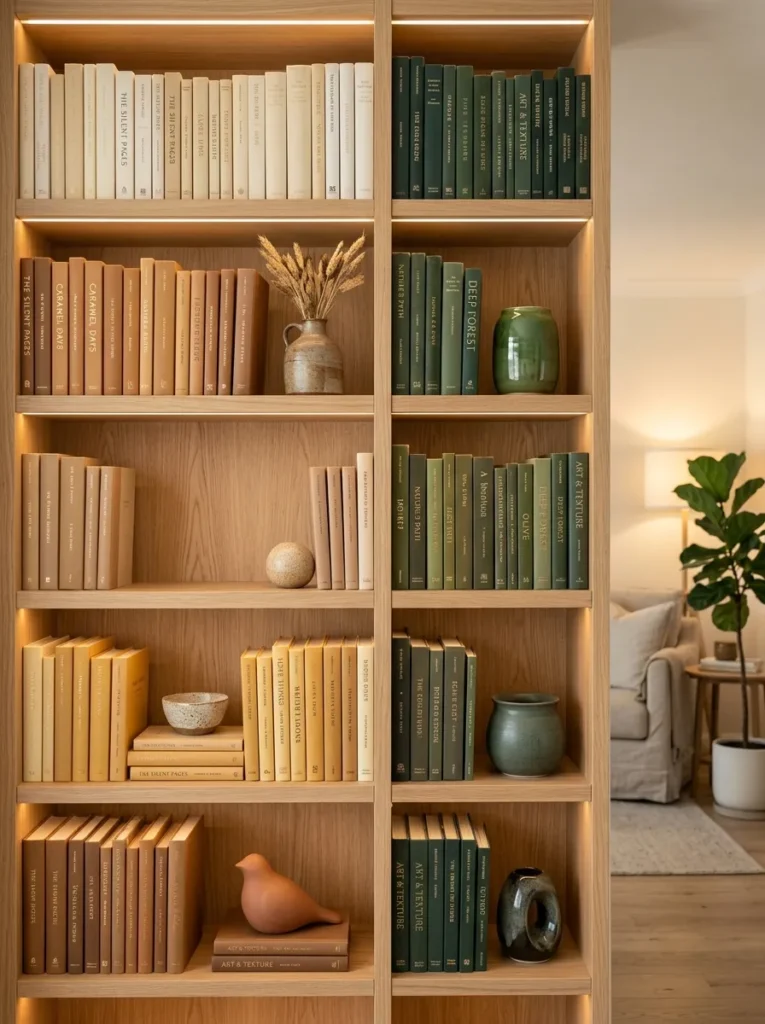
Vibe: Warm and composed — the bookshelf that makes the room look like someone genuinely lives here and has genuinely good taste.
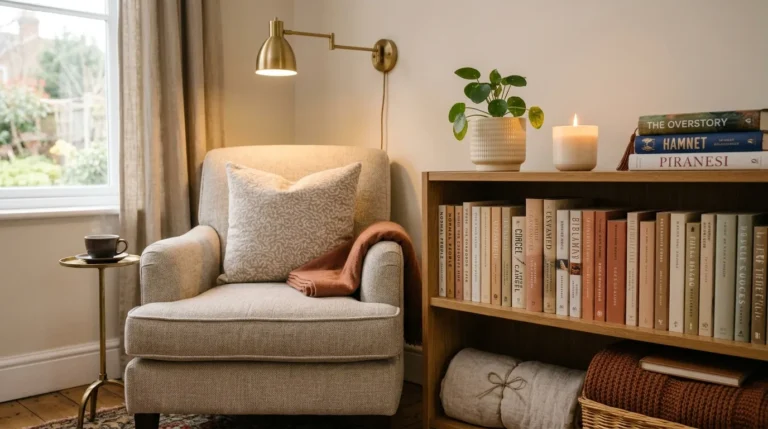
Why it works: The book-and-ceramic balance is the fundamental shelf composition principle that most reliably produces a cozy, personalized, and visually resolved display — books provide the color, the height variation, and the personal content of the shelf, while ceramics provide the three-dimensional depth, the tactile material warmth, and the compositional punctuation that prevents a shelf of books alone from reading as merely organized storage. The color-gradient book organization (grouping books by spine color rather than subject or alphabet) is the single practical styling decision that most immediately transforms a random book collection into a visual composition — the warm ivory-to-caramel gradient creates the specific tonal movement across the shelf surface that reads as designed rather than accumulated. Leaving one shelf section 50% empty is the breathing room discipline that prevents the shelf from reading as cramped and that allows each ceramic object in the populated sections to receive adequate visual attention.
How to get it: Remove all books from the shelf and organize them by spine color on the floor before returning them — the floor organization allows the color gradient to be planned and adjusted before commitment. The correct ratio of books to ceramic objects for a cozy reading is approximately 8:1 — eight books for every one ceramic object, with the ceramics positioned at the end of each color group rather than between individual books. Three ceramics per shelf section (one tall, one medium, one small) creates the graduated height rhythm that makes the ceramic punctuation read as designed rather than random.
Quick Win: Organizing the books already on your existing shelves by spine color — removing them, sorting by color on the floor, and returning in color gradient groups — immediately transforms the visual quality of any bookshelf from accumulated to composed, at zero material cost and approximately 45 minutes of reorganization effort.
Shop the Look
| Product |
|---|
| Handmade stoneware vase small |
| Ceramic bowl earthy glaze |
| Warm LED strip under-shelf |
| Hardcover book collection |
| Natural timber shelf |
Also View: 17 Chic IKEA KALLAX Bedroom Ideas for Storage
2. Warm Amber Lamp on Every Shelf Level
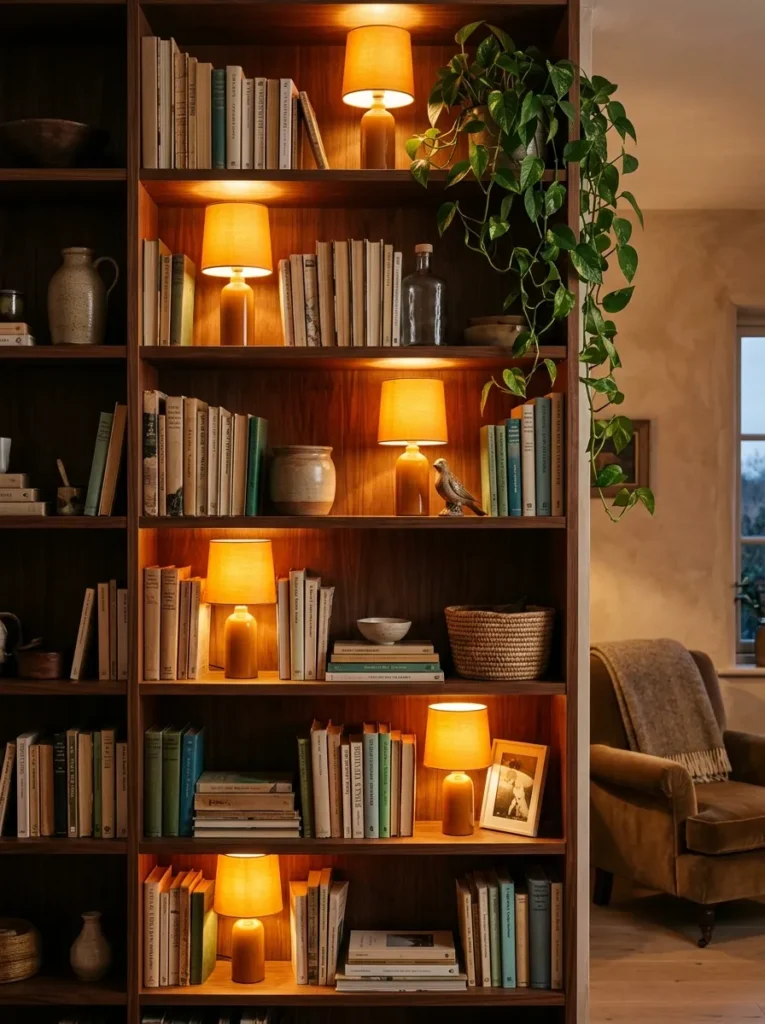
Vibe: Deeply warm and cozy — the shelf that makes the room feel like the most comfortable evening destination in the house from the moment the lamps are switched on.
Why it works: Placing small warm amber lamps at multiple levels within a shelving unit is the shelf lighting idea that most powerfully creates the sense of warm, intimate domestic lighting from a display surface — the lamp light at shelf level illuminates the surrounding books and objects from within the shelf space, creating warm pools of amber light that read as hearth-like in their warmth and intimacy rather than as task lighting directed from above or across the room. Multiple small lamps distributed vertically through the shelf height create the sense of a living, inhabited shelf — light emerging from within the shelf structure rather than falling on it from outside communicates the warmth and presence of a space that is actively occupied rather than passively displayed. The amber shade specifically — filtering the lamp’s light through a warm amber or ivory translucent material — produces the 2200K light quality that is the warm end of the residential LED spectrum, closest to the quality of candlelight.
How to get it: Source slim ceramic table lamp bases at approximately 200mm height (to fit within a standard 300mm shelf clearance) with small drum or empire shades in warm amber or ivory linen — the shade size should be approximately 150mm diameter to maintain proportion with the small base and the shelf’s depth. Connect multiple shelf lamps to a single smart plug or power strip controlled by one switch, allowing all shelf lamps to be turned on and off as a unified warm lighting source. Use 2W LED bulbs rather than higher wattages in shelf lamps — the confined shelf space amplifies the warmth of a low-wattage lamp.
Shop the Look
| Product |
|---|
| Small ceramic table lamp 200mm |
| Amber linen lamp shade small |
| 2W LED warm bulb |
| Smart plug multiple socket |
| Slim power strip shelf |
3. Dried Botanical Arrangements That Change with the Seasons
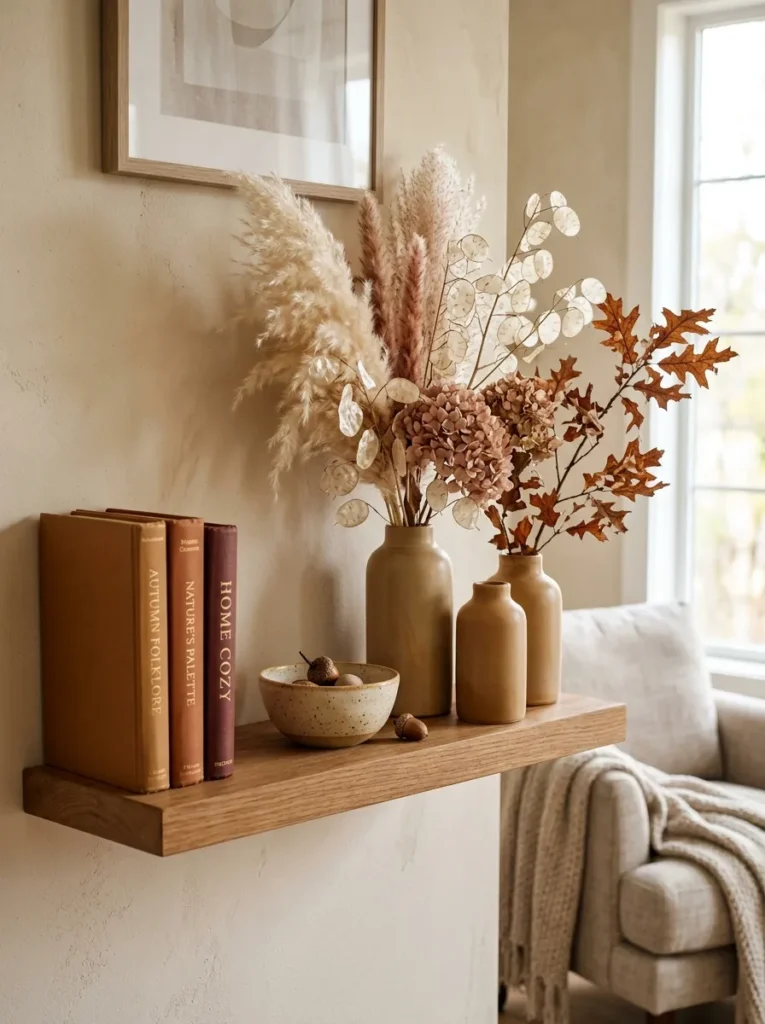
Vibe: Warm and seasonal — the shelf that requires no replacement, only a change of botanicals, to feel entirely fresh and entirely of the moment.
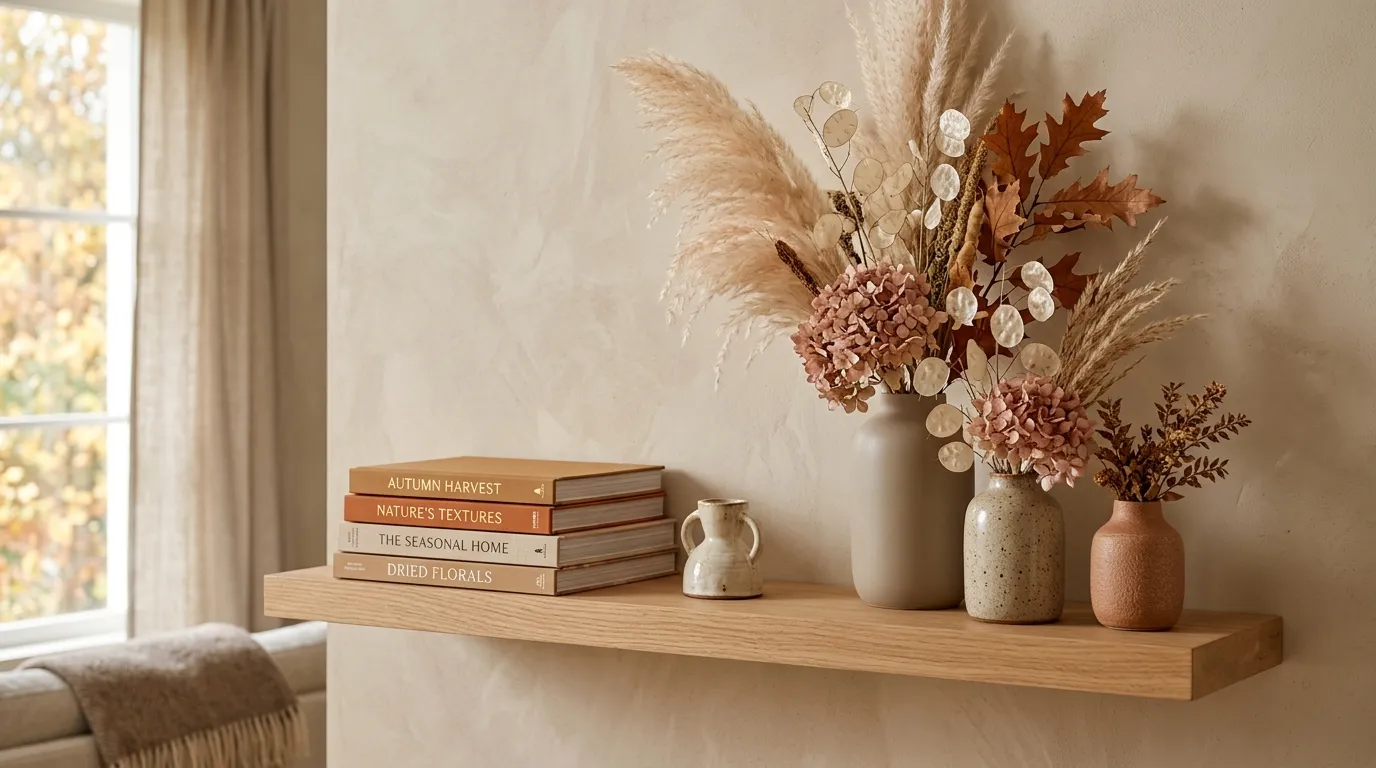
Why it works: Dried botanical arrangements that change with the seasons are the shelf decor element that most naturally and most cost-effectively maintains the shelf’s visual freshness over time without requiring the replacement of any permanent shelf objects. The seasonal botanical is the shelf’s living (or once-living) temporal marker — spring’s soft pampas and dried ranunculus giving way to summer’s wheat stalks and dried lavender, to autumn’s lunaria and hydrangea, to winter’s pine cones and cedar — creating a shelf display whose character evolves with the natural year rather than remaining static from the day it was arranged. The three-vase graduated height grouping is the vessel format that most effectively presents dried botanicals as a composed arrangement rather than a single vase of stems: three vessels at tall, medium, and short heights create the visual depth and dimensional complexity that a single arrangement cannot achieve.
How to get it: Establish a set of three permanent ceramic or glass vases in graduated heights (350mm, 250mm, and 150mm) that serve as the seasonal botanical’s permanent structural home on the shelf — the vases remain on the shelf year-round, with the botanical content changing seasonally. Source dried botanicals from specialist dried flower suppliers, farmers markets, and natural foraging (seasonal seed heads, pine cones, preserved leaves) rather than exclusively from florists — the combination of purchased and foraged botanicals creates the most natural and most personally meaningful seasonal display.
Shop the Look
| Product |
|---|
| Dried pampas grass stems |
| Dried hydrangea bunch |
| Three ceramic vases graduated |
| Dried lunaria silver pods |
| Dried botanical seasonal set |
4. A Single Statement Trailing Plant at Shelf Height
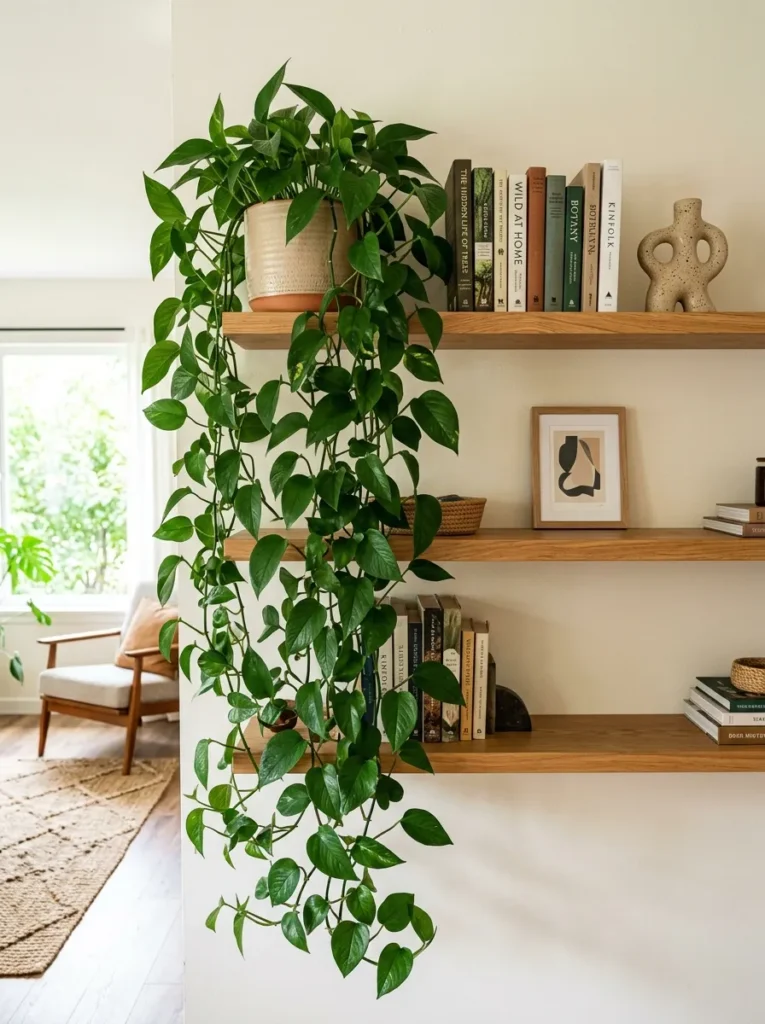
Vibe: Lush and organic — the shelf that makes the distinction between inside and outside feel like a matter of perspective rather than architecture.
Why it works: A single substantial trailing plant at the end of a shelf is the shelf decor idea that most powerfully introduces the vertical organic element — the plant’s trailing growth extending downward below the shelf creates a natural cascade that occupies the vertical space beside the shelf and connects the shelf’s horizontal plane to the room’s floor level. This vertical connection is the quality that makes a trailing shelf plant read as more architecturally integrated than a potted plant placed on the floor beside the shelf: the cascade from shelf height creates a continuous green element that relates to both the shelf and the room simultaneously. The specific beauty of the trailing philodendron or pothos cascade is the naturalness of its growing direction — the plant grows toward light, which in a room with natural window light means the trail develops a specific directional lean that reads as genuinely organic rather than arranged.
How to get it: Choose a trailing variety with vigorous growth and tolerance for the lighting conditions of the shelf position — heartleaf philodendron (Philodendron hederaceum) is the most tolerant of low-light shelf positions and produces the most abundant, fastest-growing trail; pothos (Epipremnum aureum) is nearly as vigorous and slightly more drought-tolerant for shelves that receive inconsistent watering. Position the ceramic pot at the shelf’s end position (rather than centered) to create the asymmetric composition that most naturally reads as a growing plant positioned for light access rather than for display symmetry.
Shop the Look
| Product |
|---|
| Heartleaf philodendron established |
| Quality ceramic pot warm putty |
| Pothos trailing plant |
| Plant care watering can slim |
| Shelf plant saucer |
5. Books Turned Spine-In for Textural Uniformity
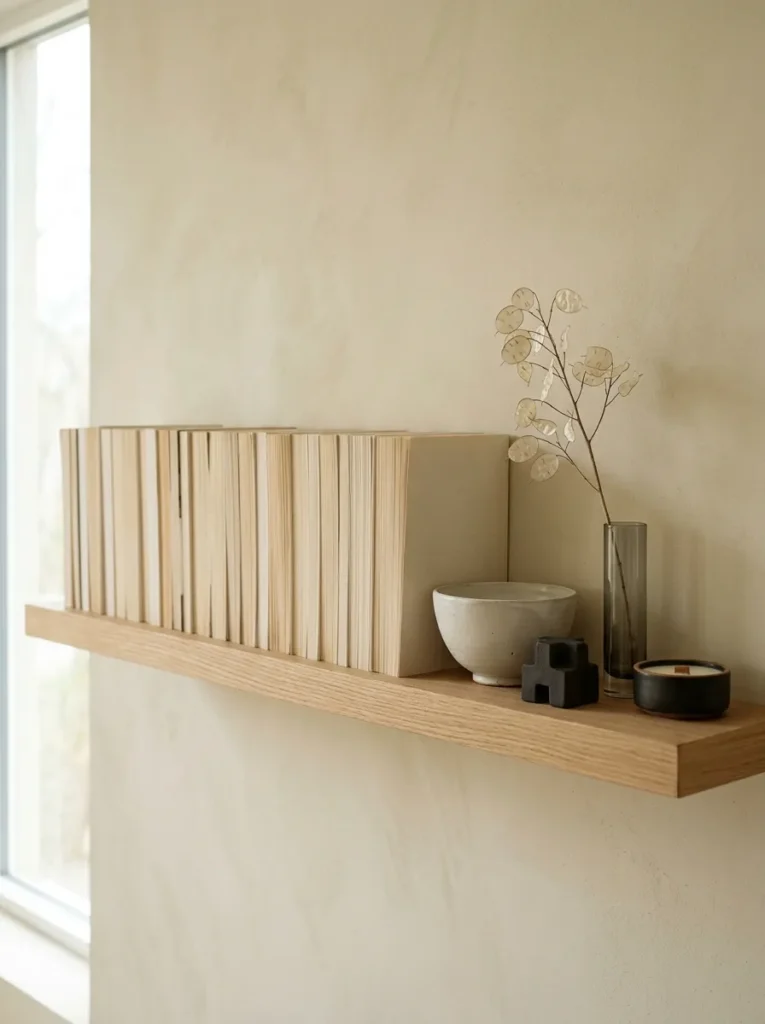
Vibe: Calm and minimal — the shelf styling that makes every object placed in front of the books appear as though it was specifically chosen for that position.
Why it works: Turning books spine-inward creates the shelf’s most visually calm and most materially textural arrangement — the pages-out orientation replaces the visual noise of varied book spine colors, font styles, and publisher graphics with a continuous field of cream-white page edge texture that reads as a neutral, warm-toned surface rather than a collection of competing visual elements. This unified backdrop is the specific quality that makes the spine-in arrangement ideal for a Japandi or minimal aesthetic shelf: it concentrates the visual content of the shelf into the deliberately chosen objects placed in front of the books rather than distributing visual attention across the book spines themselves. The cream-white of the pages also creates a warm, slightly organic field — the natural paper tone reads as warm and material rather than clinical and white, providing the neutral backdrop that allows even modest ceramic objects to read as deliberately chosen.
How to get it: The spine-in arrangement works most effectively with hardcover books whose page block depth is approximately equal across all volumes — significant variation in book depth creates a raggedly irregular front surface that undermines the uniform texture quality. Organize the spine-in books by height within each shelf section — descending from tall to short left to right — to create the stepped visual rhythm that reads as composed within the otherwise uniform field. Limit the front-of-shelf objects to a maximum of three per shelf section to maintain the minimal, calm aesthetic that the spine-in backdrop is designed to support.
Shop the Look
| Product |
|---|
| Hardcover book collection uniform |
| Ceramic bowl minimal |
| Small sculptural object |
| Slim bud vase dried stem |
| Natural timber floating shelf |
6. Woven Baskets for Hidden Storage Within the Shelf
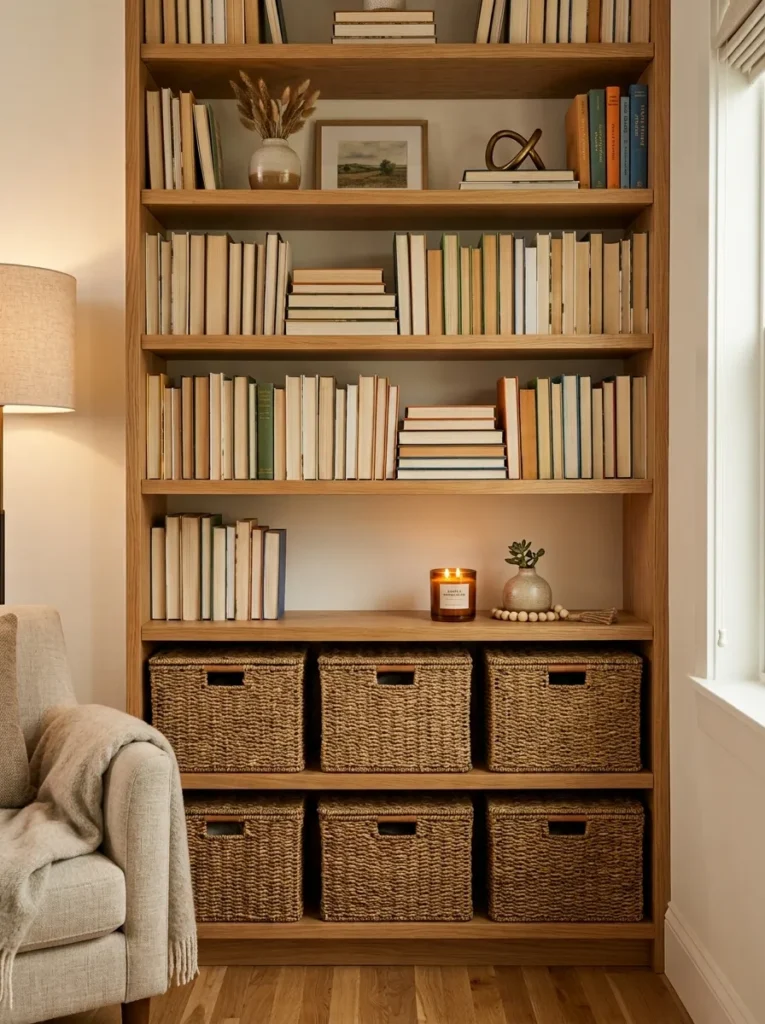
Vibe: Organized and warm — the shelf that hides everything it needs to hide and displays everything it is worth displaying, without any visible evidence of the organizational effort required.
Why it works: Woven baskets with lids in the lower shelf sections of a shelving unit are the shelf decor idea that most practically resolves the small home’s most persistent shelf challenge — the presence of functional but visually disruptive objects (remotes, cables, small toys, paperwork, spare batteries) that need accessible storage but that undermine the shelf’s visual quality when displayed openly. The woven basket is the specific storage vessel that resolves this challenge most naturally and most visually elegantly because its natural fiber texture reads as a designed shelf object in its own right rather than as a storage container — a woven seagrass basket in a shelf is a warm, organic, compositionally positive element that enhances the shelf’s cozy quality rather than simply concealing clutter beneath it. The basket lid’s flat top surface creates an additional display area — a candle, a small ceramic, or a seasonal botanical placed on the basket lid converts functional storage into a display composition.
How to get it: Source woven baskets in a size that fills the shelf opening with a 20–30mm clearance on each side — a too-small basket reads as placed in the shelf rather than fitted to it, while a precisely fitted basket reads as chosen for the specific shelf position. Seagrass, water hyacinth, and rattan are the three natural fiber basket materials that most naturally and most warmly complement a timber or painted shelf — all three have the warm, organic quality that reads as cozy rather than utilitarian.
Shop the Look
| Product |
|---|
| Lidded seagrass basket shelf size |
| Woven rattan basket with lid |
| Candle small for basket lid |
| Water hyacinth basket |
| Basket sizing measure tape |
7. A Small Framed Mirror Within the Shelf Display
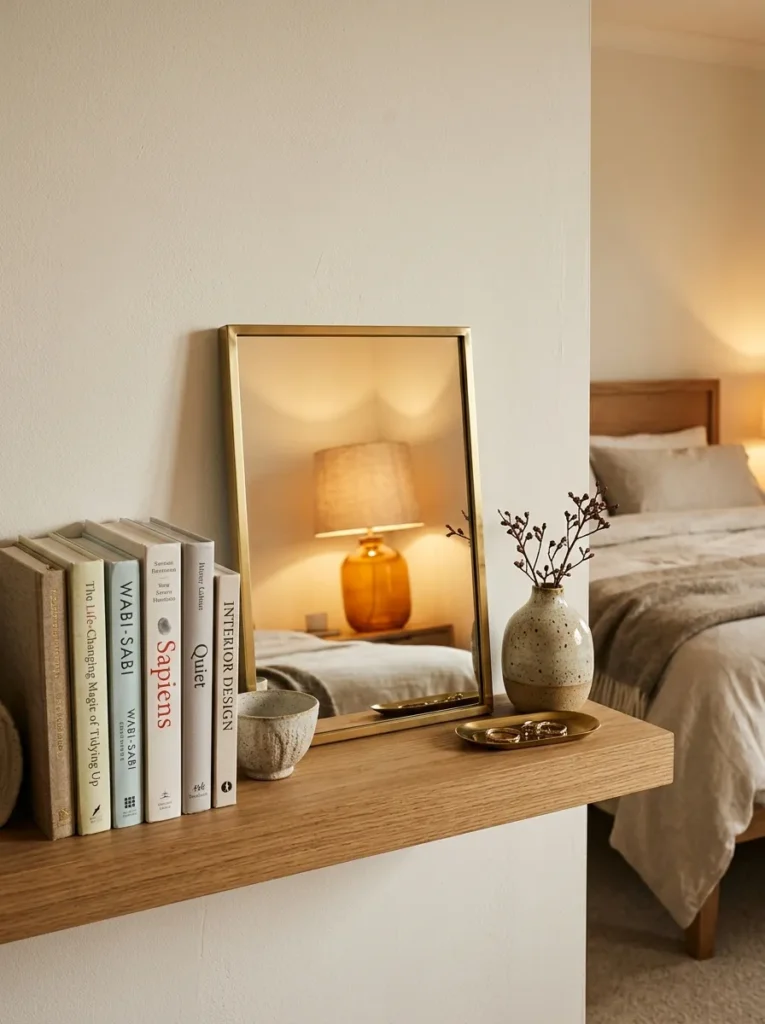
Vibe: Warm and reflective — the shelf detail that most rewards a second look with the discovery that the mirror is reflecting the room rather than merely completing a composition.
Why it works: A small framed mirror leaning within a shelf display — rather than hung on the wall — is the shelf decor idea that most uniquely performs two simultaneous design functions: it serves as a compositional object within the shelf arrangement (providing the reflective surface’s specific visual quality and the frame’s material warmth) and it performs the light-amplification function of a mirror (reflecting whatever warm light source is in the room back into the shelf display, brightening the shelf from within). The leaning position rather than hung position is the specific installation choice that gives the shelf mirror its casual, collected quality — a mirror that is leaning is perceived as having been placed rather than installed, which communicates the personal, accumulated character of a genuinely inhabited shelf display rather than a professionally styled one.
How to get it: The mirror scale is the most important specification for a shelf mirror — at 250mm × 350mm, the mirror is large enough to reflect a meaningful portion of the room’s ambient light but small enough to read as a shelf object rather than a wall mirror temporarily placed on a shelf. A slim brass or thin natural timber frame provides the warmth and material quality that makes the shelf mirror read as a chosen decorative object rather than a utility mirror. Position the mirror with its lower edge resting on the shelf surface and its upper edge leaning at approximately 10 degrees from the wall — this slight lean prevents the mirror from reading as a hung object.
Shop the Look
| Product |
|---|
| Small mirror slim brass frame |
| Small mirror natural timber frame |
| Mirror shelf leaning |
| Book stack beside mirror |
| Ceramic object shelf |
8. A Curated Travel Memory Shelf
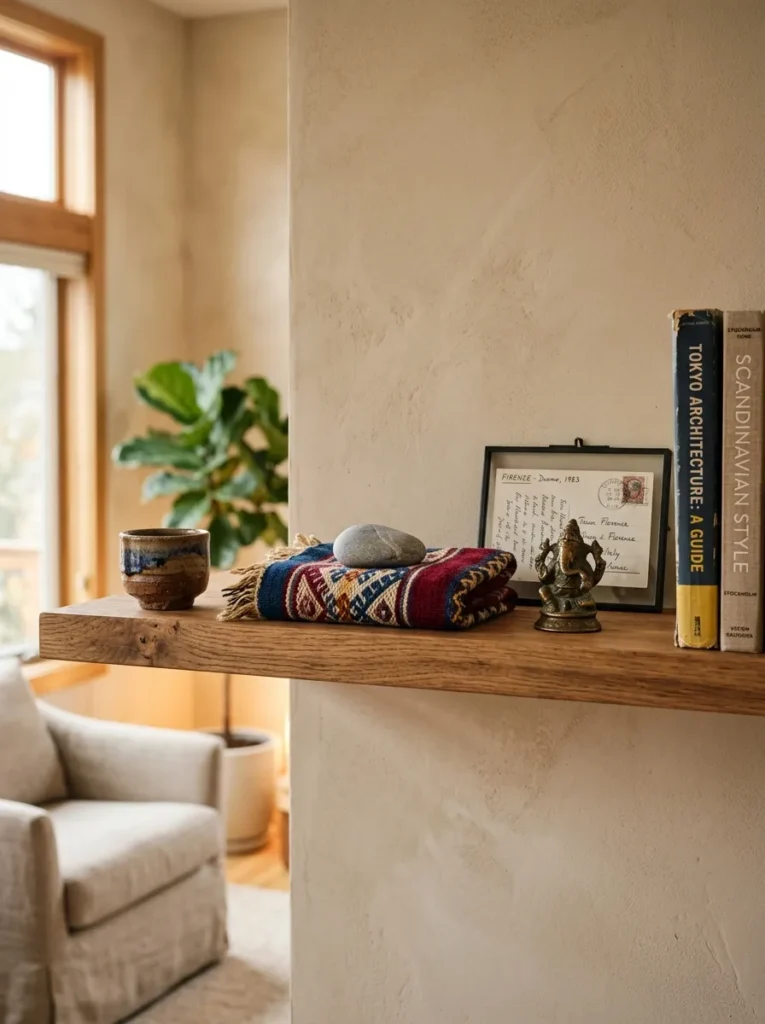
Vibe: Warm and personally revealing — the shelf that tells the story of a specific person who has been somewhere interesting and brought something home.
Why it works: A curated travel memory shelf is the shelf decor idea that most powerfully communicates the irreplaceable personal quality that separates a genuinely cozy shelf from a designed display — the objects on a travel memory shelf cannot be purchased in a home goods store, cannot be replicated in another home, and communicate something specific and genuine about the person who collected them. This irreproducibility is the design quality that makes a travel memory shelf more engaging and more revealing than any professionally styled shelf: every object has a story that the object itself partially tells through its specific material character, its geographic origin, and its evident hand-making. The smooth beach pebble communicates its specific beach without identification; the handwoven textile communicates its specific market and its specific maker without a label.
How to get it: Source travel objects with the intentionality of the shelf display in mind — choosing one specific, genuinely beautiful object per destination rather than accumulating a large collection of souvenir-grade items. The travel shelf’s curatorial principle: only objects that are genuinely beautiful by themselves (not merely as souvenirs), that are genuinely hand-made or hand-selected, and that genuinely remind you of a specific meaningful experience rather than merely representing a geographic location. Position with generous spacing between objects — a travel memory shelf with seven objects at crowded spacing reads as a collection of souvenirs; the same seven objects at generous spacing with each receiving individual visual attention reads as a curated personal archive.
Shop the Look
| Product |
|---|
| Place-specific design book |
| Slim postcard frame |
| Travel textile folded display |
| Natural pebble display |
| Travel ceramic small vessel |
9. Layered Shelf Vignette with Three Heights
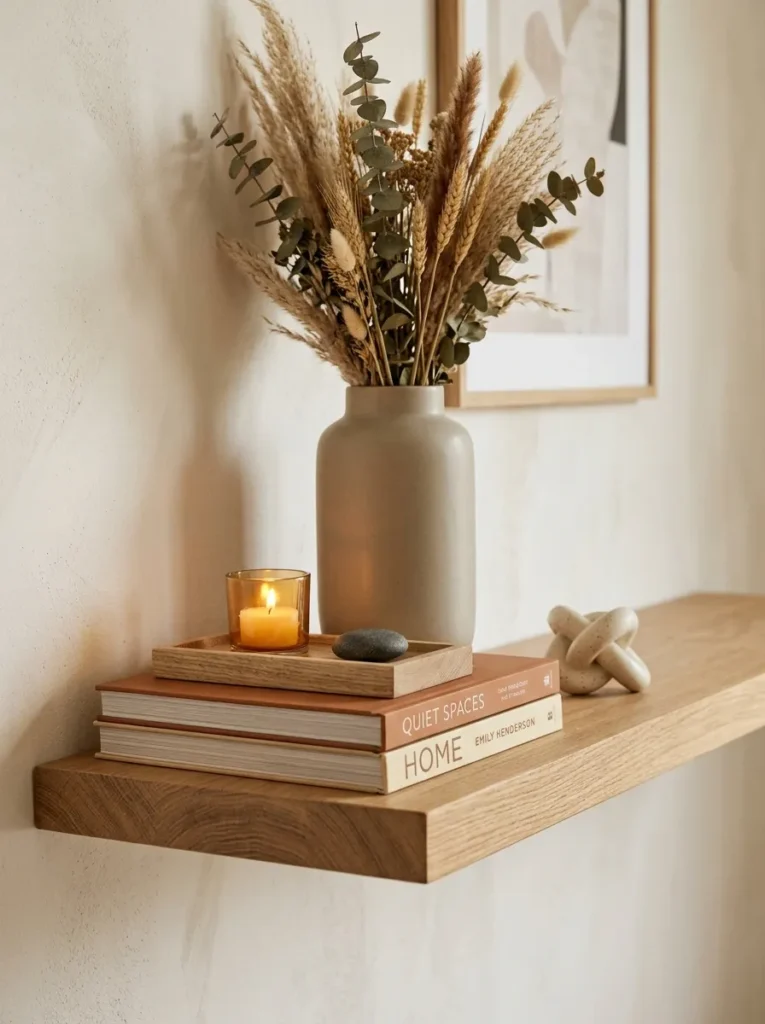
Vibe: Warm and composed — the shelf vignette that rewards a second look with the discovery of each height level’s specific detail.
Why it works: The three-height vignette is the single shelf composition principle that most reliably creates visual depth on a flat shelf surface — by positioning a tall element at the back, a medium element in the middle ground, and a low element at the front of the shelf’s depth, the composition creates the visual illusion of spatial recession that is the specific quality of a three-dimensional arrangement perceived from a single viewpoint. This depth illusion is what separates a vignette (a composed arrangement with dimensional quality) from a surface display (objects placed on a flat surface without reference to their three-dimensional relationship). The tray as the front-level element is the compositional device that consolidates two or three smaller objects into a single visual unit at the composition’s foreground — a tea light candle and a smooth pebble in a tray read as a composed foreground element; the same objects without a tray read as two objects placed at the front of the shelf without compositional logic.
How to get it: The three-height principle works most effectively when the height ratio between levels is significant — the tall element should be approximately twice the height of the medium element, and the medium element should be approximately twice the height of the low element. In practice: tall at 350–400mm, medium at 150–200mm, and low at 50–80mm produces the clearest depth illusion. Position the arrangement at one end of the shelf rather than centered — an asymmetrically positioned vignette creates more visual interest and reads as more personally arranged than a centered composition.
Shop the Look
| Product |
|---|
| Tall ceramic vase 400mm |
| Hardcover book stack three |
| Small tray natural timber |
| Tea light ceramic holder |
| Smooth pebble decorative |
10. Fairy Lights Woven Through the Shelf Display
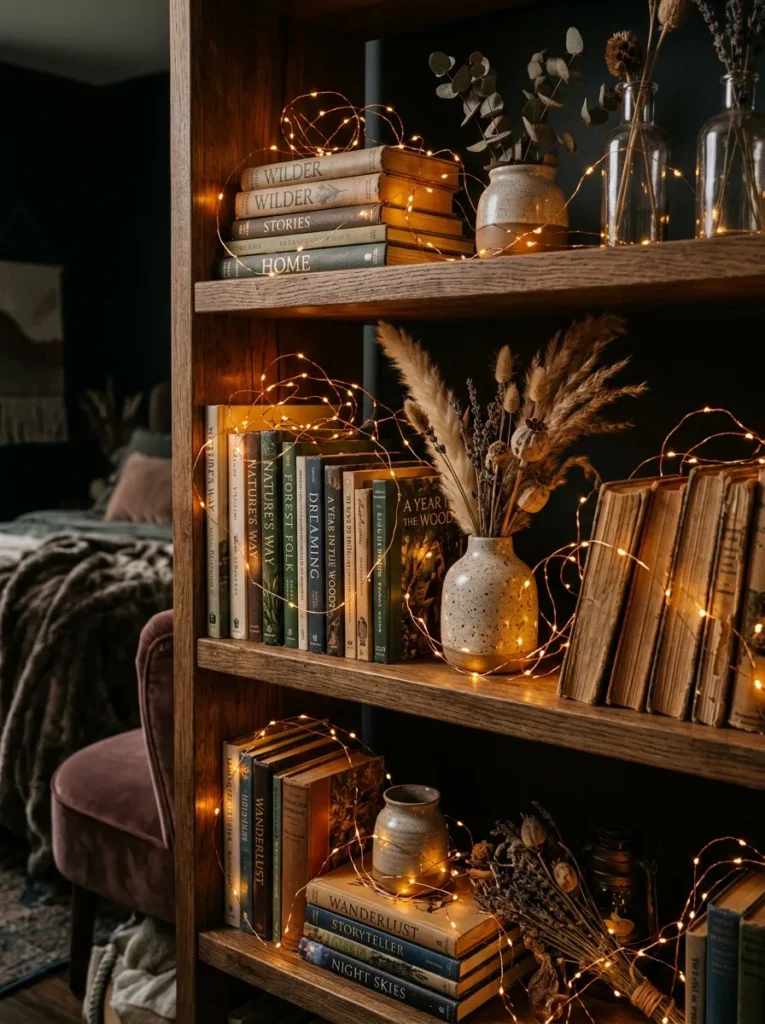
Vibe: Magical and warm — the shelf that becomes the room’s most beautiful object the moment the overhead light is turned off.
Why it works: Copper wire fairy lights woven through a shelf display are the shelf lighting idea that most completely transforms the shelf’s character between daytime and evening — during the day, the shelf reads as a warm, organized book-and-object display; in the evening with the room’s ambient light dimmed and the fairy lights illuminating the shelf from within its own display, the same shelf reads as a magical, warmly glowing installation whose warmth and intimacy exceed anything achievable with conventional shelf lighting. The copper wire fairy light’s specific quality — the warm amber of the LED points at 2200K, the visible copper metallic wire, the informal, organic quality of the wire’s routing through the display — creates the shelf’s most atmospheric evening light quality because it distributes the light within the display at the objects’ own scale rather than illuminating them from a single external source.
How to get it: Use a 10-meter copper wire fairy light string (battery operated for routing flexibility, or USB powered for convenience) and route it deliberately through the shelf display from the top shelf to the bottom — wound twice around the tallest book stack, draped between the two largest ceramic objects, looped through the dried botanical arrangement, and pooled slightly in the bottom shelf section. The routing should be intentional and visible — the copper wire’s path through the display is as much of the composition as the light points, and a carelessly routed wire undermines the warmth of the effect.
Shop the Look
| Product |
|---|
| Copper wire fairy lights 10m battery |
| Warm LED point 2200K |
| Fairy light timer plug |
| Wire routing clip small |
| Copper wire fairy light USB |
11. A Dedicated Candle Shelf with Varied Heights and Types
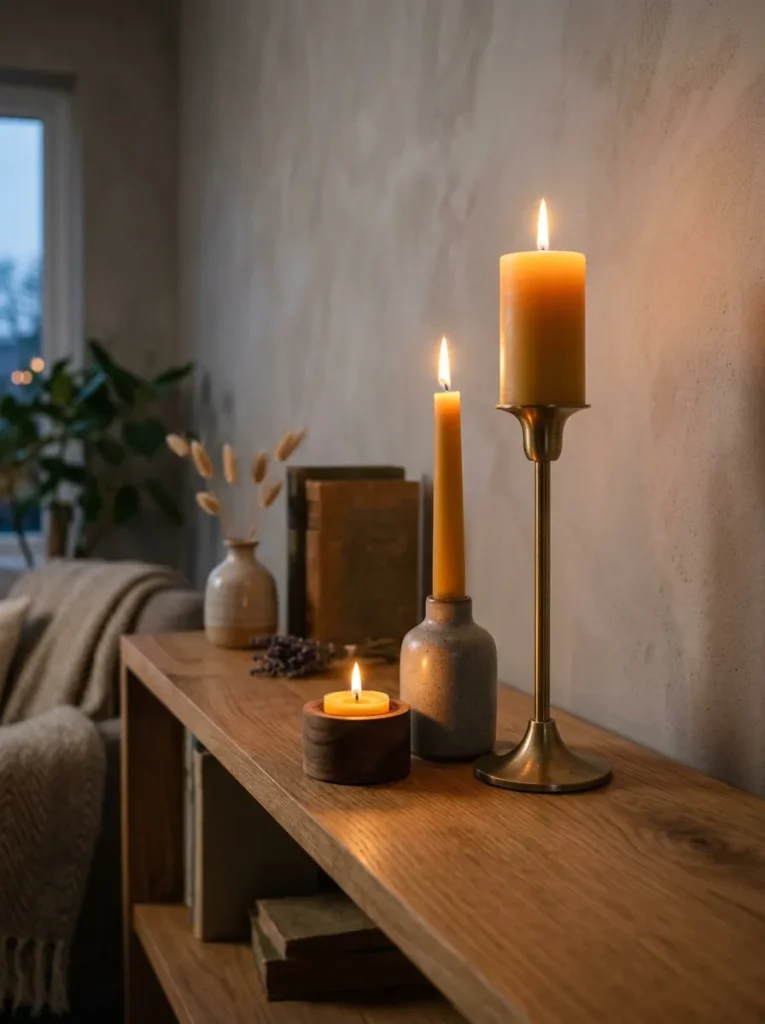
Vibe: Warm and ceremonial — the shelf level that makes the act of lighting the candles at the beginning of every evening feel like the most considered ritual in the home.
Why it works: A shelf level dedicated entirely to candles and candleholders in varied heights and materials is the shelf decor idea that most directly creates the fireside warmth quality that the cozy shelf aspires to — the multiple small flames at shelf height create a warm, intimate light quality that reads as hearth-like in its warmth and as ritual-like in its composed arrangement. The combination of three candleholder materials (brass for formality and warmth, ceramic for handmade organic quality, and natural timber for rustic warmth) within the same height-varied composition creates the material variety within a unified aesthetic that most effectively reads as curated rather than matched. Beeswax candles specifically — with their warm honey color and their naturally mild honey fragrance — are the candle material choice that most powerfully combines visual beauty with sensory richness.
How to get it: Safety is the primary specification for a shelf candle arrangement — ensure that no candle flame is within 150mm of any shelf above it, and that all candles are in holders with adequate wax-catching bases. Never leave a shelf candle arrangement unattended. Extinguish with a candle snuffer rather than by blowing — blown candles produce smoke that stains the shelf and adjacent books and objects over time. Source beeswax candles from a specialist beeswax chandler for the highest quality — commercial paraffin candles produce significantly more soot and smoke than genuine beeswax, which affects both the aesthetic quality of the candlelight and the health quality of the indoor air.
Shop the Look
| Product |
|---|
| Beeswax taper candle set |
| Slim brass candlestick 300mm |
| Ceramic candle holder warm |
| Timber tealight holder natural |
| Beeswax tealight candle set |
12. Stacked Books with a Ceramic on Top
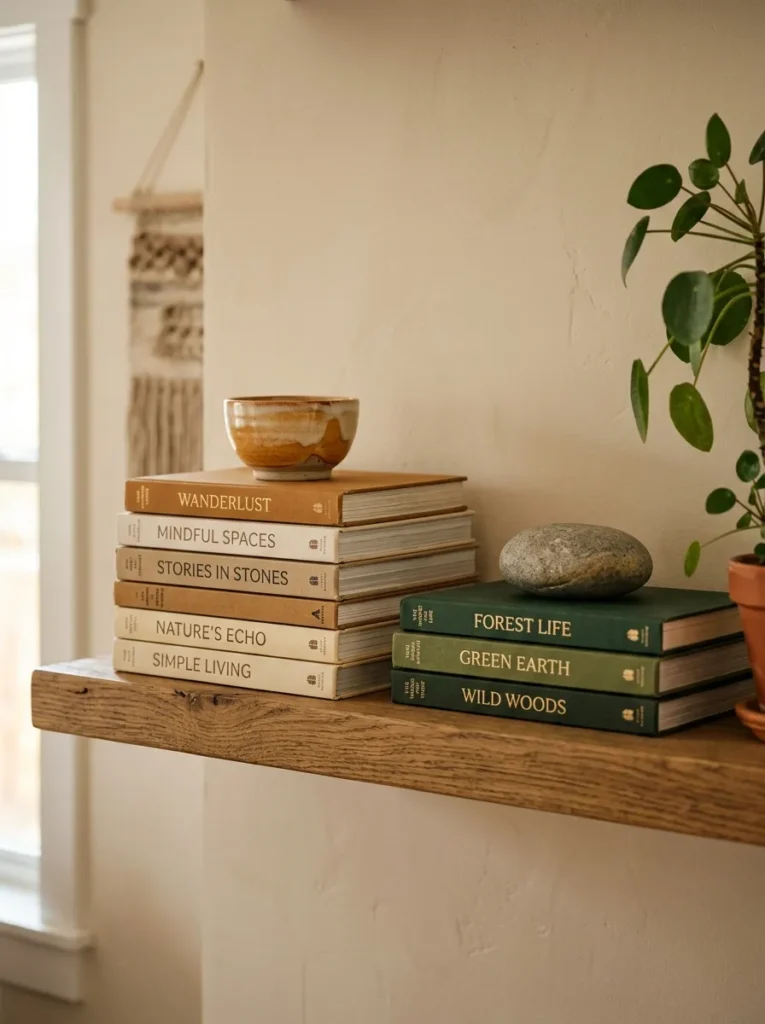
Vibe: Warm and simply composed — the shelf arrangement that requires only books and one small object to read as completely styled.
Why it works: The horizontal book stack with a ceramic or natural object on top is the shelf composition idea that most elegantly resolves the practical challenge of mixed-height book collections — it converts a variable-height group of books into a controlled-height pedestal that elevates its small object above the shelf plane, creating the height variation that makes a single-level shelf display dimensionally interesting. The stack of horizontally arranged books is also the book display format that most clearly shows the book as an object — the spine-up orientation revealing the specific texture of the book cover’s material, the depth of the pages’ cream-white edge, and the book’s physical mass — rather than merely a storage orientation. Two stacks of different heights at different positions on a single shelf creates the asymmetric composition that reads as most naturally styled.
How to get it: Build the book stacks with the largest, heaviest book at the base and progressively lighter books above — this proportional relationship maintains the stack’s stability and creates the natural taper that reads as aesthetically correct. The object placed on top of the stack should weigh less than the top book and have a footprint smaller than the book’s surface — a large or heavy object on a small book stack looks precarious and reads as poorly considered. The most effective top objects for a book stack are small handmade ceramics, smooth river stones, and small sculptural objects — all three have the appropriate scale, weight, and material quality to complete the stack composition.
Shop the Look
| Product |
|---|
| Hardcover design book set |
| Small handmade ceramic bowl |
| Smooth river stone collection |
| Natural timber floating shelf |
| Book stack styling guide |
13. Fresh Herbs in Small Ceramic Pots on a Kitchen Shelf
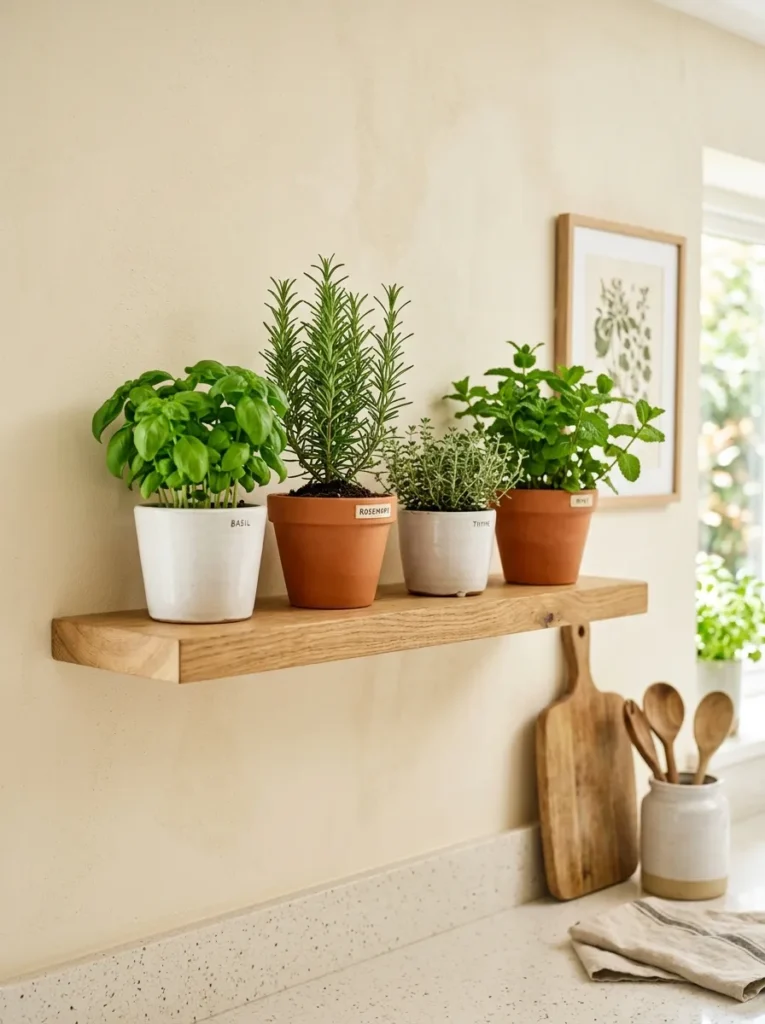
Vibe: Fresh and domestic — the kitchen shelf that is simultaneously the room’s most functional surface and its most naturally beautiful one.
Why it works: Fresh herbs in small ceramic pots on a kitchen shelf are the shelf decor idea that most completely collapses the distinction between decoration and function — the herbs that serve as the shelf’s primary botanical display element are simultaneously the kitchen’s most accessible culinary resource, making the shelf as useful to the cook as it is beautiful to the observer. This dual function communicates a specific domestic philosophy that the cozy shelf aspires to: beauty that arises from the quality of daily life rather than from the purchase of decorative objects. The fresh herb’s living quality — its specific fragrance released when a leaf is brushed, its daily growth that makes the shelf’s composition subtly different on every morning — creates the temporal variety and sensory richness that makes a kitchen herb shelf genuinely more engaging than a kitchen shelf of equivalent decorative objects.
How to get it: Replace the herbs when they pass their peak visual quality — typically every 4–8 weeks depending on growing conditions — rather than allowing them to become leggy, yellowed, or depleted. The ceramic pots should be in a consistent palette (all terracotta, or all white, or all warm grey) across the four herb varieties to create the visual cohesion that makes the herb row read as a designed display rather than a random collection of potted plants. Water the herbs individually by removing each pot from the shelf and watering at the sink — in-place watering risks shelf moisture damage.
Shop the Look
| Product |
|---|
| Basil herb plant small |
| Rosemary herb plant |
| Thyme herb plant |
| Small terracotta pot set |
| Herb pot drip saucer |
14. A Children’s Shelf with Story and Warmth
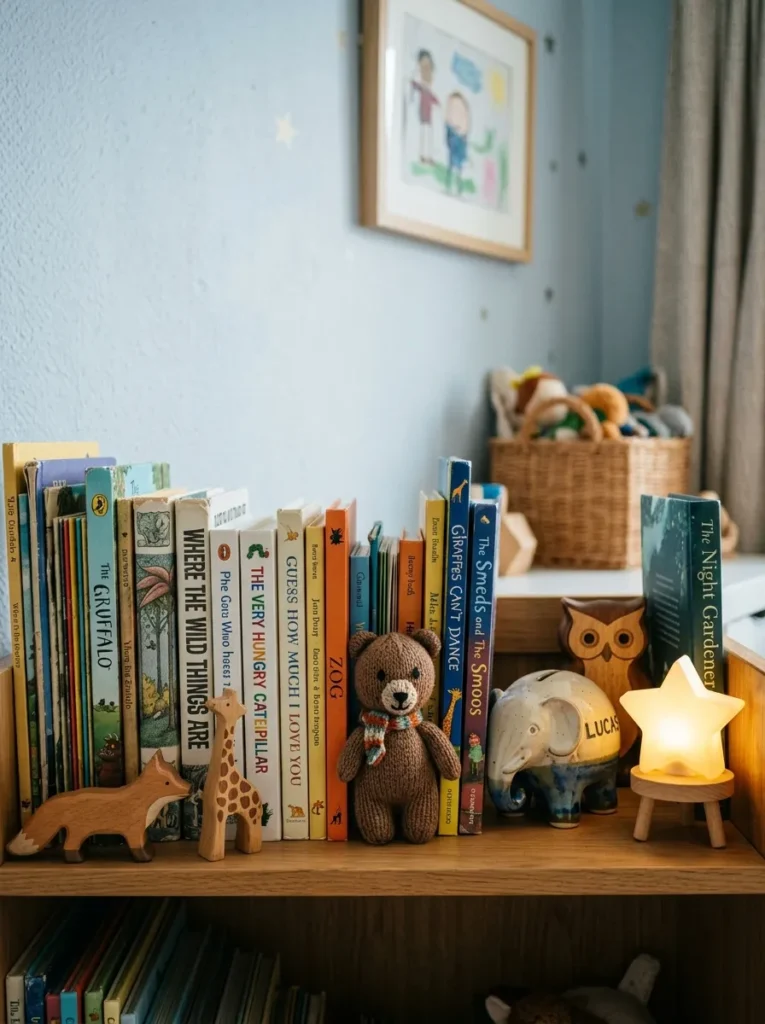
Vibe: Warm and story-full — the child’s shelf that reads as the beginning of a reading life rather than the backdrop of a nursery photoshoot.
Why it works: A children’s shelf styled with warmth and genuine story — books with illustrated spines facing outward rather than shelved spine-out, small wooden toys with the specific warmth of natural material, and a soft nightlight — is the shelf decor idea that most naturally creates a genuinely cozy, genuinely child-appropriate environment whose warmth is not manufactured for aesthetic effect but is inherent in the objects’ own qualities. The illustrated picture book spine facing outward is the book display approach that most naturally invites a child to engage with the shelf — the child can see and choose the book by its illustration rather than by reading a spine title, which is how children actually relate to their books. The natural wooden animal figures are the specific toy type that most naturally contributes to a warm, beautiful shelf display because their material quality (smooth, warm-toned, rounded wood forms) reads as genuinely beautiful from an adult aesthetic perspective while serving the child’s imaginative play function.
How to get it: Display picture books with illustrated covers facing outward using a forward-facing picture book ledge shelf rather than standard shelving — ledge shelves allow the illustrated cover to be the book’s primary visual element, which both invites child engagement and creates the most visually interesting shelf display from the room’s perspective. Limit the shelf to the child’s currently most-loved books (a rotating selection of 8–12 books) rather than displaying the full book collection — rotating books maintains the child’s engagement with the shelf and prevents the accumulation of the visual clutter that arises when all books are permanently displayed.
Shop the Look
| Product |
|---|
| Picture book ledge shelf |
| Wooden animal figure set |
| Hand-knit small toy |
| Soft nightlight warm glow |
| Ceramic children’s figure |
15. An All-White Shelf for Maximum Visual Calm
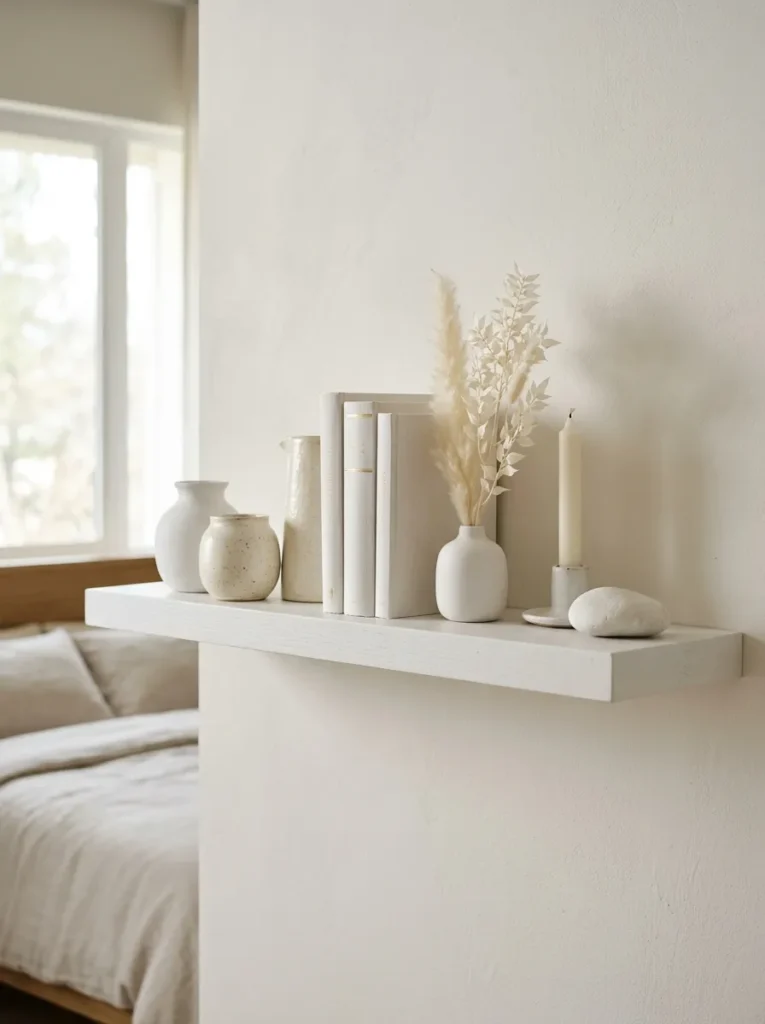
Vibe: Serene and restful — the bedroom shelf that demonstrates that the most sophisticated color use is the restraint to use only one.
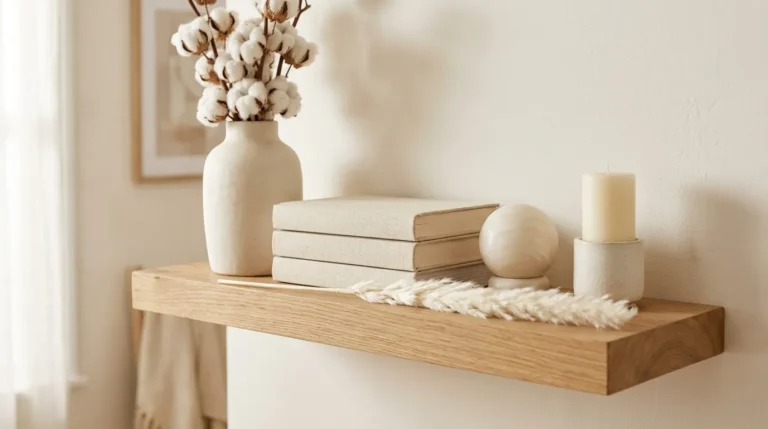
Why it works: An all-white monochromatic shelf display is the shelf decor idea that most completely applies the design principle of tonal restraint to achieve a quality of visual calm that is the specific atmosphere most appropriate to a bedroom’s primary function — rest and sleep. When all objects on a shelf share the same white-ivory tonal family, the eye perceives the composition as a unified, calm surface rather than as a collection of competing individual objects, creating the visual stillness that promotes the relaxed, restful mental state that the bedroom requires. The visual interest within the monochromatic palette comes entirely from textural and formal variety — the smooth glaze of the white ceramic vessel against the matte surface of the beeswax candle against the papery texture of the dried botanical against the tactile surface of the white hardcover — which is perceived at the close, intimate range of a bedroom shelf without requiring the arousing contrast of color variety.
How to get it: The all-white palette’s success depends entirely on the warmth consistency of all white objects — cool whites (containing blue undertones) mixed with warm whites (containing yellow undertones) create temperature discords that read as unintentional color variation rather than deliberate tonal range. All objects should be in warm white or warm ivory specifically — the warm white of beeswax wax, the warm ivory of natural dried botanicals, the warm glaze white of handmade ceramics. Manufactured bright whites from mass-production ceramics typically introduce the blue-cool tone that disrupts the monochromatic harmony.
Shop the Look
| Product |
|---|
| White ceramic vessel set three sizes |
| White beeswax candle |
| White ceramic candle holder |
| White hardcover book set |
| Dried cream botanical stem |
16. The Lived-In Shelf — Personal, Imperfect, and Genuinely Warm
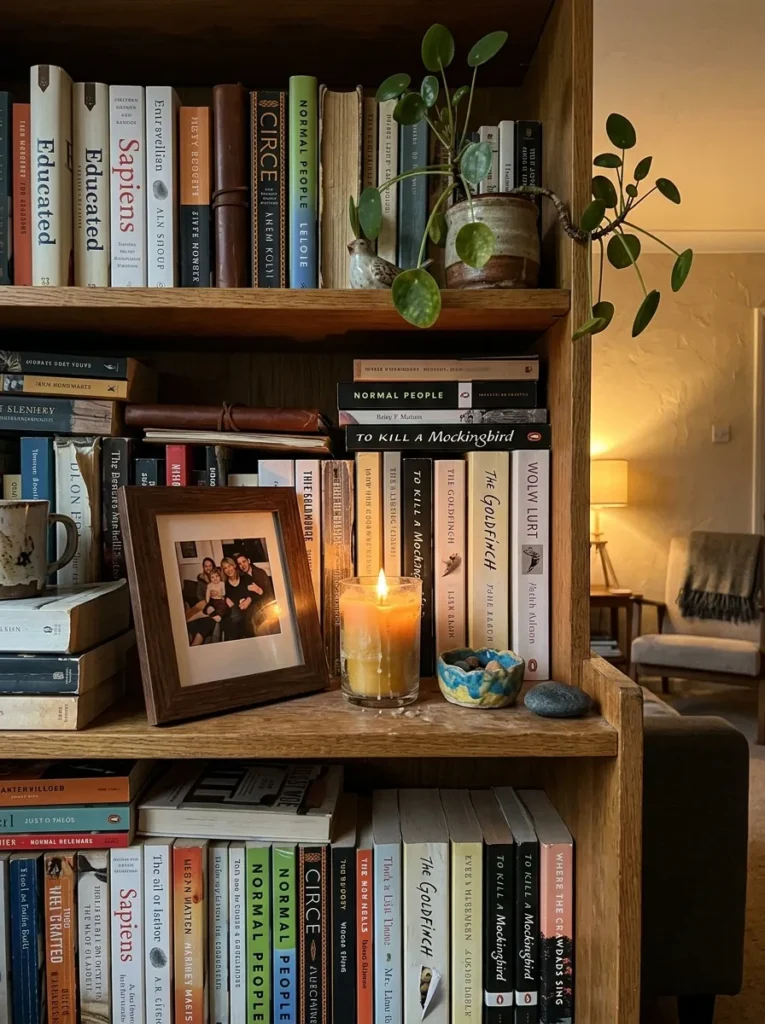
Vibe: Deeply personal and warm — the shelf that proves that the most beautiful shelves are not the most perfectly styled but the most genuinely inhabited.
Why it works: The genuinely lived-in shelf — with its organic book arrangement, half-burned candle, child’s gift clay pot, and outgrown plant — is the shelf decor idea that most powerfully challenges the premise of perfect shelf styling by demonstrating that genuine personal warmth is more compelling and more beautiful than any professionally styled composition. A shelf that shows evidence of active use — books whose positions reflect the order in which they were read and returned, a candle that has been lit and has accumulated melted wax, a plant that has grown past its original composition — communicates the inhabited quality that is the specific quality that all styled shelves aspire to replicate. The child’s clay gift (the specifically irregular, specific-child-revealing pinch pot) is the single most powerful indicator of genuine domestic warmth available on any shelf — it communicates love, specific relationship, and personal history that no purchased object can replicate.
How to get it: The lived-in shelf cannot be created through styling decisions — it can only be allowed to develop through genuine inhabitation of a well-chosen starting composition. The design discipline for a genuinely lived-in shelf is resistance rather than action: resisting the impulse to rearrange books by color when they are returned from reading, resisting the replacement of the half-burned candle with a new one before it is completely finished, and resisting the removal of the child’s clay pot to a less prominent position when it upsets the shelf’s aesthetic coherence. These resistances are the practice of genuinely cozy shelf design: allowing the shelf to be a living archive of domestic life rather than a maintained display composition.
Shop the Look
| Product |
|---|
| Simple photograph frame leaning |
| Half burned beeswax candle |
| River stone decorative |
| Trailing plant small pot |
| Organic book collection personal |
How to Start Your Cozy Shelf Decor Transformation
Your single first move is to clear every object from one shelf completely and observe the empty shelf for 24 hours before deciding what to return to it. This sounds counterintuitive — most shelf styling advice begins with arrangement principles — but the empty shelf observation is the most informative step in the styling process because it reveals the shelf’s physical qualities (its depth, its relationship to natural light, its color and material, its height within the room’s visual field) that determine which of the 16 ideas in this list is most appropriate for that specific shelf in that specific room. A shelf in direct natural light responds best to botanical and living elements (Ideas 4, 13, and 3); a shelf in a dimly lit corner responds best to warm amber light sources (Ideas 2, 10, and 11); a high shelf above the eye line is best served by trailing plants and light (Ideas 4 and 10); a low shelf at seated eye height is best served by the personal and the tactile (Ideas 8, 9, and 16).
The most common shelf styling mistake is treating every shelf in a home with the same organizational approach — applying the same color-organized book and ceramic formula to every shelf regardless of the shelf’s position, the room’s function, or the aesthetic intention of the specific space. The bedroom shelf most naturally serves Ideas 5, 7, 15, and 16 (tonal calm, personal objects, and restful simplicity); the kitchen shelf most naturally serves Ideas 13 and 6 (functional herb display and organized hidden storage); the living room main bookshelf most naturally serves Ideas 1, 3, 4, and 11 (the classic book-and-ceramic balance, seasonal botanicals, the dramatic trailing plant, and the candle arrangement). Applying the bedroom’s all-white monochromatic calm to the living room bookshelf produces a beautiful shelf that is inappropriate to its context; applying the kitchen’s fresh herb vitality to the bedroom shelf produces a shelf that is engaging but incompatible with the bedroom’s restful purpose.
Three specific purchases under $50 that create immediate cozy shelf quality: (1) A set of three graduated ceramic vases in warm earthy tones ($25–45 from any quality homewares retailer) provides the permanent botanical vessel trio (Idea 3) that transforms any shelf section from a flat surface display to a three-dimensional botanical composition, year-round and across every seasonal botanical replacement. (2) A 10-meter copper wire battery fairy light string ($12–20 from any homewares or electrical retailer) woven through any existing shelf display (Idea 10) immediately transforms the shelf’s evening quality at the lowest possible material cost — the fairy light installation takes 15 minutes and produces the most dramatic difference between daytime and evening shelf quality available. (3) A single large trailing plant in a quality ceramic pot ($20–40 for the plant and $15–30 for the pot) positioned at the top shelf edge (Idea 4) introduces the vertical organic element that most powerfully connects the shelf to the living, natural world — the trailing plant’s cascading growth creates the most unmistakably cozy quality available in any shelf display because it cannot be replicated by any manufactured or dried alternative.
Realistically, a completely styled wall of built-in bookshelves — organized books in color gradients, ceramic objects at appropriate intervals, dried seasonal botanicals, a trailing plant at the top, candles at one shelf level, fairy lights woven through, and woven baskets with lids at the lower levels — requires $200–500 in styling materials (ceramics, botanicals, baskets, fairy lights, candles) beyond the existing book collection, and 3–5 hours of arrangement time. A single floating shelf transformed from empty to warmly styled — a three-height vignette with a dried botanical grouping, a book stack with a ceramic on top, and a copper wire fairy light draped across the arrangement — requires $40–80 in materials and 30 minutes of arrangement. Most people begin with the single most-visible shelf in their most-used room, style it with three of the 16 ideas in this list, observe how the room responds to the improved shelf quality for a month, and then extend the approach to the remaining shelves informed by what they learned from the first.
Frequently Asked Questions About Cozy Shelf Decor
What is the best ratio of books to decorative objects on a shelf?
The ratio of books to decorative objects that most reliably creates a cozy, balanced shelf display is approximately 70% books to 30% objects by visual volume — this means that books occupy the majority of the shelf and set the visual tone, while objects provide the compositional punctuation, height variation, and material variety that prevent the shelf from reading as purely functional storage. In practical terms, this ratio means approximately one ceramic object for every six to eight books in a shelf section, positioned at the junction between color groups or at the end of a book grouping rather than between individual books. Deviating significantly from this ratio in either direction — too many objects creating a display-heavy shelf without personal content, or too few objects creating a storage shelf without compositional interest — produces shelves that read as either overly decorated or insufficiently styled.
How do I organize books on a shelf for the most aesthetically pleasing result?
The book organization approaches that create the most visually compelling shelf displays, in order of aesthetic impact, are: color gradient organization (books grouped by spine color in a gradient from light to dark or warm to cool), height organization within color groups (books in each color group arranged from tallest to shortest), and spine-inward with selected objects placed in front (all books pages-out for a uniform cream-white texture). The color gradient approach is the most impactful for a living room bookshelf where visual richness is the primary goal; the spine-inward approach is the most appropriate for a minimalist or Japandi bedroom shelf where visual calm is the primary goal. Subject or alphabetical organization — the most functional arrangement — consistently produces the least aesthetically compelling shelf display because the resulting random mix of spine colors, sizes, and typographic styles creates visual complexity without compositional logic.
How do I keep my shelf looking cozy without it becoming cluttered?
The discipline that most consistently prevents shelf clutter while maintaining coziness is the object audit — the periodic (ideally monthly) removal of every object from the shelf and the return of only those that satisfy two tests: the object is genuinely beautiful or genuinely personally meaningful, and the shelf is visually improved by the object’s presence. Objects that fail either test are removed. The shelf audit should also assess the shelf’s overall visual weight — a shelf that reads as heavy or compressed benefits from the removal of one or two objects and the introduction of more breathing room between remaining pieces. The breathing room principle — no two objects should be touching, and each shelf section should have at least 20% of its length as empty surface — is the single discipline that most consistently prevents a cozy shelf from reading as cluttered.
What lighting works best for shelf displays?
The lighting approaches that most effectively create warm, cozy shelf illumination are: warm amber LED strips mounted along the underside of the shelf above (which provide warm downlighting of the shelf’s contents from the most flattering angle), small ceramic table lamps placed within the shelf at every second level (which create intimate, warm pools of lamp light at multiple shelf heights), and copper wire fairy lights woven through the display (which create the warmest, most atmospheric, and most magical shelf lighting available). All three approaches should specify light sources at 2200–2700K color temperature — the warmest end of the residential LED spectrum — because cool or white light sources on a shelf immediately undermine the warm, cozy quality that the shelf’s material content is designed to create. Overhead room lighting alone is the least effective shelf lighting approach — it creates a flat, shadowless illumination of the shelf surface that eliminates the dimensional shadow quality that makes a shelf display visually interesting.
How do I style a shelf in a rental apartment without drilling or making permanent changes?
The shelf styling approaches that require no drilling, no permanent fixtures, and no structural modification to the rental property are: all of the arrangement ideas in this list (which apply to any shelf surface regardless of how it is mounted), the copper wire battery fairy light approach (which requires no wiring, only a battery change), the trailing plant approach (which requires only a plant in a pot placed on an existing shelf), the dried botanical grouping (which requires only vases placed on existing shelving), and the woven basket storage approach (which requires only baskets placed on existing shelves). For renters who want to add shelving rather than style existing shelves, Command strip floating shelf systems (rated for shelves up to 5kg) provide additional display surfaces without wall drilling, and freestanding shelf units (a bookcase, a ladder shelf, or an open shelving unit) add significant shelf space without any wall contact.
Ready to Style Your Shelves?
These 16 ideas span the full range of what a cozy shelf can be — from the classic book-and-ceramic balance that makes any bookshelf read as genuinely considered, and the warm amber lamp at every shelf level that transforms a daytime display into an evening sanctuary, to the lived-in shelf that proves genuine personal warmth is more beautiful than perfect styling, the travel memory archive that communicates specific identity more powerfully than any design decision, and the fairy-light-woven evening shelf that makes the most ordinary collection of books and objects glow as though it was always meant to be lit that way — so whether you are styling a single floating shelf in a studio apartment or a full wall of built-in bookshelves in a family living room, there is a genuinely achievable, genuinely warm approach here for your specific shelves, your specific objects, and the specific quality of domestic warmth and personal revelation that a cozy shelf in any home is capable of providing. The styling begins not with a purchase but with an observation — with the empty shelf, observed in its specific light for 24 hours, that reveals what it most needs and what it can most beautifully become. Today’s specific action: choose the single shelf in your home that you look at most frequently, remove everything from it, look at it empty in its morning light, and identify which of the 16 ideas in this list most naturally responds to that specific shelf’s specific position, its specific light, and the specific room and life it serves. That identification is the beginning of the styling, and everything else follows from the warmth and the specificity and the genuine personal meaning that you bring to what you place back on it.