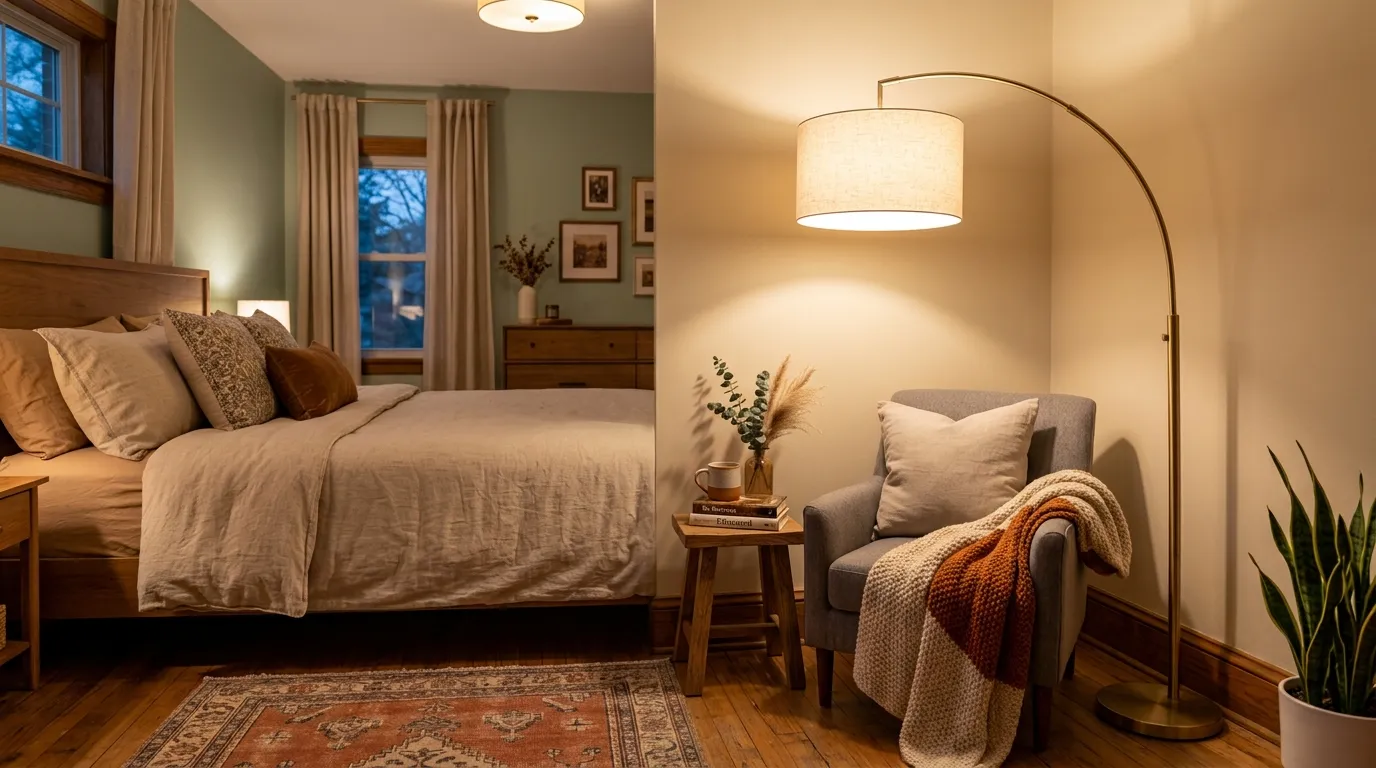
15 Bedroom Light Ideas That Create a Luxe Feel
Bedroom lighting that creates a luxe feel is the deliberate system of light sources — ceiling fixtures, wall sconces, table lamps, floor lamps, LED strips, and candlelight — chosen and positioned to produce a bedroom atmosphere of warmth, flattery, and genuine comfort rather than merely adequate illumination. This article gives you 15 bedroom lighting ideas across fixture selection, positioning strategy, color temperature, dimming systems, accent and decorative lighting, architectural lighting integration, and candlelight so every light source in your bedroom contributes to the specific quality of warm, layered, flattering illumination that genuine bedroom luxury requires.
The difference between a bedroom that feels luxurious and one that merely has expensive furniture is almost always lighting — specifically, the quality, temperature, direction, and layering of the light that fills the room in the evening hours when the bedroom is most used for relaxation and rest. The most expensive bedding reads as flat under cool overhead fluorescent light; the most modest bedding appears genuinely sumptuous under warm, dimmed, multi-source lighting at the correct color temperature. Lighting is not the finishing touch in a bedroom design — it is the environmental condition under which every other design decision is experienced. Here are 15 ideas worth saving — and implementing.
Why Bedroom Lighting Transforms the Experience of the Space
Bedroom lighting design draws from the convergence of photobiology (the science of how light affects biological processes including sleep), environmental psychology (the study of how ambient light conditions affect mood, cognitive performance, and emotional state), and the hospitality design tradition that has invested decades of research and creative intelligence into determining exactly which light conditions make sleeping environments feel most genuinely luxurious. The results of these three research streams are consistent: the bedroom light conditions that produce the most luxurious experienced quality are warm color temperature (2200–2700K amber light), low-to-medium illumination levels (200–500 lux for ambient use, not the 500–800 lux appropriate for task-focused rooms), multiple layered sources at varied heights rather than single overhead illumination, and the ability to dim all sources to the minimum level appropriate for the activity in progress.
The physiological case for warm bedroom lighting is documented extensively in sleep research — blue-wavelength light (present in cool white and daylight-spectrum fixtures above 3000K) suppresses melatonin production through the eye’s melanopsin photoreceptors, delaying sleep onset by up to 90 minutes with evening exposure. Warm amber light at 2200–2700K contains minimal blue wavelength and allows natural melatonin rise after approximately 8pm, which supports both sleep onset and sleep quality. A bedroom with cool-white overhead lighting is actively working against the occupant’s sleep every evening regardless of how beautiful the fixture is — the correct color temperature is a non-negotiable physiological requirement, not an aesthetic preference.
The design case is equally well-established — hotel suites that achieve the highest guest satisfaction ratings consistently use layered warm lighting from multiple sources at varied heights rather than single overhead illumination, and the specific quality of “warmth” that guests describe in luxury hotel bedrooms is almost always an accurate description of the lighting rather than of the materials or furnishings. The warmth of a room is its lighting.
What to Prioritize
| Priority | Detail |
|---|---|
| Color Temperature | 2200–2700K in every bedroom light source — this is not negotiable for luxury feel or sleep quality |
| Dimmer Control | Every bedroom circuit should be on a dimmer — full bright is for cleaning, not for experiencing the room |
| Layering | Minimum three light sources at different heights — ceiling, mid-level, and low-level sources together |
| Direction | Light should come from beside and below, not primarily from above — avoid face-level downlighting |
15 Bedroom Light Ideas That Create a Luxe Feel
1. Warm Filament Bulbs in Every Fixture
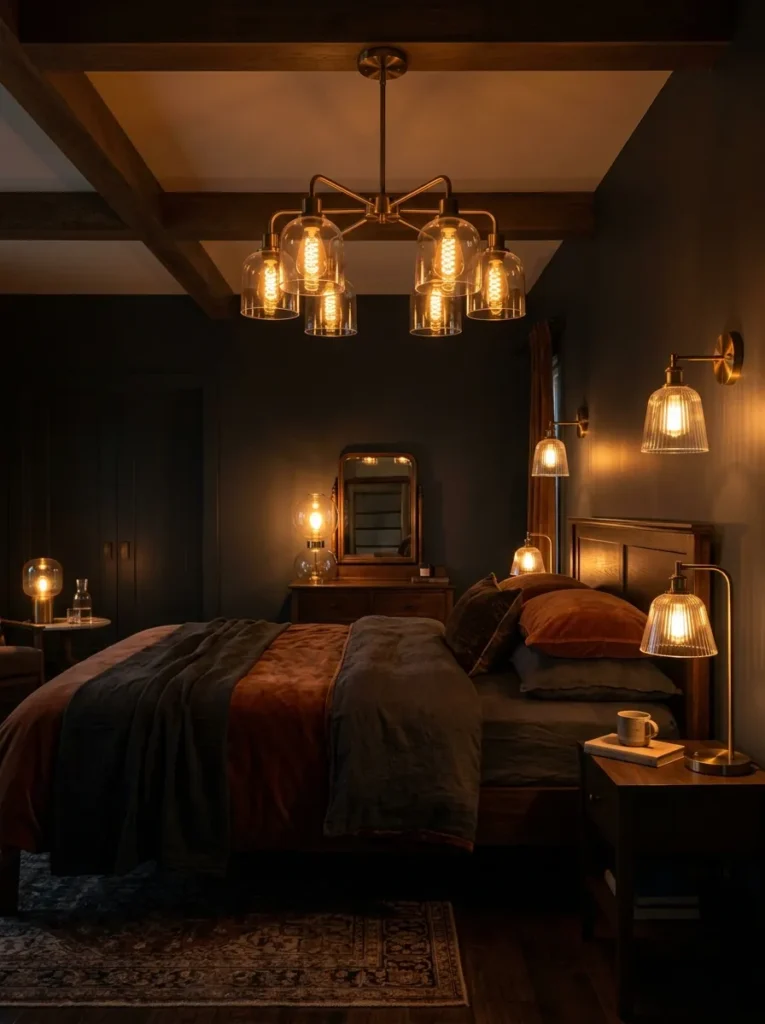
Vibe: The room is amber — replacing every existing bedroom bulb with warm 2200K Edison filament LED equivalents immediately transforms the room’s entire atmospheric register from adequately illuminated to genuinely luxurious, where the amber quality of the filament bulb creates the candlelight-adjacent warmth that is the most consistent signature of luxury bedroom environments.
Why it works: The Edison filament LED bulb is the single most impactful and most cost-effective bedroom lighting upgrade available because it changes the color temperature of every existing fixture simultaneously — the same ceiling pendant, the same table lamps, and the same wall sconces that currently produce cool or neutral light will produce warm amber light immediately upon bulb replacement. The filament’s visible coil within the glass envelope is specifically the visual quality that makes the warm bulb so atmospheric in bedroom environments — the visible warm coil reads as a flame rather than as an electric element, connecting the bulb aesthetically to the candlelight tradition of bedroom illumination that the luxury hotel environment has always referenced. The color temperature difference between a 2200K filament bulb and a standard 4000K LED is far greater than the numbers suggest — the 2200K bulb produces the light quality of early morning sunrise or late afternoon golden hour, while the 4000K produces the light quality of a clear midday sky.
How to get it: Replace every bulb in every bedroom fixture with a warm white LED equivalent — specifically 2200K or 2700K color temperature, never higher. Philips Warm Glow, GE Reveal Amber, and specialty filament LED brands all produce quality warm bulbs at $3–$8 per bulb. For fixtures with visible bulbs (glass globe pendants, open-shade lamps, cage pendants), use genuine Edison filament style bulbs with visible filament coils — the visual quality of the filament is as important as the color temperature in these applications.
Quick Win: Replacing all existing bedroom bulbs with 2200K equivalents costs $15–$40 total and takes 15 minutes — it is the single highest-return bedroom improvement available at any price, producing a dramatically more luxurious atmosphere immediately.
Shop The Look
- Edison filament LED bulb 2200K warm
- Warm white LED 2700K bedroom bulb
- Filament LED globe bulb amber set
- Vintage Edison bulb LED equivalent
- Warm amber bulb candelabra E12 set
Also view: 13 Bedroom Ceiling Lighting Ideas for Modern Homes
2. Bedside Table Lamps at the Correct Height
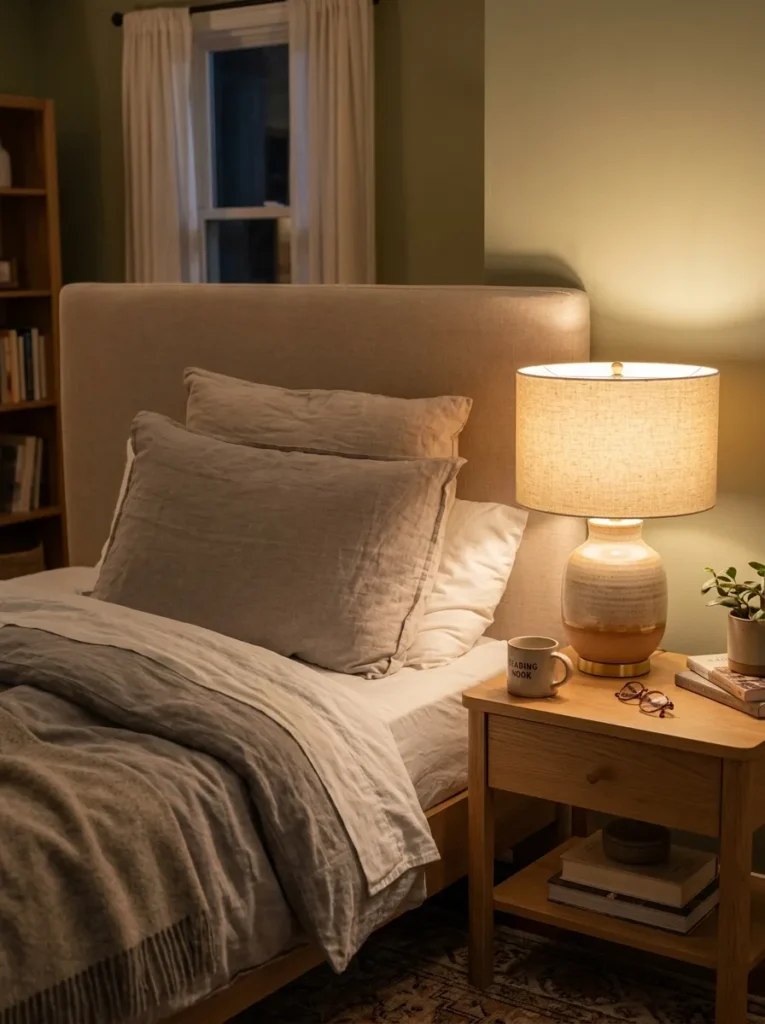
Vibe: The lamp is correct — a bedside table lamp at the precise height where its shade’s bottom edge aligns with the shoulder of a seated reader creates the most functional and most flattering bedside light available — the light falls on the book and the hands without shining directly into the eyes.
Why it works: The most common bedside lamp mistake is incorrect height — either a lamp that is too short (with the shade too low, directing all light downward onto the nightstand surface rather than onto the reading material) or too tall (with the shade above eye level, shining directly into the eyes of a person sitting up in bed). The correct position places the shade’s bottom edge at approximately shoulder height of the bedroom’s average occupant when sitting up in bed — typically 20–22 inches above the mattress surface for a standard bed height. At this position, the lamp illuminates the reading zone (the book and hands at lap level) from slightly above and to the side, which is the most functional reading light direction, while the shade at shoulder height prevents direct eye contact with the light source from the seated reading position. This specific geometry — light from slightly above shoulder level directed downward and inward — is the lighting condition that hotel designers specify as standard for luxury bedside illumination.
How to get it: Measure the current height from the mattress surface to the bottom of the lamp shade when the lamp is positioned on the nightstand. If the shade bottom is not between 20 and 22 inches above the mattress, the lamp is at the wrong height — either adjust the nightstand height, change the lamp’s overall height, or replace the lamp with a correctly proportioned alternative. A lamp with a total height (base plus shade) of 28–32 inches on a standard 26–30-inch nightstand typically positions the shade bottom in the correct 20–22-inch range above the mattress.
Shop The Look
- Bedside table lamp correct height 30 inch
- Ceramic base lamp warm bedroom
- Brass table lamp warm bedroom
- Natural linen shade table lamp
- Lamp height guide nightstand positioning
Also view: 15 Master Bedroom Decor Ideas for Small Spaces
3. Dimmer Switches on Every Bedroom Circuit
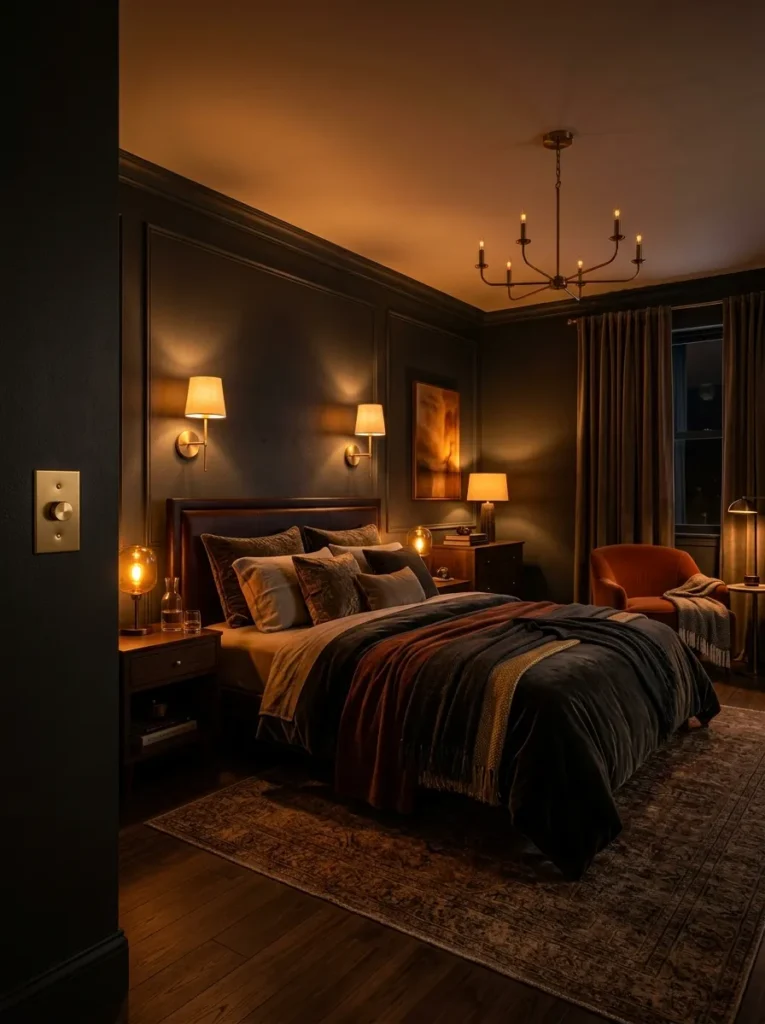
Vibe: The room is atmospheric — dimmer switches on every bedroom circuit transform the bedroom’s lighting from a binary on/off function into a continuously adjustable atmospheric tool, where the difference between the room at full bright and the room at 30% dim is the difference between a lit room and a genuinely luxurious sleeping environment.
Why it works: The dimmer switch is the bedroom lighting upgrade with the highest ratio of impact to cost — a $15–$30 dimmer switch installation on an existing circuit transforms a fixed-level fixture into a continuously adjustable light source without any change to the fixture itself. The specific light level that most consistently produces the luxurious bedroom atmosphere is 20–40% of maximum — the level at which the warm filament bulbs create visible, warm pools of light with genuine shadow zones between them, the room appears to have depth and warmth rather than uniform illumination, and the physiological shift toward sleep onset is actively supported by the reduced illumination level. Full-bright bedroom lighting serves cleaning and getting-dressed functions; dimmed bedroom lighting serves relaxation, reading, and the transition to sleep that constitute the majority of the bedroom’s evening use.
How to get it: Install a compatible dimmer switch on each bedroom circuit — the ceiling fixture circuit and the outlet circuit serving the bedside lamps (if the bedside lamps are on switched outlets). Smart dimmer switches (Lutron Caseta, Leviton Decora Smart) provide smartphone control and programmable dimming schedules ($40–$60 per switch). Standard rotary or slide dimmers ($15–$25 per switch) provide manual control without smart features. Ensure the chosen dimmer is compatible with the specific LED bulbs in the circuit — LED dimmer compatibility varies by manufacturer, and incompatible dimmers can cause buzzing, flickering, or limited dimming range.
Shop The Look
- Lutron Caseta smart dimmer bedroom
- Slide dimmer switch LED compatible
- Smart dimmer switch bedroom schedule
- Dimmer switch multi-pack bedroom
- LED compatible dimmer switch 3-way
4. Bedside Wall Sconces for Architectural Lighting
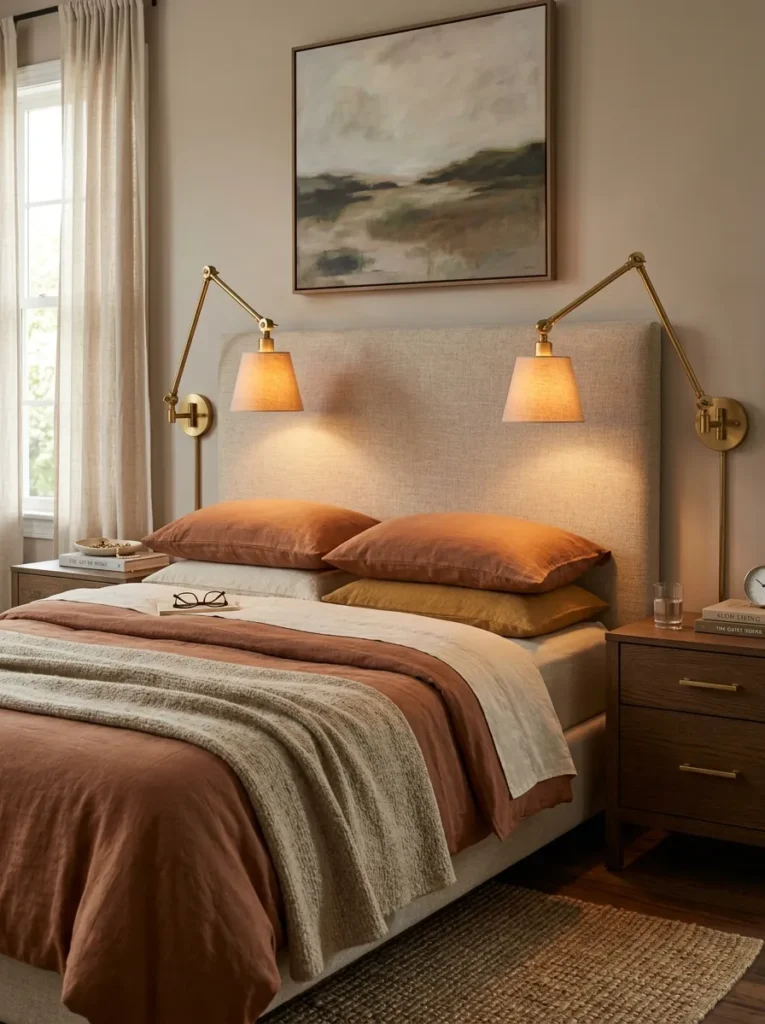
Vibe: The sconces are architectural — bedside wall sconces replace the table lamp’s visual bulk with a clean, wall-mounted solution that frees the nightstand surface, provides bilateral reading light from the optimal position, and creates a bedroom-wall composition of genuine architectural elegance.
Why it works: Wall-mounted bedside sconces solve three simultaneous problems that table lamps create in luxury bedroom design. First, they free the nightstand surface — removing the lamp base, shade, and cord from the nightstand creates approximately 1 square foot of usable surface that can be styled with three deliberately chosen objects rather than organized around the lamp’s footprint. Second, they provide bilateral reading light from the architecturally correct position — mounted at 60 inches from the floor (face height for a person sitting up in bed), sconces direct light from beside and slightly above the reader’s position, which is more functional and more flattering than the downward-directed light of a table lamp positioned below face level. Third, they create a wall composition of genuine architectural intention — the paired sconces flanking the headboard establish a symmetrical, hotel-quality wall arrangement that communicates designed intentionality.
How to get it: Hardwired sconce installation (where the sconce connects directly to the wall’s electrical circuit, with no visible cord) is the most elegant option and requires an electrician to run wiring through the wall to the mounting position. Plug-in sconces (which mount to the wall with the cord running down the wall in a cord cover) provide a cord-visible alternative without electrical work at $60–$150 per sconce. Hardwired articulating arm sconces in brushed brass are available from quality lighting retailers at $80–$250 each.
Shop The Look
- Articulating arm wall sconce brass pair
- Plug-in wall sconce bedroom pair
- Hardwired bedroom sconce wall mount
- Linen shade bedside sconce warm
- Wall sconce 60 inch mount height
5. Under-Bed LED Strip for Floating Effect
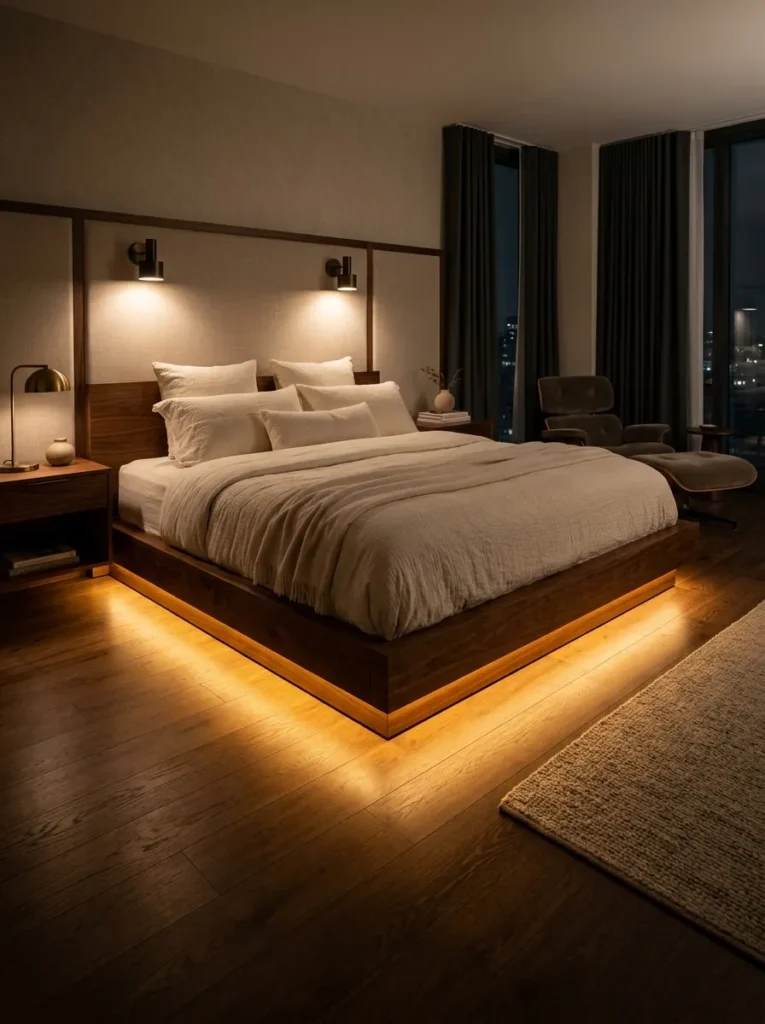
Vibe: The bed is floating — warm LED strip lighting concealed beneath a platform bed’s base creates the specific floating-bed illumination of luxury hotel design, where the warm amber glow on the floor beneath the bed makes the bed appear to levitate above a warm halo of light.
Why it works: The under-bed LED strip creates two simultaneous effects that transform a bedroom’s perceived quality and atmosphere. First, the visual floating effect — the warm amber floor glow between the bed’s base and the floor creates the impression that the bed is suspended above a warm light field rather than resting on the floor, which gives the bedroom’s primary furniture piece an unusual and specifically luxurious visual quality. Second, the low-level ambient light contribution — the reflected warm light from the floor beneath the bed provides the lowest-zone ambient illumination that completes the bedroom’s layered lighting system at its most fundamental level, filling the shadow zone under the bed that might otherwise read as a dark void. Together these effects create the specific warm-floor-level glow that guests in luxury hotels describe as making the room feel “warm” in a way they cannot specifically attribute to any single source.
How to get it: Use warm white LED strip at 2700K or 2200K color temperature (never cool white, which creates a clinical rather than warm effect) on adhesive backing, applied to the interior face of the bed platform’s base at the floor-facing edge. The strip should be positioned so it is not directly visible from any standing or seated position in the room — only the reflected floor glow should be visible. Route the power cable through a small hole in the platform base to a switched outlet. Total cost: $15–$40 for quality warm LED strip in the required length.
Shop The Look
- LED strip warm 2200K adhesive bedroom
- LED strip bed platform install kit
- Warm LED strip flexible adhesive
- LED strip controller dimmer switch
- Under bed LED strip 2700K warm
6. Statement Chandelier with Warm Bulbs on Dimmer
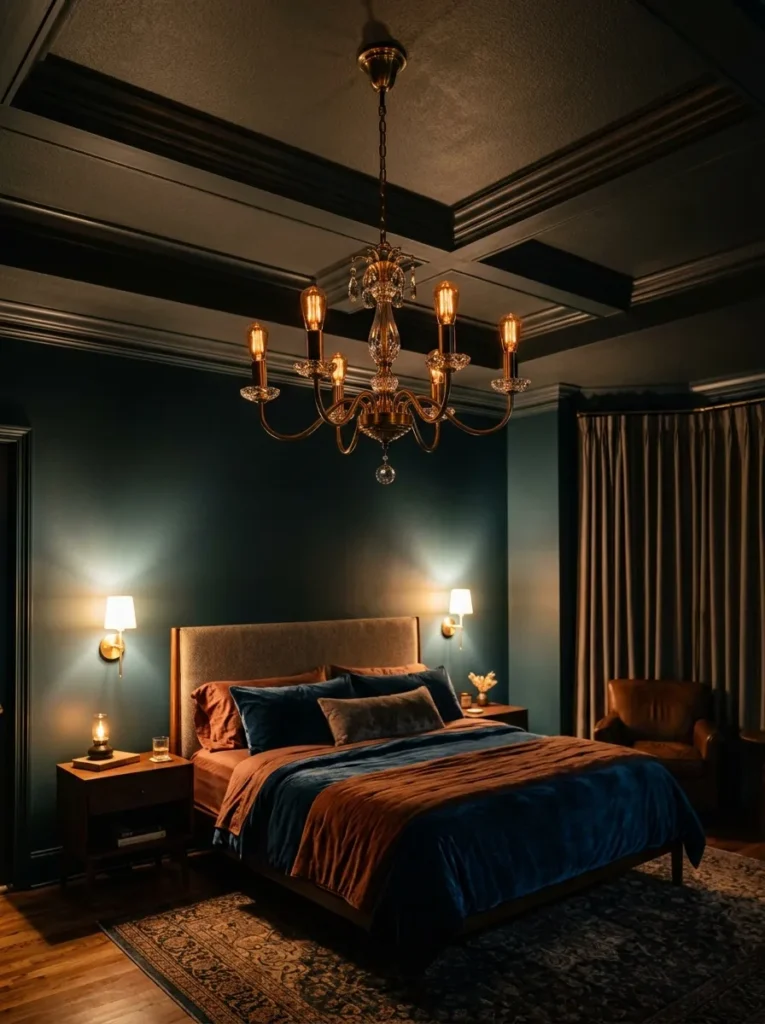
Vibe: The chandelier is atmospheric — a chandelier used at 25–30% of its maximum illumination level creates a warm amber constellation in the bedroom’s upper zone that provides gentle atmospheric ceiling light without the harsh task-lighting quality of a chandelier at full brightness.
Why it works: The bedroom chandelier is one of the most frequently misused bedroom lighting fixtures — it is typically operated at full bright (which produces harsh, un-diffused light from above that creates the worst possible facial shadows and the most utilitarian possible bedroom atmosphere) when its genuine value is exclusively at low dimmed levels where it creates a warm amber ceiling constellation rather than overhead illumination. A chandelier at 25–30% creates the specific warm ambient quality that makes the bedroom ceiling zone feel alive and warm — the small warm amber points of each candelabra bulb visible through the fixture’s glass or crystal create the impression of a warm, inhabited ceiling rather than a functional light source. At this level, the chandelier’s primary function is atmospheric rather than illuminating, and the bedside lamps or sconces provide all necessary functional light for reading and grooming.
How to get it: Install a compatible LED dimmer switch on the chandelier’s circuit (Lutron or Leviton dimmers provide the smoothest LED dimming performance). Replace chandelier bulbs with warm candelabra-base filament LED bulbs at 2700K or 2200K in 25–40 watt equivalent (250–400 lumens each) — the lower equivalent wattage at 2700K creates the warm amber point source quality that the chandelier’s atmospheric function requires. Operate the chandelier exclusively at the 20–35% dimmed range for bedroom use — never at full bright except for practical tasks such as cleaning.
Shop The Look
- Candelabra filament LED warm 2700K set
- Brass bedroom chandelier small warm
- Crystal chandelier bedroom dimmer
- Smart dimmer chandelier compatible
- Candelabra LED bulb E12 2200K set
7. Warm Recessed Lighting with Individual Dimmers
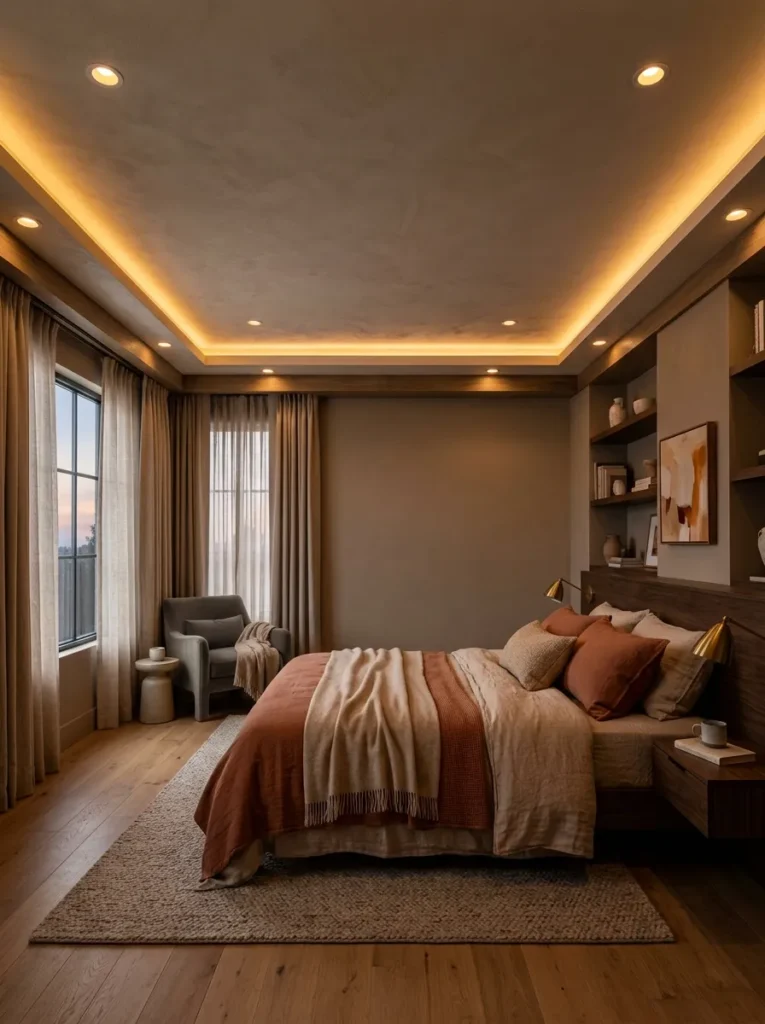
Vibe: The room is perimeter-warm — recessed lighting positioned around the room’s perimeter rather than centered above the bed creates warm architectural ambient light from the walls rather than harsh task lighting from directly above the sleeping position.
Why it works: Recessed lighting in bedrooms is typically poorly positioned — centered directly above the bed where it creates the most unflattering possible directional light (directly downward at the lying body’s face) and the least atmospheric possible light distribution (uniform illumination of the entire floor from a single ceiling zone). Recessed lights positioned at the room’s perimeter — approximately 18 inches from the wall, angled to wash the walls with warm light rather than directed straight down at the floor — create an entirely different lighting effect: warm wall-washing that illuminates the room from its edges inward, creating a genuinely warm ambient glow around the room’s perimeter while allowing the room’s center (above the bed) to be in a softer, less directly illuminated zone. This perimeter-warm lighting approach is the standard specification in quality hotel bedrooms.
How to get it: If recessed lighting is being newly installed in a bedroom, specify the position at 18 inches from the wall rather than in the center of ceiling sections, and angle the fixtures toward the wall for a wall-washing effect. If existing recessed lighting is centered above the bed, use warm directional bulbs that can be angled toward the walls within the recessed housing, and install individual dimmers on each circuit. Warm 2700K trim in a recessed housing (the trim color should be warm white rather than bright white or chrome) maintains the warm atmosphere when the fixtures are not illuminated.
Shop The Look
- Recessed light 2700K warm trim set
- LED recessed downlight warm bedroom
- Recessed lighting dimmer controller
- Wall wash recessed fixture angle
- Warm trim recessed light housing
8. Floor Lamp in the Bedroom Corner for Ambient Fill
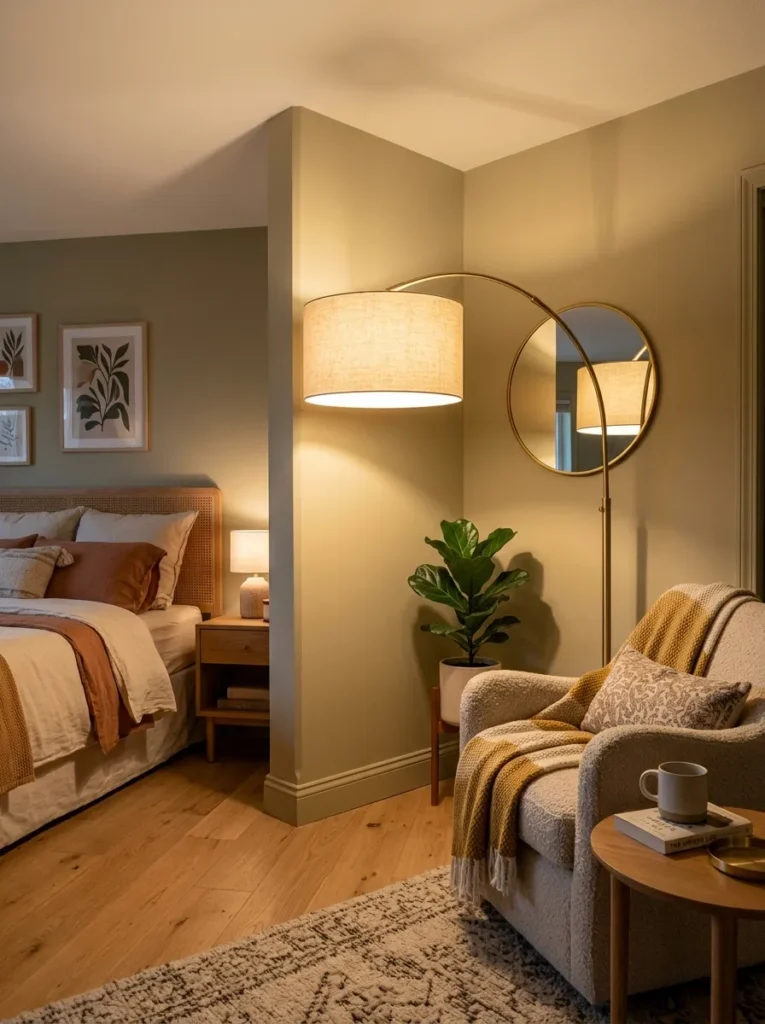
Vibe: The lamp is ambient — a warm floor lamp in the bedroom’s corner fills the room’s shadow zone with gentle warm light, completing the layered lighting system by providing the ambient fill that bedside lamps and ceiling fixtures cannot reach without harsh directionality.
Why it works: The bedroom corner is the room’s most naturally shadowed zone — both the ceiling fixture and the bedside lamps direct their light primarily toward the bed and the central room area, leaving the corners in relative shadow that can make even a warmly lit bedroom feel slightly incomplete in its ambient distribution. A floor lamp in the bedroom’s most used corner (typically the reading chair corner or the corner opposite the bed’s foot) provides warm ambient fill that completes the room’s light distribution without creating additional directed light at the bed. The floor lamp’s contribution to the layered lighting system is specifically the elevation — positioned at floor level with an upward-and-downward shade distribution, the floor lamp provides warm light in the room’s lowest zone (lighting the floor and lower wall areas that other fixtures skip) while also contributing upward ambient to the mid-room zone. The arc floor lamp specifically (with a curved arm extending the shade over a chair or beside the bed) creates the intimate reading light configuration that the bedroom’s relaxation zone requires.
How to get it: Floor lamps for bedroom ambient use should be in warm materials (brass, warm wood, ceramic base) with large, light-transmitting shades in natural linen, paper, or cream cotton that diffuse the warm bulb rather than directing it. Position in the corner that receives the least light from the room’s other sources — typically diagonally opposite the primary window. Connect to a floor switch or a smart plug that can be controlled independently from the room’s other lighting circuits. Use a 2700K or 2200K bulb at 400–600 lumens for ambient fill levels.
Shop The Look
- Arc floor lamp brass bedroom corner
- Standard floor lamp warm linen shade
- Bedroom floor lamp warm ambient
- Brass floor lamp reading bedroom
- Floor lamp smart plug control
9. Mirror Positioned to Reflect and Multiply Light Sources
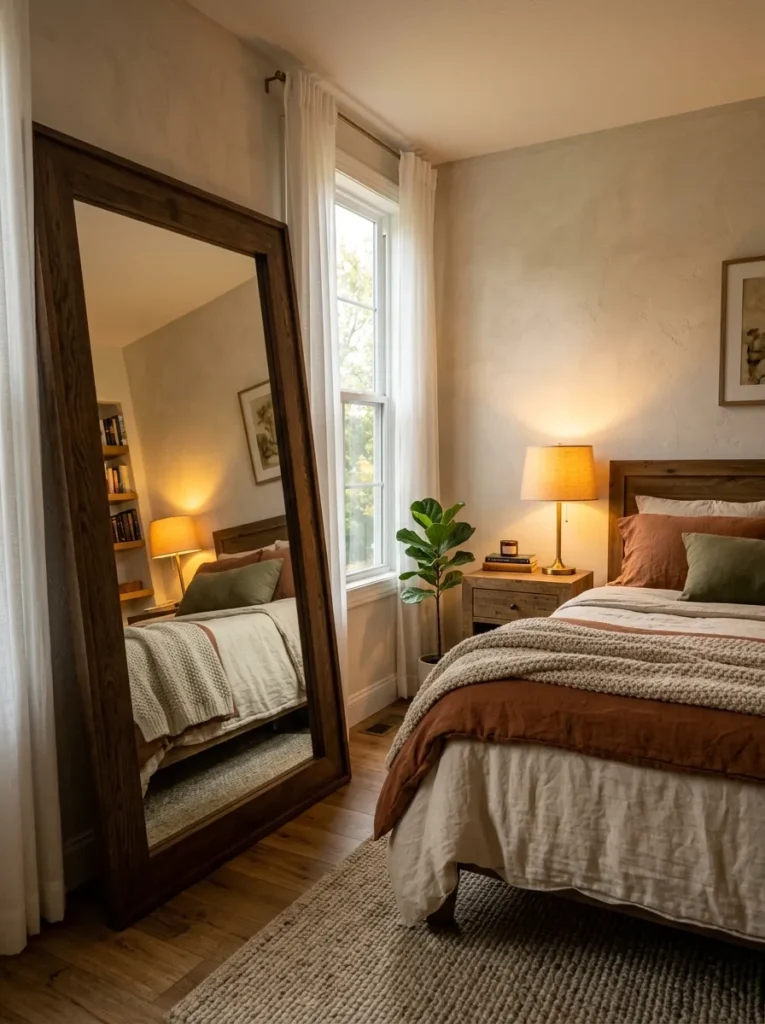
Vibe: The mirror is multiplying — a correctly positioned large bedroom mirror that reflects both a natural light source and the warm bedside lamp creates the visual effect of doubled light sources, making the bedroom appear significantly warmer and more richly lit than the actual number of fixtures can account for.
Why it works: A mirror positioned to reflect an existing light source creates a secondary apparent light source in the room — the reflected image of a warm bedside lamp appears in the mirror as a second lamp, and the reflected natural light from a window appears as a second window, both with the visual warmth and directional quality of the original. This doubling effect is the most cost-effective bedroom lighting enhancement available because it multiplies existing light sources rather than adding new ones — a single well-positioned mirror can create the visual impression of twice the existing light without any additional electrical work or fixture purchase. The mirror’s effectiveness for light multiplication depends on its placement relative to the sources it will reflect — it should be positioned at an angle that reflects the primary warm light source (the bedside lamp) at the position where that doubled light will be most visible from the bed.
How to get it: Position the bedroom mirror on the wall that most directly faces the primary bedside lamp or the room’s natural light source — this is typically the wall adjacent to (perpendicular to) the window rather than opposite it. A full-length mirror (60–72 inches tall) provides the most effective light reflection because it captures the full vertical extent of the bedside lamp’s warm glow. The mirror’s frame material should coordinate with the room’s warm material palette (warm wood, aged brass, antique gilt) rather than reading as a cool or reflective interruption of the warm material environment.
Shop The Look
- Large bedroom mirror warm frame
- Full length mirror aged brass frame
- Leaning mirror bedroom light multiply
- Antique frame mirror bedroom
- Floor lean mirror warm wood
10. Candles and Candlelight as Primary Evening Ambiance
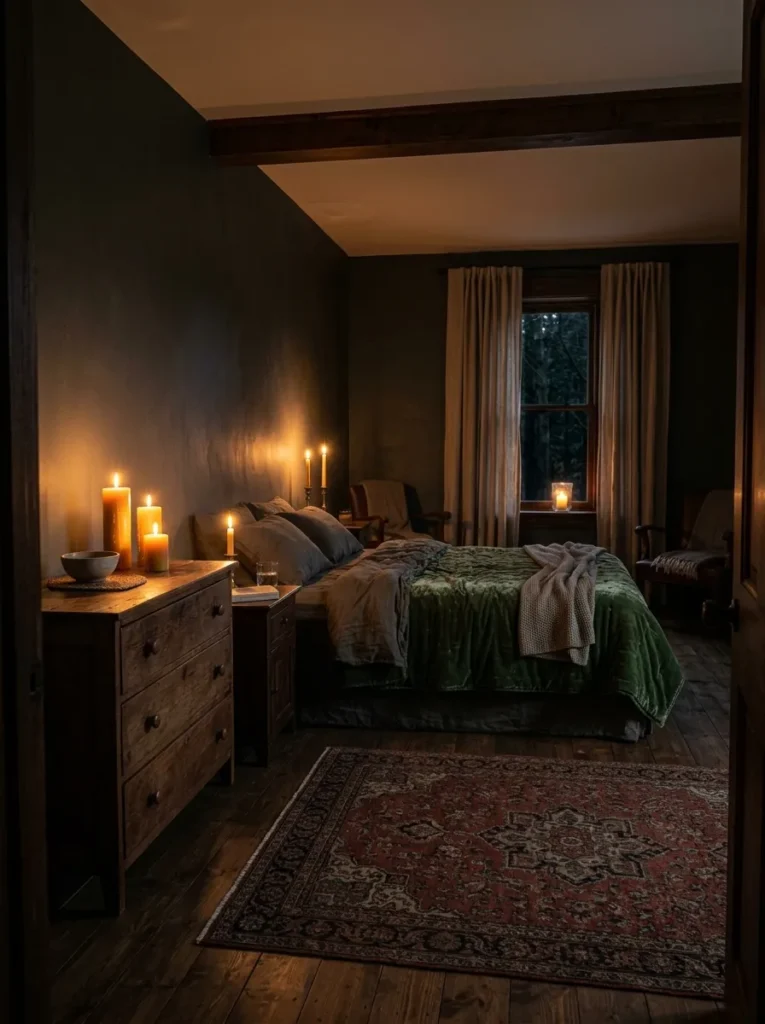
Vibe: The room is intimate — a bedroom lit exclusively by candlelight achieves the warmest and most genuinely luxurious atmosphere available to any bedroom, where the 1800K color temperature of genuine flame creates the most physiologically sleep-supportive and the most emotionally intimate light quality that has existed throughout human history.
Why it works: Candlelight is the reference light source against which all warm electric lighting is compared — when lighting designers specify 2200K “candle-warm” LED bulbs, they are attempting to approximate the 1800K color temperature of genuine flame. The genuine article — beeswax candles specifically, which burn at a slightly different light quality than paraffin, with a natural honey fragrance that adds an olfactory dimension to the warm visual quality — creates the most genuinely luxurious bedroom atmosphere available because it achieves the warmth and intimacy that all warm electric lighting approximates but cannot fully replicate. The flickering quality of genuine flame (its slight, irregular variation in both direction and intensity) creates the perpetually moving warm light that research consistently identifies as the most calming and most genuinely warm-feeling ambient light available. The practical consideration is safety — candles should never be left burning unattended, should be positioned away from textiles, and should be extinguished before sleep.
How to get it: Beeswax candles (available from specialty candle makers and natural products retailers, $8–$20 for quality pillar candles) burn at a slightly higher temperature than paraffin, producing less soot and more consistent flame quality while releasing the specific honey fragrance that makes beeswax candlelight distinctively warm. Position pillars on heat-safe surfaces (stone, ceramic, metal trays) and tapers in brass or silver candlesticks. The practical alternative for bedrooms where live fire is a concern: high-quality LED candles with realistic flame simulation (Luminara, Candlescapes) provide approximately 70% of genuine candlelight’s atmospheric quality at zero fire risk — useful for the continuous low-level bedroom candlelight that sleeping-present candles would require.
Shop The Look
- Beeswax pillar candle set varied height
- Brass taper candlestick set bedroom
- Beeswax taper candle natural unscented
- Glass votive holder bedroom accent
- Realistic LED flame candle Luminara
11. Backlit Headboard Panel for Warm Halo Effect
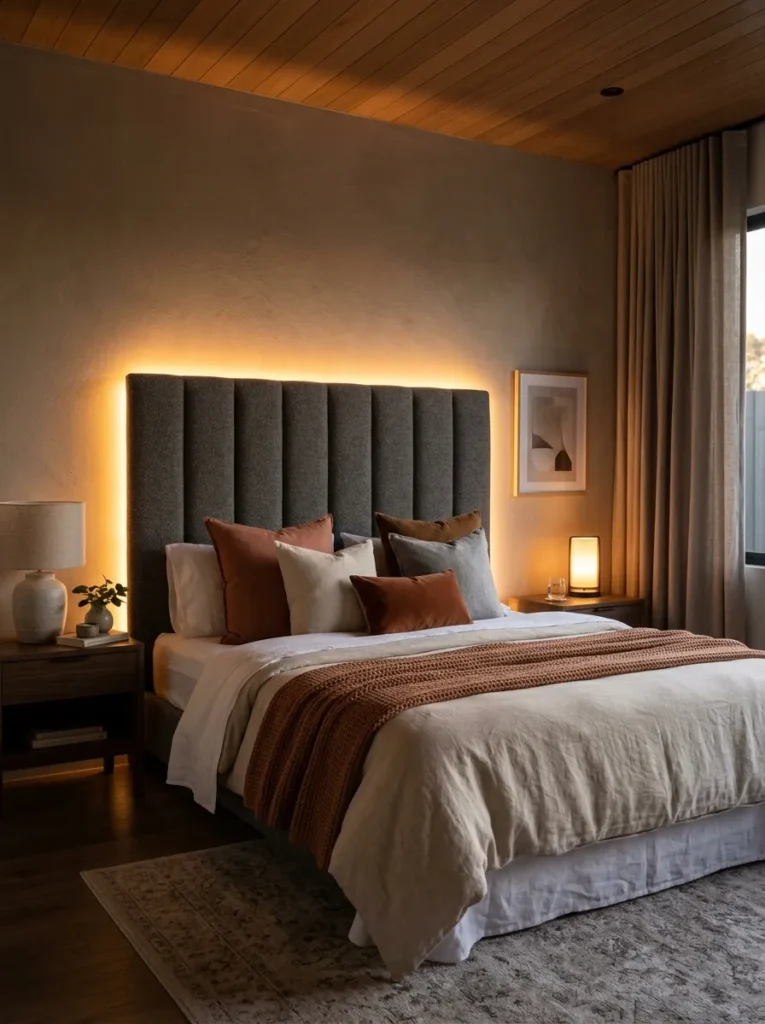
Vibe: The headboard is floating — warm LED backlighting behind the headboard creates a warm amber halo on the wall above the bed that makes the headboard appear to float slightly from the wall surface, creating the specific architectural warm-halo effect of luxury hotel headboard design.
Why it works: The backlit headboard halo is among the most recognizable signature lighting elements of luxury hotel design — the warm amber glow around and behind the headboard panel creates the impression of the bed existing within a warm, intimate light zone that is distinct from the rest of the room. This effect works through the optical illusion of the halo — the warm light on the wall behind the headboard creates a bright zone that makes the headboard appear darker by contrast, giving it a floating, three-dimensional quality rather than the flat against-the-wall appearance of an unlit headboard. The warm ambient light contributed by the backlit halo also fills the room’s primary focal zone (above the bed) with gentle warm illumination from the wall surface itself rather than from any visible fixture.
How to get it: Install warm white LED strip (2700K or 2200K) along the back edge of the headboard — the strip should be attached to the headboard’s back surface, positioned so the light radiates outward toward the wall rather than being visible from the front. The LED strip should be at the headboard’s upper edge and the two vertical side edges, creating a complete U-shaped halo rather than only a top-edge line. Route the power cable down the back of the headboard and behind the bed to a switched outlet or a smart plug for independent control. Total material cost: $20–$50 in warm LED strip and smart plug.
Shop The Look
- LED strip warm 2700K headboard install
- Smart plug LED strip control bedroom
- Warm LED strip adhesive headboard
- LED strip power supply bedroom
- LED strip controller dimmer warm
12. Warm Desk or Reading Lamp for Bedroom Work Zone
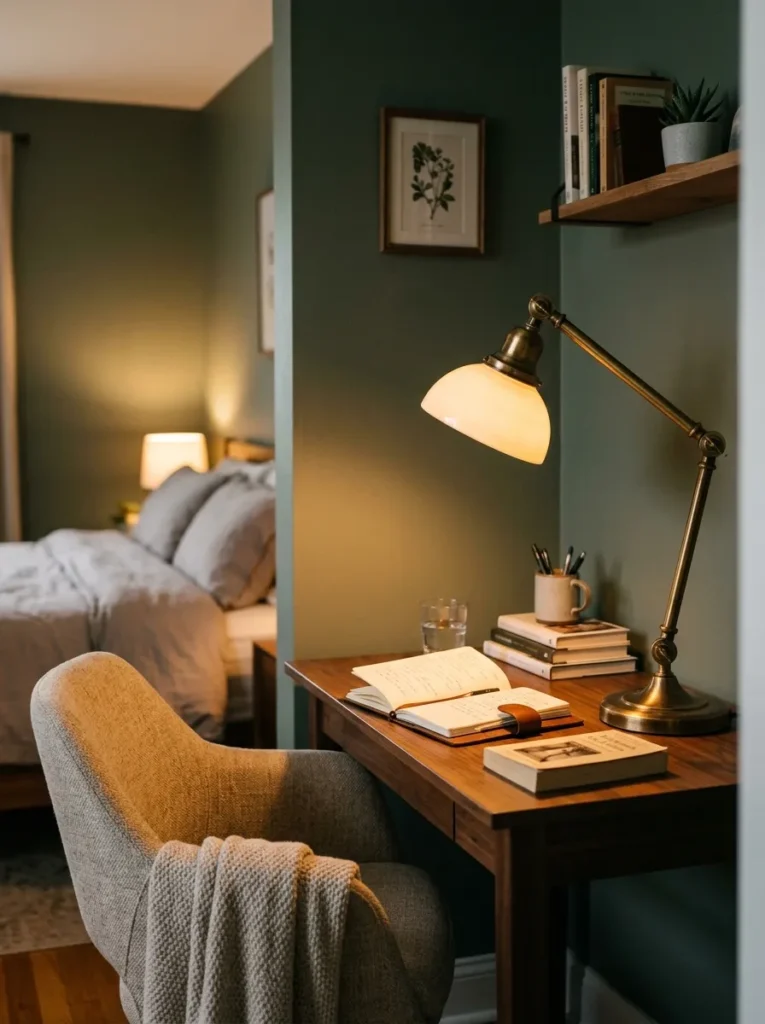
Vibe: The lamp is focused — a warm adjustable desk or reading lamp creates a specifically lit work or reading zone within the bedroom without disrupting the room’s overall warm ambient atmosphere, providing the task light intensity needed for focused work while maintaining the warm color temperature that the bedroom’s sleep-supporting environment requires.
Why it works: The bedroom work or reading zone presents a specific lighting challenge — it requires sufficient illumination for focused tasks (reading text, writing, viewing a screen) while maintaining the warm color temperature that the bedroom’s sleep-supporting environment demands. A cool-white task lamp (the common desk lamp specification) provides adequate task illumination but introduces the blue-wavelength light that disrupts melatonin production when used in the evening hours. A warm-toned adjustable lamp at 2700K or lower provides sufficient task illumination for most reading and low-demand work tasks while maintaining the bedroom’s warm atmospheric quality. The adjustable arm is critical — it allows the lamp to be precisely positioned for each task and user, and to be directed away from the bed during sleep periods.
How to get it: Warm adjustable desk lamps in bedroom-appropriate materials (aged brass, warm ceramic, warm wood) are available from specialty lighting retailers and home decor stores at $40–$150 for quality models. The lamp must be on a dimmer (either an integrated touch dimmer or a compatible plug-in dimmer) to allow the task light to be reduced to ambient levels when the focused task is complete. Specify 2700K maximum color temperature and 400–600 lumen output for reading-appropriate light levels — higher lumen output (800–1200 lumens) appropriate for a home office is too bright for bedroom work zones where the room’s overall light level is deliberately kept low.
Shop The Look
- Adjustable desk lamp warm brass bedroom
- Reading lamp warm ceramic bedroom
- Task lamp warm 2700K bedroom work
- Adjustable arm lamp warm bedroom
- Brass desk lamp touch dimmer
13. Ceiling Pendant with Warm Diffusion Shade
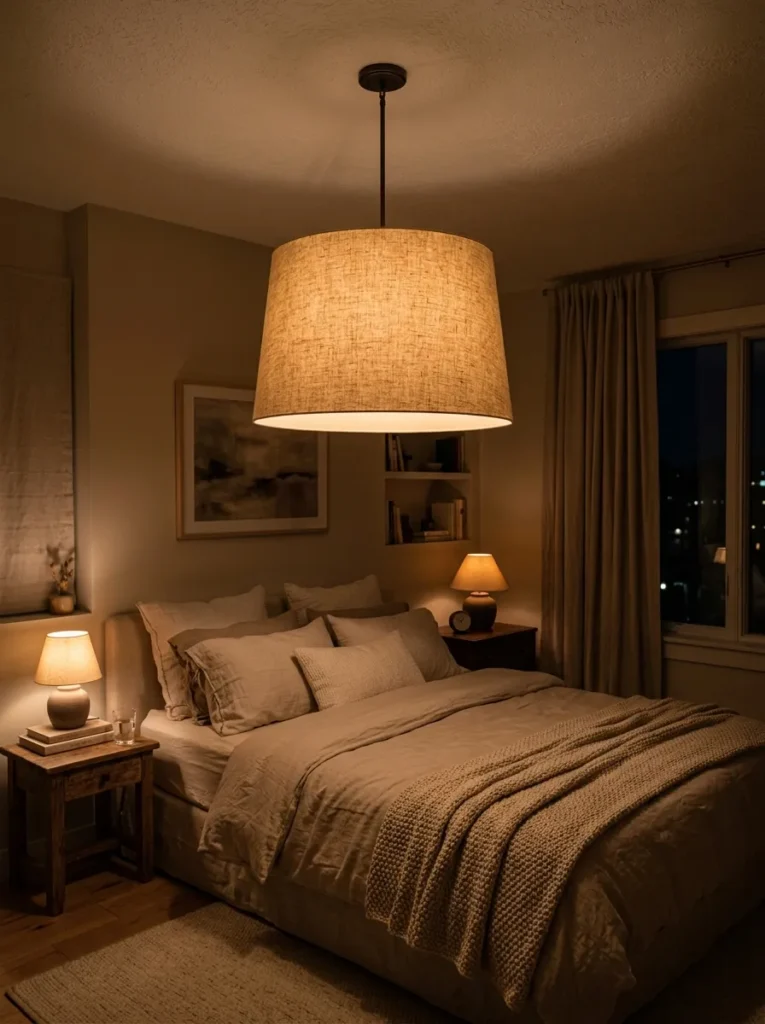
Vibe: The pendant is diffused — a bedroom ceiling pendant with a warm, light-diffusing shade in natural linen, rice paper, or alabaster creates a ceiling light source without a point-source quality — the entire shade surface appears to glow warmly from within rather than concentrating brightness at a single visible bulb.
Why it works: The light-diffusing shade is the ceiling pendant design principle that most directly prevents the harshness that overhead bedroom lighting can create — by distributing the light across the entire shade surface rather than allowing it to emanate from a visible point source, the diffusing shade creates the large-area soft glow that is far more flattering and far less physiologically stimulating than any exposed or partially visible bulb. Natural linen shades (which have a warm amber color transmission that adds to the warm bulb’s quality), Japanese paper shades (which transmit warm light through their fiber structure in the specific quality associated with Japanese paper lanterns), and alabaster shades (which transmit warm light through the natural stone’s crystalline structure with extraordinary evenness) all provide quality warm diffusion that synthetic alternatives cannot replicate.
How to get it: The shade material should be specified for its light transmission quality rather than only its visual appearance when unlit — hold the shade to a light source and assess the color and evenness of light transmission before purchasing. Natural linen transmits warm amber-cream light; Japanese washi transmits warm cream light with slight fiber variation; alabaster transmits an extremely even warm cream light through the stone’s natural crystalline structure. Install on a dimmer switch and operate at 30–40% for evening bedroom use — at this level, the diffusing shade creates a warm ambient glow rather than overhead task lighting.
Shop The Look
- Linen shade bedroom pendant diffused
- Japanese paper shade pendant warm
- Alabaster shade pendant bedroom
- Large diffusing shade pendant ceiling
- Pendant dimmer bedroom warm
14. Smart Lighting System with Bedroom Scene Programming
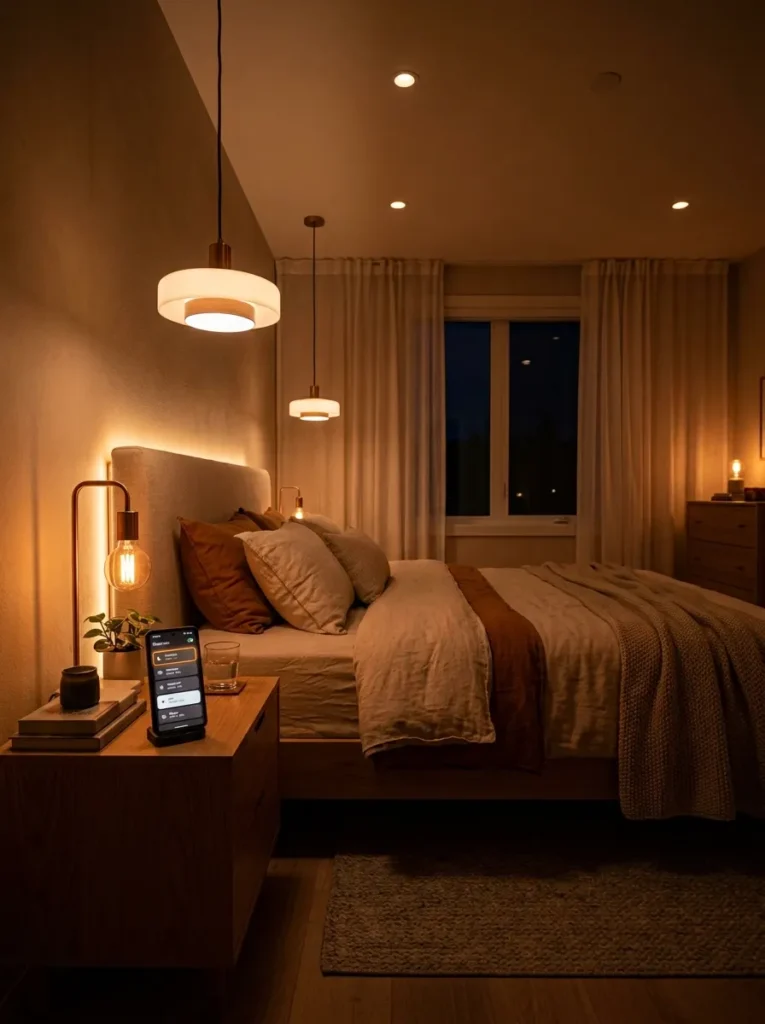
Vibe: The system is intelligent — a smart bedroom lighting system with pre-programmed scenes (Wake-Up, Day, Reading, Evening, Sleep) automates the transition from functional to atmospheric bedroom lighting throughout the day, making the correct warm, dimmed evening atmosphere the default state rather than something that requires manual adjustment of multiple switches.
Why it works: A smart bedroom lighting system solves the single most persistent challenge of multi-source layered bedroom lighting — the management complexity. A bedroom with a ceiling fixture, two bedside sconces, a floor lamp, and an LED strip under the bed has five independent light sources that ideally need to be adjusted simultaneously as the room’s use transitions from morning getting-dressed to evening relaxation to pre-sleep ambiance. Without a smart system, achieving the correct evening atmosphere requires adjusting five individual controls; with a smart system, a single “Evening” scene tap adjusts all five sources simultaneously to their correct warm, dimmed evening levels. This management simplicity means the luxurious warm dimmed atmosphere is actually used as the default evening setting rather than being reserved for occasional use when the effort of adjustment seems worthwhile.
How to get it: Lutron Caseta is the most widely compatible and most reliably functioning smart bedroom lighting system for residential use — its dimmers are compatible with more LED bulb types than any competitor and its ecosystem extends to all light types including ceiling fixtures, plug-in lamps, and smart plugs for non-hardwired lamps. The hub cost ($80–$100), plus smart dimmer switches ($40–$60 each), plus smart plugs for lamp circuits ($15–$25 each) creates a complete bedroom smart lighting system for $200–$400. Program scene presets for Wake-Up (full bright, 3000K equivalent for morning cortisol support), Day (medium bright, 2700K for daytime use), Reading (medium warm, 2700K bedside sconces primary), Evening (low warm, 2200K all sources), and Sleep (minimal ambient, 2200K only).
Shop The Look
- Lutron Caseta smart dimmer bedroom
- Smart hub bedroom lighting system
- Smart plug lamp control bedroom
- Bedroom scene programming guide
- Lutron smart bridge app bedroom
15. Layered Lighting System — The Complete Approach
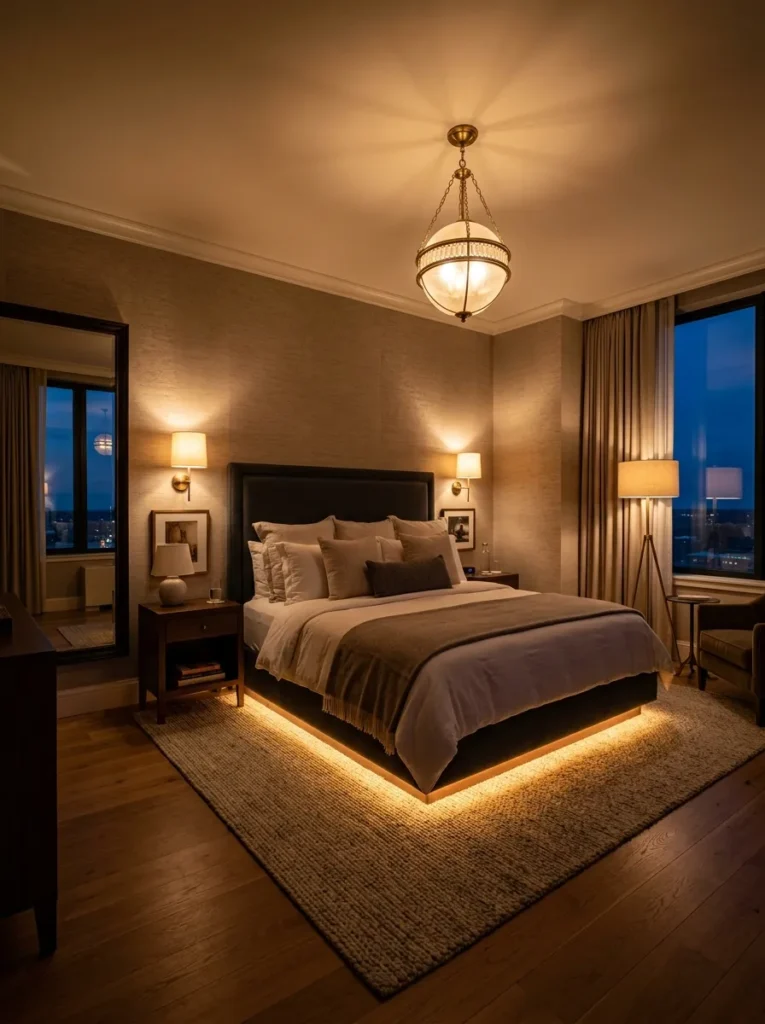
Vibe: The room is sumptuous — the complete layered bedroom lighting system with five warm sources at different heights and different intensities creates the atmosphere of a genuinely luxurious bedroom environment where the warmth comes from the accumulated quality of multiple warm sources rather than from any single fixture.
Why it works: The layered bedroom lighting system is the lighting design principle that underlies every genuinely luxurious bedroom environment — the understanding that no single light source, however beautiful its fixture or warm its bulb, can create the atmospheric quality of multiple warm sources at varied heights. A bedroom with one ceiling fixture, however warmly specified and carefully dimmed, still reads as single-source illumination — the light comes from one direction (above) and creates one quality of shadow (uniform downward). A bedroom with five warm sources at three heights (ceiling, mid-wall sconces, and floor level) creates light that appears to come from within the room itself rather than from any single external source — the warm amber glow fills the room from multiple directions simultaneously, creating the specific quality of warmth and dimensionality that luxury environments achieve and that single-source illumination cannot approach regardless of the fixture’s quality or the bulb’s color temperature.
How to get it: Build the complete layered system in sequence: begin with the bedside sources (the highest impact per investment, either table lamps or wall sconces), add the dimmer control on the ceiling fixture, add the floor lamp for corner fill, add the under-bed LED strip for the floating floor effect, and finally integrate all sources into a smart system for automated scene control. The total investment for a complete layered bedroom lighting system using quality but not luxury-tier fixtures: $200–$600 in fixtures and smart controls across all five source types. The total investment using premium fixtures: $500–$1,500. Both tiers produce the luxurious layered atmosphere when all sources are at the correct warm color temperature and the correct dimmed levels simultaneously.
Shop The Look
- Complete bedroom lighting kit layered
- Smart bedroom lighting five source
- Layered bedroom lighting guide
- Warm light source bedroom set
- Bedroom lighting design complete
How to Implement Bedroom Luxury Lighting
The correct implementation sequence for a bedroom lighting upgrade is: color temperature first, dimmer control second, layering third, and fixture aesthetics fourth. This sequence prioritizes the factors that most directly affect the bedroom’s experienced quality (the warmth of the light, the ability to dim it, and the number of sources contributing to its atmosphere) before the factors that affect its visual quality when the lights are off (the fixture’s appearance as a room accessory). A bedroom with warm bulbs, dimmer switches, and three sources of varied height in modest but appropriate fixtures reads as more genuinely luxurious than a bedroom with a beautiful designer chandelier at full bright cool-white illumination.
The most common bedroom lighting mistake is spending the majority of the lighting budget on a single beautiful fixture while neglecting the bulb color temperature, the dimmer switch, and the layering that determine the atmosphere of the room in actual use. A $500 designer chandelier with 4000K cool-white bulbs on a non-dimming switch produces a worse bedroom lighting atmosphere than a $50 basic pendant with 2200K warm filament bulbs on a $20 dimmer switch. The fixture’s appearance is the smallest contributor to the bedroom’s experienced lighting quality — the color temperature and the dimming capability are the largest contributors, and they are the least expensive elements to upgrade.
Three bedroom lighting upgrades under $40 that produce immediate, dramatic improvement in the room’s atmospheric quality: replacing all bedroom bulbs with warm 2200K filament LED equivalents ($15–$25) — the single most impactful improvement available at any price; installing a compatible dimmer switch on the ceiling fixture circuit ($15–$25) — the second most impactful improvement; and adding a single warm floor lamp in the bedroom’s darkest corner ($0 if an existing lamp is relocated, or $20–$60 for a simple floor lamp from discount retailers) — the third most impactful improvement. These three upgrades together implement the most essential elements of the layered warm bedroom lighting system at a total cost of $30–$110.
A complete luxury bedroom lighting system — warm bulbs throughout, dimmer switches on all circuits, bedside sconces, floor lamp, under-bed LED, and smart scene programming — represents a total investment of $200–$600 that produces a permanently more luxurious bedroom atmosphere every evening for the lifetime of the installation. No single bedroom purchase at an equivalent price — no furniture piece, no bedding set, no area rug — produces a comparable return in daily experienced quality, because the lighting system determines the atmospheric quality under which every other investment in the bedroom is experienced.
Frequently Asked Questions About Bedroom Luxury Lighting
What is the most important lighting change I can make to my bedroom?
Replacing every existing bedroom light bulb with a warm 2200K or 2700K LED equivalent is the single most impactful bedroom lighting change available because it affects every existing fixture simultaneously at the lowest cost and with the most immediate result. The color temperature change from a standard 3000K or 4000K bulb to a 2200K equivalent transforms the room’s entire atmospheric register — the warm amber quality of the light changes how every material in the room appears (warmer, richer, more flattering) and changes how the room feels physiologically (more relaxing, more supportive of the transition to sleep). At a total cost of $15–$30 for most bedrooms, this is also the highest-return lighting investment available at any price point.
How do I create a luxurious bedroom lighting atmosphere without rewiring?
The complete luxurious bedroom lighting atmosphere can be achieved without any electrical rewiring through three specific approaches: plug-in wall sconces (which mount to the wall with a cord running down to a nearby outlet, available in quality brushed brass versions at $60–$150 each), plug-in dimmer switches (which insert between the wall outlet and the lamp cord, providing dimming control for existing table lamps and floor lamps without any switch replacement), and smart plugs (which connect any lamp to a smart home system for scene programming and scheduling without any hardwired installation). The under-bed LED strip connects to a standard outlet behind or beneath the bed. Together, these no-rewiring approaches implement the complete layered warm dimming system in most bedrooms.
What color temperature should every bedroom light be?
Every bedroom light source — ceiling fixtures, bedside lamps, wall sconces, floor lamps, and LED accent strips — should be specified at 2700K or lower. The ideal for maximum sleep support and maximum warmth is 2200K, which is the color temperature closest to genuine candlelight and contains the minimum blue wavelength of any broadly available LED light source. The upper limit is 2700K — any fixture above 2700K in a bedroom produces measurable blue-wavelength light that can affect melatonin production with evening exposure. Warm white (2700K) is the standard safe specification; extra warm white (2200K) is the preferred luxury specification.
How many light sources does a bedroom need for a genuinely luxurious atmosphere?
The minimum for a genuinely luxurious layered bedroom atmosphere is three sources at a minimum of two different heights: one overhead source (ceiling fixture or chandelier, dimmed to 20–40% in the evening), two bedside sources (table lamps or wall sconces), and one additional ambient source (floor lamp, under-bed LED, or window-sill accent lighting). This three-category system (overhead, bedside, and ambient accent) creates the minimum layering for the multi-directional warm light atmosphere that luxury bedroom environments achieve. The complete five-source system (overhead, bilateral bedside, floor lamp corner, under-bed halo) creates the most complete and most genuinely luxurious layered atmosphere available in a residential bedroom.
Should bedroom lighting be on a timer or smart schedule?
A smart lighting schedule in the bedroom provides measurable benefits for both sleep quality and convenience. The ideal bedroom smart lighting schedule has four programmed scenes: a Wake-Up scene (full bright or medium bright, scheduled 30 minutes before the target wake time to support the natural cortisol awakening response), a Day scene (medium bright, 2700K for daytime bedroom use), an Evening scene (all sources dimmed to 20–40%, 2200K, activating automatically at 8–9pm to support melatonin production), and a Sleep scene (minimal to zero light, either turning all sources off or leaving only a very low night light active). The Evening scene automatic activation is the most valuable smart schedule feature because it ensures the bedroom is always in the correct warm dimmed state without requiring manual adjustment — the room is automatically prepared for rest before the occupant has decided to go to bed.
Ready to Transform Your Bedroom’s Lighting?
These 15 bedroom lighting ideas cover the full spectrum of what genuinely luxurious bedroom illumination can achieve — from the immediate transformation of warm filament bulbs in every fixture and the management intelligence of a complete smart scene system, to the architectural elegance of bedside wall sconces and the romantic intimacy of genuine beeswax candlelight, from the hotel-quality floating effect of under-bed LED strips and the warm ambient contribution of a corner floor lamp, to the physiological precision of correctly positioned bedside lamps and the atmospheric quality of a statement chandelier used at 25% on a dimmer. You do not need all 15 to create a bedroom of genuine luxurious warmth — you need the warm color temperature in every bulb, the dimmer control on every circuit, and at least three sources at different heights providing light simultaneously in the evening. Start tonight with the bulbs: replace every bedroom bulb with the warmest 2200K or 2700K equivalent available, dim them to 30%, and sit in the room that results. The bedroom you see will tell you exactly what the next lighting investment should be. Pin the ideas that named the specific quality your bedroom’s lighting is currently missing — those are the ones worth implementing first.