14 Corner Shelf Ideas That Maximize Space
Corner shelf ideas that maximize space solve the specific architectural problem of the 90-degree wall junction — a zone that standard rectangular furniture cannot occupy without leaving an awkward gap at the corner point, that is consistently underused despite being surrounded by two full wall surfaces, and that, when addressed with the right shelving approach, provides some of the most visually interesting and spatially efficient storage available in any room. This article gives you exactly 14 ideas spanning floating corner shelf systems, freestanding corner units, built-in corner solutions, and the specific material, proportion, and installation decisions that distinguish a corner shelf installation that genuinely maximizes space from one that merely occupies the corner.
A corner shelf done well is not a space-saving compromise — it is the room’s most architecturally considered storage decision, the installation that uses the full three-dimensional geometry of the building rather than treating the room as a series of flat walls with storage bolted to them one at a time. Here are 14 ideas worth installing.
Why Corner Shelf Ideas Maximize Space in Every Room
The architectural geometry of a corner creates a specific spatial opportunity that conventional shelf systems cannot exploit: the 90-degree angle between two walls provides a structural triangle of wall support at the corner junction that makes corner shelving among the most structurally stable of all wall-mounted shelf configurations, while the angular position creates the visual interest of an object or arrangement that is experienced from a dynamic rather than a flat-on angle. A corner shelf is simultaneously seen from the front (from the room’s primary viewing axis), from the side (from the adjacent viewing axis), and from the diagonal (from the room’s corner-to-corner viewing axis), giving it three distinct visual compositions from one installation.
The space maximization case for corner shelves specifically addresses the most consistently wasted spatial zone in domestic rooms: the corner floor area (typically a triangular zone of 20–40cm on each wall from the corner point) and the corner wall area (the two wall surfaces adjacent to the corner that are too close to the corner for standard rectangular furniture but too wide to leave empty). A correctly specified corner shelf uses this zone completely — its triangular or curved shelf depth occupies the corner’s specific geometry rather than the rectangular geometry of standard shelving — while making the corner visually active rather than dead.
Style at a Glance
| Element | Space Function | Design Edge |
|---|---|---|
| Philosophy | The corner is the room’s most underused structural opportunity | Every corner shelf should be beautiful from three viewing angles |
| Materials | Timber, glass, metal, bamboo, MDF | Warm natural, painted, industrial, or botanical |
| Key Decision | Bracket type, shelf depth, stacking height, and corner material |
14 Corner Shelf Ideas That Maximize Space
1. Floating Triangle Corner Shelf — The Simple Single-Level Solution
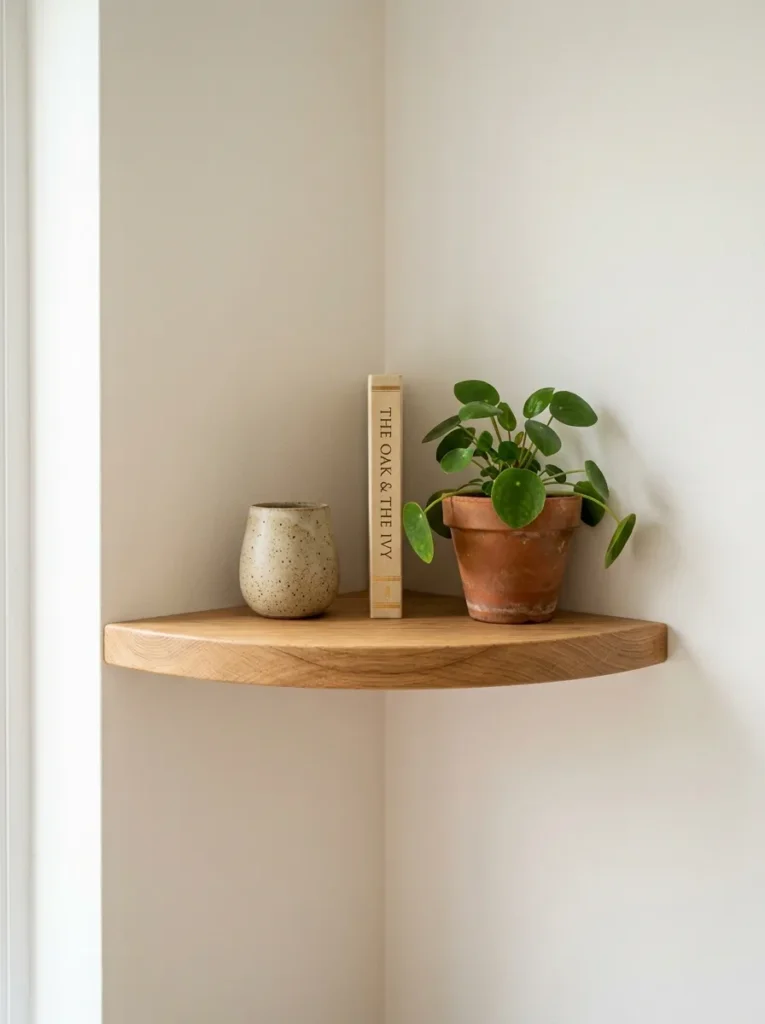
Vibe: The floating triangle shelf feels like the corner finally received a piece of furniture designed specifically for its geometry — the triangular form fitting the corner exactly while the curved front edge softens the angular logic into something genuinely beautiful.
Why it works: A single floating triangular shelf with a curved front edge applies the corner geometry resolution principle — the fundamental challenge of corner shelving is that the 90-degree wall junction creates a geometry that standard rectangular shelves cannot occupy cleanly: a rectangular shelf in a corner either projects awkwardly into the room or leaves a gap at the corner point. A triangular shelf (one straight side against each wall, hypotenuse facing the room) fills the corner geometry precisely, occupying no more depth from each wall face than its specified dimension while fitting the corner junction perfectly. The curved hypotenuse converts the purely geometric triangular form into a softened architectural element that reads as designed rather than geometrically derived.
Bracket specification: Concealed steel brackets for triangular corner shelves require fixing into both adjacent walls simultaneously — each bracket arm extends along one wall face and the combined load is borne by both. Fix each bracket arm to the wall using minimum two 60mm wood screws into studs or masonry anchors. The shelf’s triangular base should rest on both bracket arms simultaneously for load distribution.
Budget: Solid oak triangular shelf 30cm: $40–90. Concealed brackets: $15–30. Total: $55–120.
Quick Win: A simple MDF triangular shelf painted in the wall color (creating a floating white or neutral shelf that appears as a minimal architectural element rather than a wooden shelf) costs $10–20 in materials and provides the corner’s spatial function at essentially zero visual intrusiveness.
Shop The Look
| Product |
|---|
| Solid oak triangular corner shelf |
| Concealed bracket corner set |
| Terracotta pot trailing plant |
| Corner shelf 30cm natural timber |
| Curved edge router template |
Also view: 17 Chic IKEA KALLAX Bedroom Ideas for Storage
2. Stacked Triangle Shelves — The Corner Tower Display
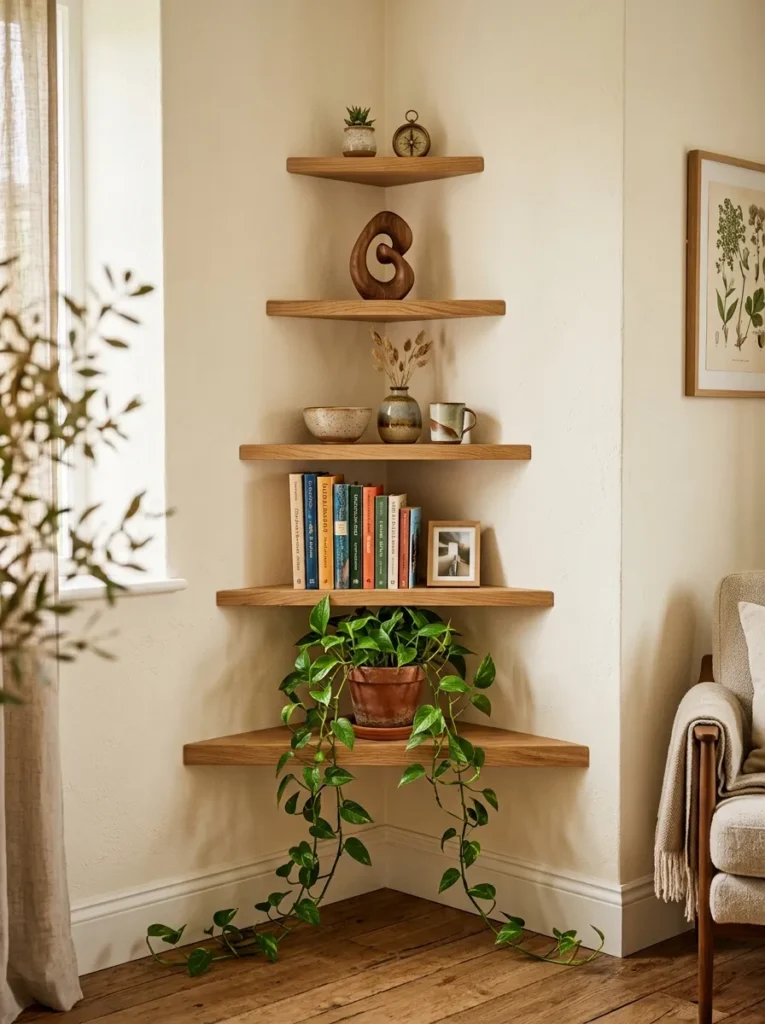
Vibe: The stacked triangle corner tower feels like the corner grew a complete vertical garden and library — the five graduated shelves from small to large creating a dynamic composition that activates the corner’s full height while the graduated scale creates visual rhythm.
Why it works: A stacked series of graduated triangular corner shelves applies the vertical corner activation principle — a single triangle shelf uses the corner at one height; a stacked series of five graduated triangle shelves activates the corner’s full vertical dimension from floor level to ceiling, creating the corner’s equivalent of a floor-to-ceiling bookcase in a format that fills the corner geometry rather than encroaching on the room’s floor plan. The graduation from smallest at the top to largest at the bottom follows the structural logic of weight (heaviest objects at the lowest, most structurally supported positions) and the visual logic of room proportion (smaller objects at visual periphery, larger ones at the center of attention).
Installation sequence: Install the shelves from bottom to top to ensure the lower, larger shelves are positioned correctly before the upper, smaller shelves are added. Use a plumb line or spirit level to ensure all shelves are consistently aligned on the corner’s central axis.
Budget: Five oak triangle shelves in graduated sizes: $120–250. Brackets: $40–80. Total: $160–330.
Shop The Look
| Product |
|---|
| Graduated corner triangle shelf set |
| Natural oak corner shelf five pack |
| Concealed bracket set five pairs |
| Trailing plant large bottom shelf |
| Book set fourth shelf display |
Also view: 15 Cozy Shelf Styling Ideas for Your Living Room
3. Corner Shelf with Integrated Botanical Display — The Living Corner
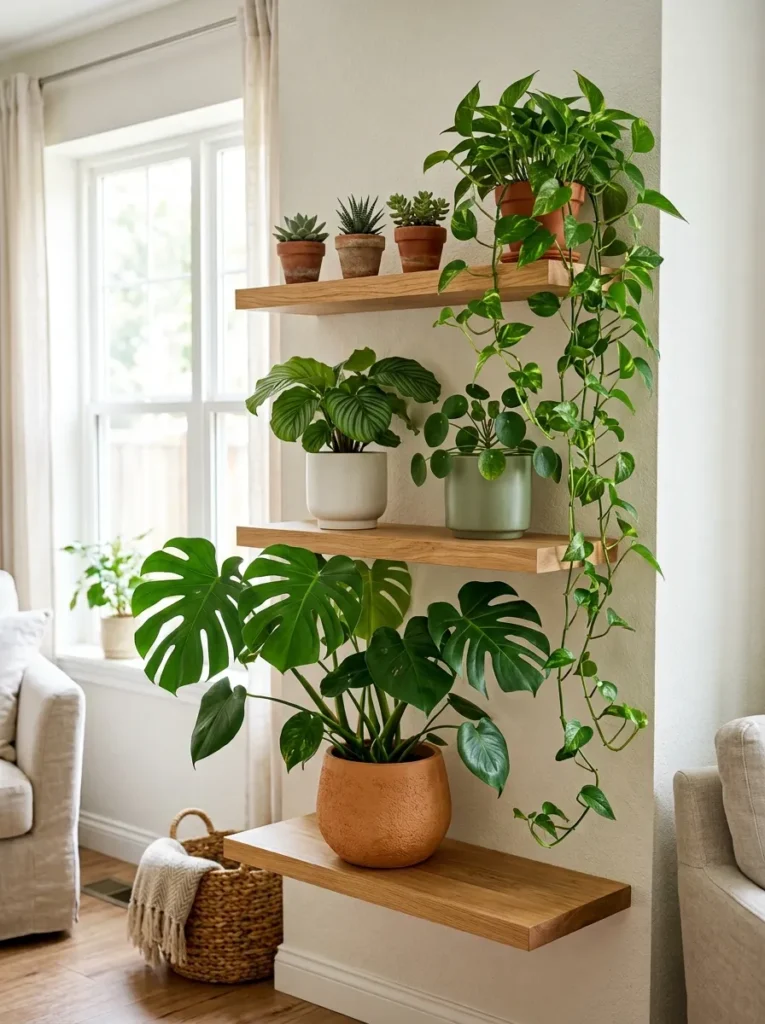
Vibe: The botanical corner installation feels like a garden that moved inside and chose the corner as its most interesting architectural position — the varied plant heights and the trailing pothos between shelves creating a living composition of genuine natural beauty.
Why it works: Corner shelves styled exclusively as a botanical display applies the dedicated purpose corner installation principle — rather than using the corner shelves as a general storage and display surface where plants compete with books, ceramics, and miscellaneous objects for visual attention, the dedicated botanical corner installation uses every shelf position exclusively for living plant material in coordinating vessels. This single-purpose approach creates a display with the coherence and visual impact of an intentional installation — the corner reads as a designed botanical feature rather than a shelf system with plants on it. The trailing pothos between shelves (whose cascading vines connect the lower and upper shelf levels visually) is the specific element that converts three separate shelf installations into one connected botanical composition.
Plant species selection for corner positions: Most corners receive lower light than adjacent window positions. Select species that tolerate lower light: pothos (Epipremnum aureum — the most light-tolerant trailing species), monstera (Monstera deliciosa — tolerates moderate indirect light), ZZ plant (Zamioculcas zamiifolia — tolerates very low light), and snake plant (Sansevieria — tolerates low light and infrequent watering).
Budget: Three oak corner shelves varied depths: $80–150. Brackets: $30–50. Plants and pots: $40–80. Total: $150–280.
Shop The Look
| Product |
|---|
| Varied depth corner shelf set |
| Large monstera bottom shelf |
| Terracotta pot set botanical |
| Trailing pothos display vine |
| Sage ceramic pot middle shelf |
4. Built-In Corner Shelving — The Architectural Alcove Treatment
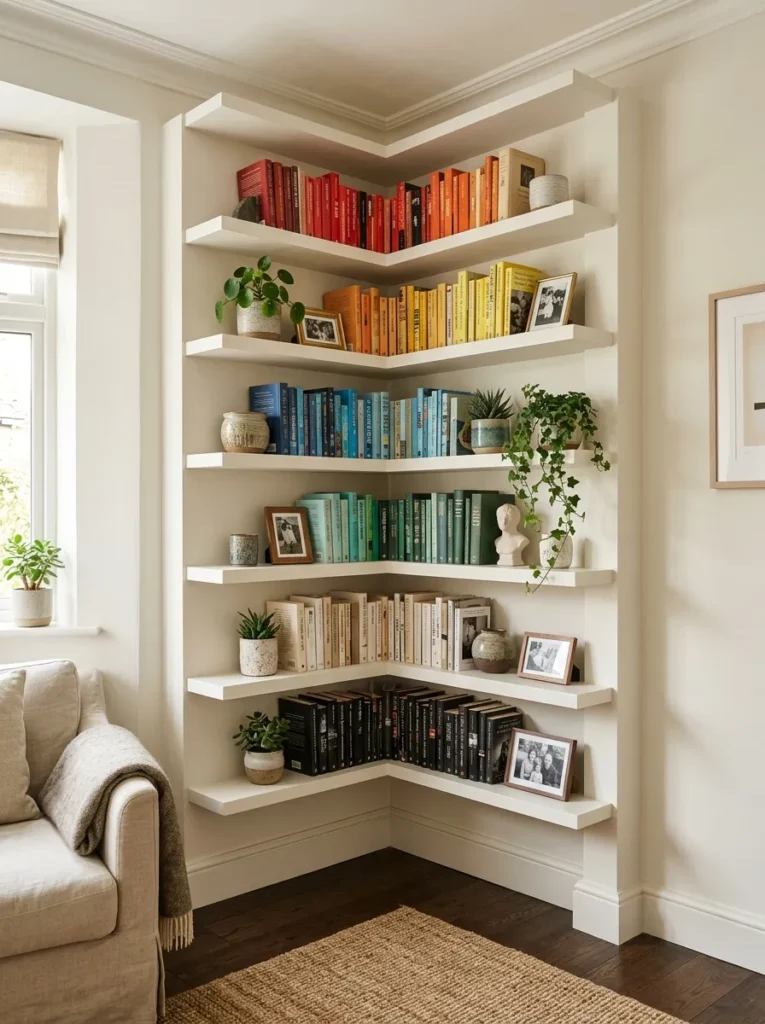
Vibe: The built-in corner shelving feels like the architect included it as part of the original design — the same-as-wall paint and the floor-to-ceiling extent making the custom shelving read as a designed architectural element rather than added furniture.
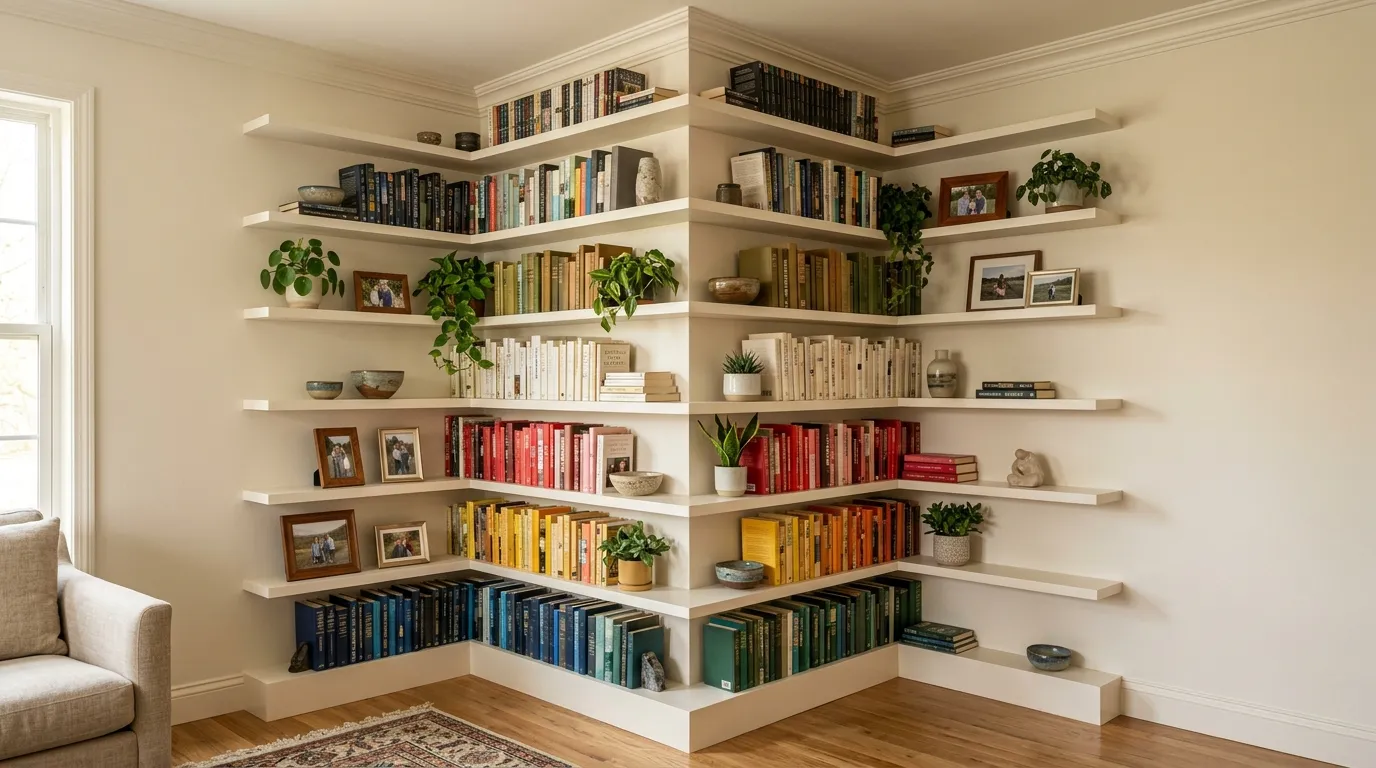
Why it works: Custom built-in corner shelving painted the same color as the surrounding walls applies the architectural integration principle — as established throughout this series in the KALLAX and bathroom articles, the transformation from furniture to architecture is achieved primarily through the same-color-as-wall paint specification. A built-in corner shelf painted to match the walls disappears visually into the room’s architecture, with only the objects on the shelves providing the visual interest. The corner built-in specifically benefits from this approach because the 90-degree geometry of the shelving unit — with two side panels running along each wall face and shelves extending across the angle — creates a spatial depth that flat-wall shelving lacks, making even a painted-white installation three-dimensionally interesting from the room’s diagonal viewing axis.
Construction: The corner built-in can be constructed from standard 18mm MDF (the same material used for fitted bedroom furniture) using a carcass-and-shelf assembly: two vertical side panels (each running along one wall face), a horizontal top panel, and individual shelves spanning between the two side panels at the required vertical intervals. Fix the side panels to the wall using timber battens screwed into studs or masonry anchors.
Budget: MDF and materials for a floor-to-ceiling corner built-in: $150–350. Painting: $20–40. Total: $170–390.
Shop The Look
| Product |
|---|
| 18mm MDF panel corner built-in |
| Same-as-wall white paint trim |
| Book set color-organized display |
| Ceramic object corner display |
| Small plant corner built-in |
5. Industrial Corner Shelf — Steel and Reclaimed Timber
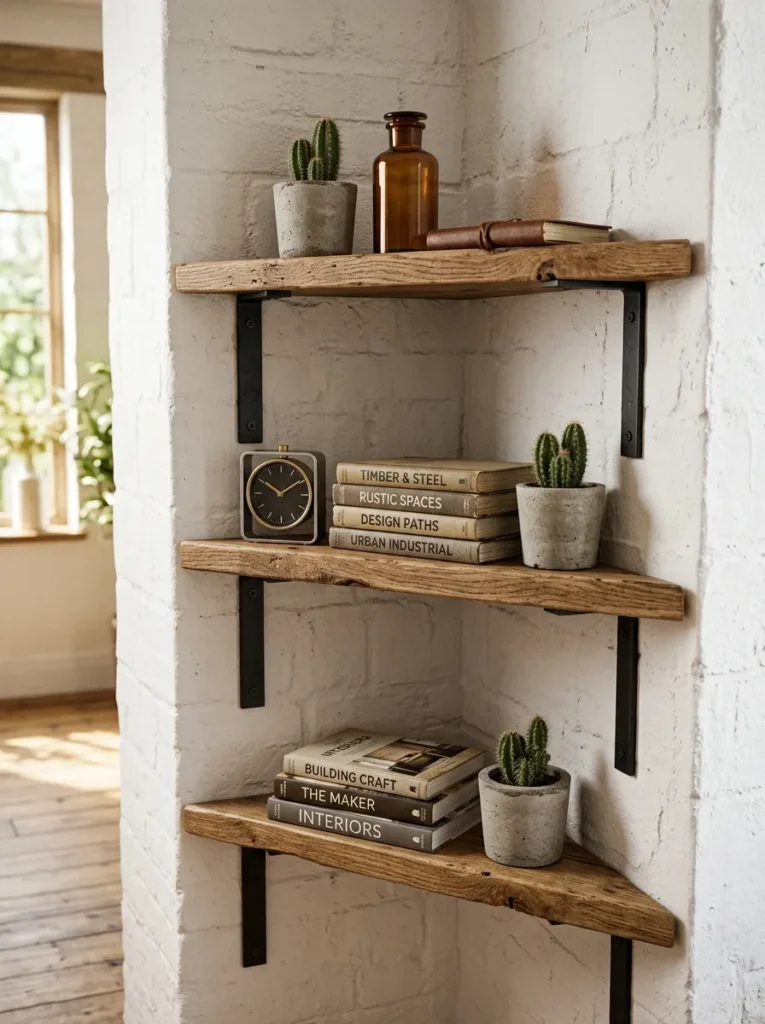
Vibe: The industrial corner shelf feels like a workshop storage system that became a decorative installation by becoming good at both functions simultaneously — the visible black steel brackets and the rough-sawn timber creating the specific warmth of honest materials used without concealment.
Why it works: Reclaimed timber corner shelves on visible industrial black powder-coat brackets applies the material honesty industrial aesthetic principle — the industrial interior design tradition’s specific contribution to shelf design is the visible bracket: where conventional design conceals the structural support (the bracket) behind or within the shelf, the industrial approach makes the bracket a designed element whose specific form (the L-angle, the bolt pattern, the matte black powder-coat finish) contributes to the shelf’s aesthetic character. The reclaimed timber’s natural character marks (knots, grain variation, weathering marks, historical nail holes) provide the warm counterpoint to the cool industrial steel, creating the specific warm-industrial pairing that has been the most consistently popular interior aesthetic combination for the past decade.
Bracket specification: Black powder-coat steel angle brackets for corner shelves should be specified with each arm length matching the shelf’s wall face dimension (25cm arm for a 25cm shelf depth) to provide adequate support across the full shelf depth. Use minimum two brackets per shelf (one on each wall face) for structural stability.
Budget: Three reclaimed timber corner shelves: $30–90 (reclaim or salvage source). Black brackets (six total): $25–60. Total: $55–150.
Shop The Look
| Product |
|---|
| Reclaimed timber corner shelf set |
| Black powder-coat L-bracket set |
| Concrete pot small cactus |
| Amber glass bottle display |
| Neutral spine book set |
6. Glass Corner Shelf — The Transparent Space-Saver
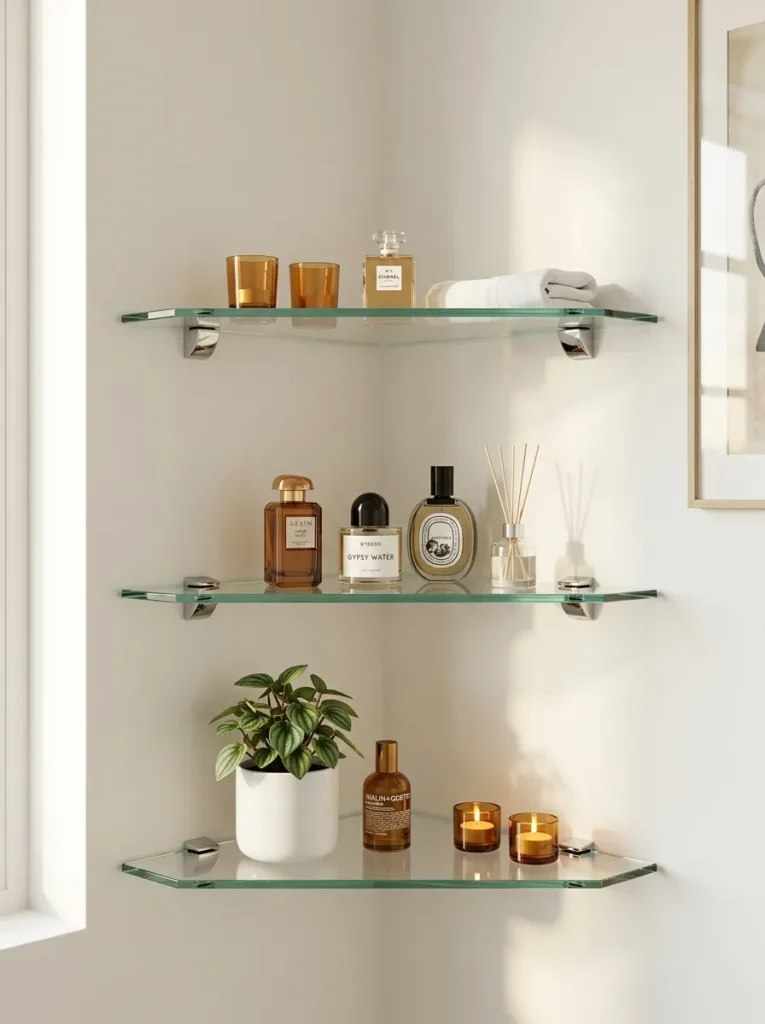
Vibe: The glass corner shelf feels like shelving that didn’t want to interrupt the room and found a way not to — the transparent glass appearing almost invisible while still providing the full structural function of solid shelving.
Why it works: Glass corner shelves on wall-fixed glass clamps applies the visual transparency maximization principle — glass shelving’s specific contribution to small spaces is its near-invisibility: from a viewing angle, a glass shelf and its contents appear to float in the space rather than projecting from the wall on a visible shelf body. In corners specifically, this transparency advantage is amplified — the glass shelf’s see-through quality allows both walls behind the shelf to remain visible rather than being obscured by a solid shelf body, preserving the visual depth of the corner while adding storage. The wall-fixed glass clamp mounting (which grips the glass shelf at its two wall-contact edges rather than using under-shelf brackets) maintains the shelf’s visual minimalism by eliminating visible support structure from the shelf’s room-facing edge.
Safety specification: Glass corner shelves must use toughened (tempered) safety glass at minimum 8mm thickness for shelves up to 40cm on each wall face. Toughened glass, if broken, fractures into small, relatively harmless fragments rather than the large, sharp shards of standard float glass. Each glass shelf must be individually measured and cut to the correct triangular dimensions — glass shelves are always custom-cut rather than purchased from stock.
Budget: Custom toughened glass corner shelf (per shelf): $40–90. Wall clamps: $15–30 per shelf. Total per shelf: $55–120.
Shop The Look
| Product |
|---|
| Toughened glass corner shelf custom |
| Glass shelf wall clamp chrome |
| Glass shelf wall clamp brass |
| Amber perfume bottle display |
| Small white ceramic plant pot |
7. Corner Shelf with Hidden Storage — The Box Shelf System
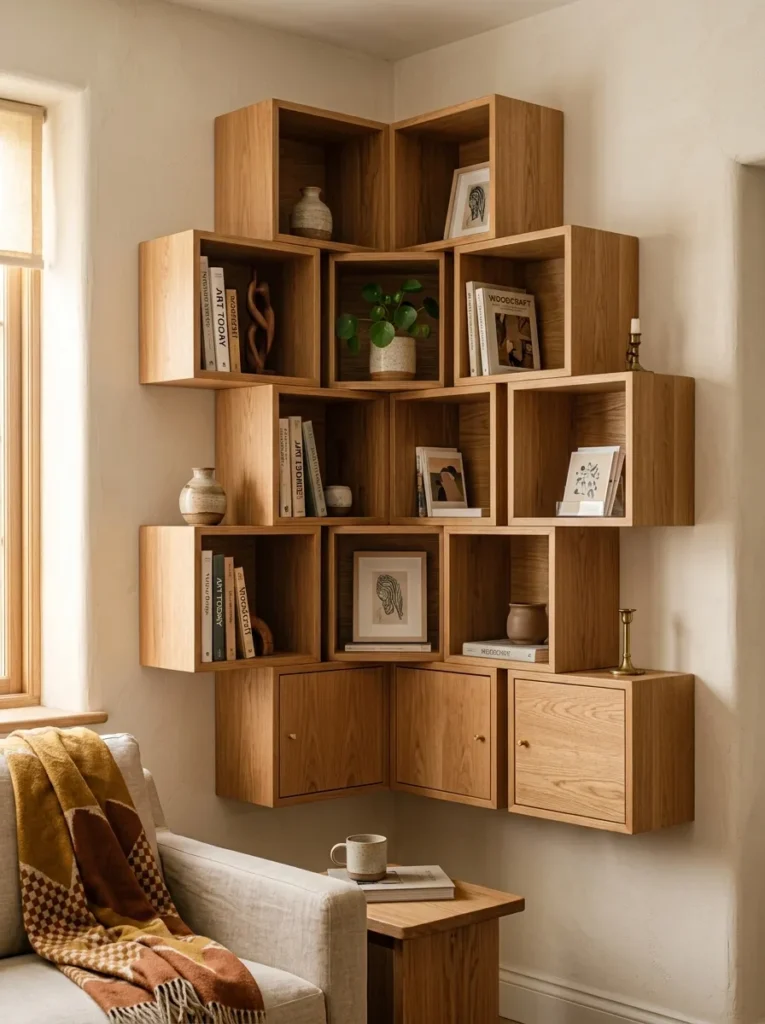
Vibe: The corner box shelf system feels like a modular wall composition that also stores things — the staggered arrangement of varied-orientation boxes creating a sculptural corner installation whose visual interest comes from the varied depths and directions rather than from the objects displayed within.
Why it works: Staggered box corner shelves in varied orientations applies the dimensional storage variety principle — conventional flat shelves provide storage on one plane (the horizontal surface); box shelves provide storage within a three-dimensional volume whose orientation can be varied to create different access types (horizontal access for display, upward access for contained display, hinged-door access for concealed storage). The staggered arrangement (adjacent boxes at different depths and heights, some horizontal and some vertical) creates the visual complexity of a designed installation rather than a linear storage system, while the box units’ enclosed structure (three sides and a back) makes the installation appear as a wall composition rather than as shelving applied to a wall.
Budget: Custom box shelf set (natural oak, six units): $80–200 from timber suppliers or online. Hinged door additions: $20–40. Total: $100–240.
Shop The Look
| Product |
|---|
| Oak box corner shelf set |
| Hinged door box shelf addition |
| Box shelf wall mount bracket |
| Object set box display |
| Staggered arrangement template |
8. Corner Ladder Shelf — The Freestanding Angled Solution
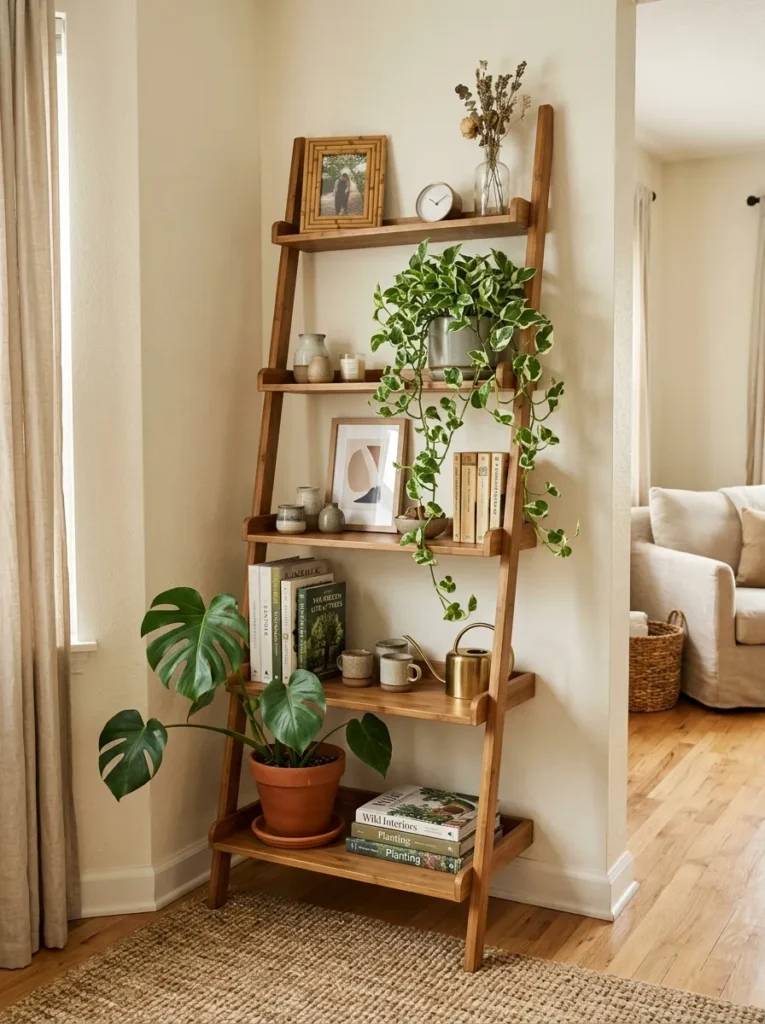
Vibe: The corner ladder shelf feels like freestanding furniture that found its natural position — the angled lean into the corner creating the specific quality of a piece of furniture that belongs at this exact architectural junction.
Why it works: A freestanding ladder shelf angled into a corner applies the no-installation corner storage principle — for renters, for positions where wall drilling is not feasible, or for households that want a reconfigurable solution, a freestanding ladder shelf provides corner storage at a quality level comparable to wall-fixed shelving without any permanent installation. The corner lean specifically provides structural stability that flat-wall ladder shelves (which require a wall to lean against) achieve through the floor-to-wall angle; the corner ladder has two wall faces to stabilize against, making it inherently more secure than the single-wall lean of a conventional ladder shelf.
Stability provision: Non-slip felt or rubber pads on the ladder’s base rails and wall-contact points prevent movement during use. For additional security (particularly in households with children), a single wall-fixing at the ladder’s top point on one wall (a single screw into a stud, from which the ladder’s top rail hangs) provides a permanent fixing at minimal installation commitment.
Budget: Natural bamboo or oak ladder corner shelf: $60–200.
Shop The Look
| Product |
|---|
| Corner ladder shelf bamboo natural |
| Oak corner ladder shelf alternative |
| Non-slip pad set base rails |
| Trailing plant top level display |
| Large plant bottom wide shelf |
9. Bathroom Corner Shelf — The Shower and Vanity Solution
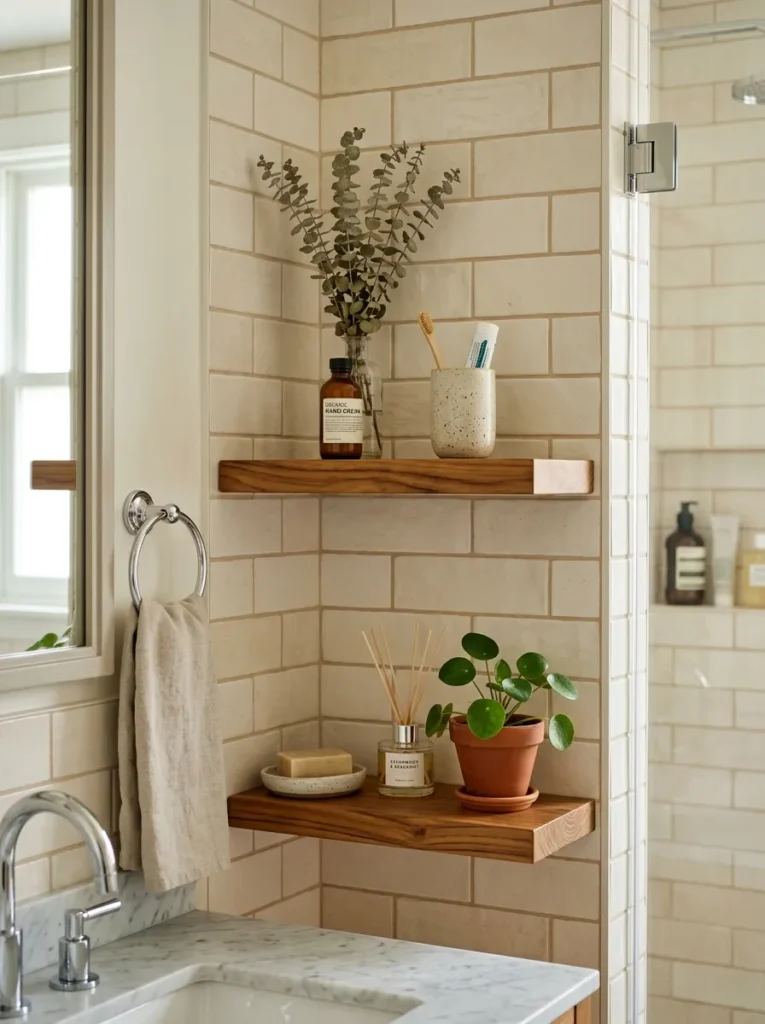
Vibe: The bathroom corner shelf feels like a spa organized its products and turned them into a display — the teak or stone material and the composed arrangement of ceramic, glass, and botanical objects creating a bathroom corner that reads as considered rather than functional.
Why it works: Bathroom corner shelves in teak or stone composite at considered heights applies the bathroom-specific material and height specification principle — bathroom corner shelves fail most commonly in two ways: inappropriate material (a timber shelf that is not sealed for humidity exposure, or a metal shelf that corrodes in the bathroom’s moisture environment) and inappropriate height (positioned at the same height as a standard living room shelf rather than at the heights relevant to bathroom use — toothbrush height, hand-washing height, mirror height). Teak (the timber with the highest natural oil content and the best moisture resistance of any commonly available species) or a stone composite (sealed against water penetration) provides the material durability required in the bathroom’s specific humidity conditions.
Teak sealing: Even naturally oily teak benefits from annual treatment with teak oil or hard wax oil in a bathroom environment where the humidity is consistently high — the oil treatment maintains the wood’s natural moisture resistance and prevents the surface from drying and cracking over time.
Budget: Two teak bathroom corner shelves: $60–150. Bracket and sealant: $20–30. Total: $80–180.
Shop The Look
| Product |
|---|
| Teak corner shelf bathroom pair |
| Stone composite corner shelf |
| Teak oil bathroom treatment |
| Ceramic soap dish warm |
| Dried eucalyptus bathroom display |
10. Kitchen Corner Shelf — Herb Garden and Spice Display
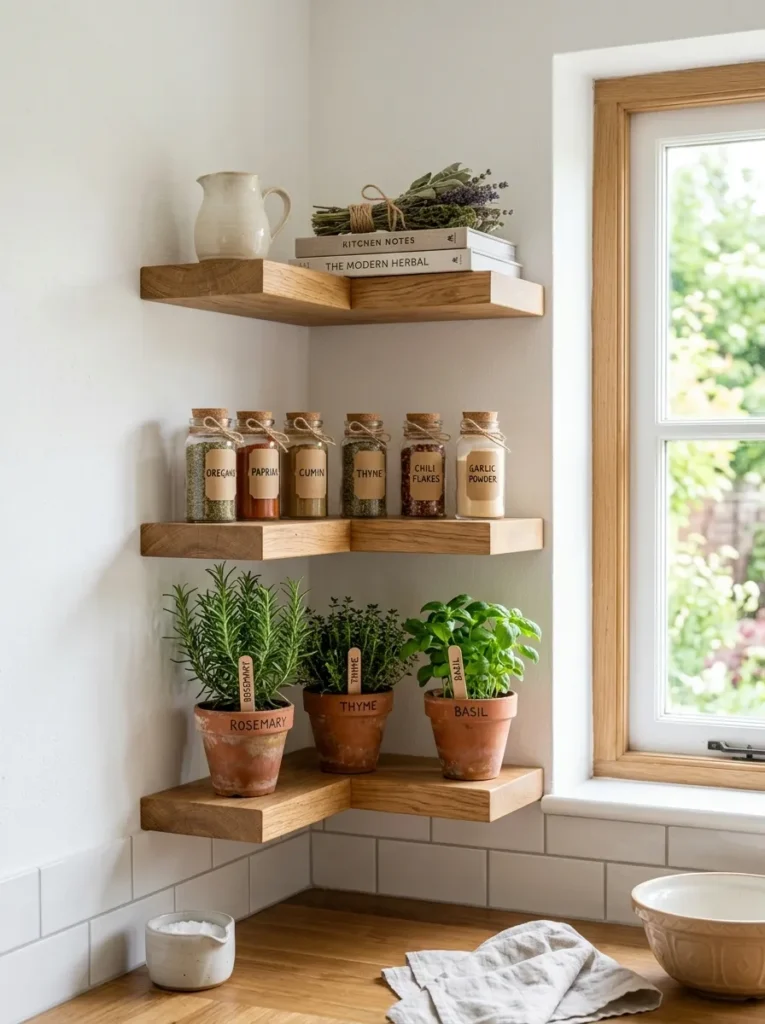
Vibe: The kitchen corner herb shelf feels like the kitchen extended its garden indoors and found the perfect corner for it — the growing herbs, the labeled spice jars, and the dried herb bundle creating a functional botanical corner that makes the kitchen smell and look like genuine food culture.
Why it works: Kitchen corner shelves positioned at the natural-light corner nearest the window applies the sun-following function principle — kitchen herb gardens require the maximum available natural light in the indoor environment, and the corner closest to the kitchen window receives light from two directions (the window itself and the reflected light from the adjacent wall), making it the warmest and brightest corner zone in most kitchen configurations. Three shelves at windowsill height in this corner create a functional herb-growing and spice-display installation that serves the kitchen’s daily cooking needs while reading as a designed botanical installation.
Herb selection for indoor growing: The most reliable indoor kitchen herbs for a corner shelf position are: rosemary (tolerates moderate indoor light, Mediterranean origin makes it resilient in dry indoor conditions), thyme (similarly tolerant, compact form fits individual terracotta pots), and basil (requires the brightest possible indoor light but rewards with the most immediate culinary usefulness). Mint in a contained pot rounds out the functional quartet — mint must always be contained (never planted in open ground or shared pots) as it spreads aggressively.
Budget: Three oak kitchen corner shelves: $60–120. Herbs and pots: $20–40. Spice jars and labels: $15–25. Total: $95–185.
Shop The Look
| Product |
|---|
| Oak corner shelf kitchen set three |
| Terracotta herb pot small set |
| Rosemary thyme basil herb set |
| Matching spice jar set glass |
| Kraft label set handwritten |
11. Corner Shelf as Display Altar — The Composed Still Life
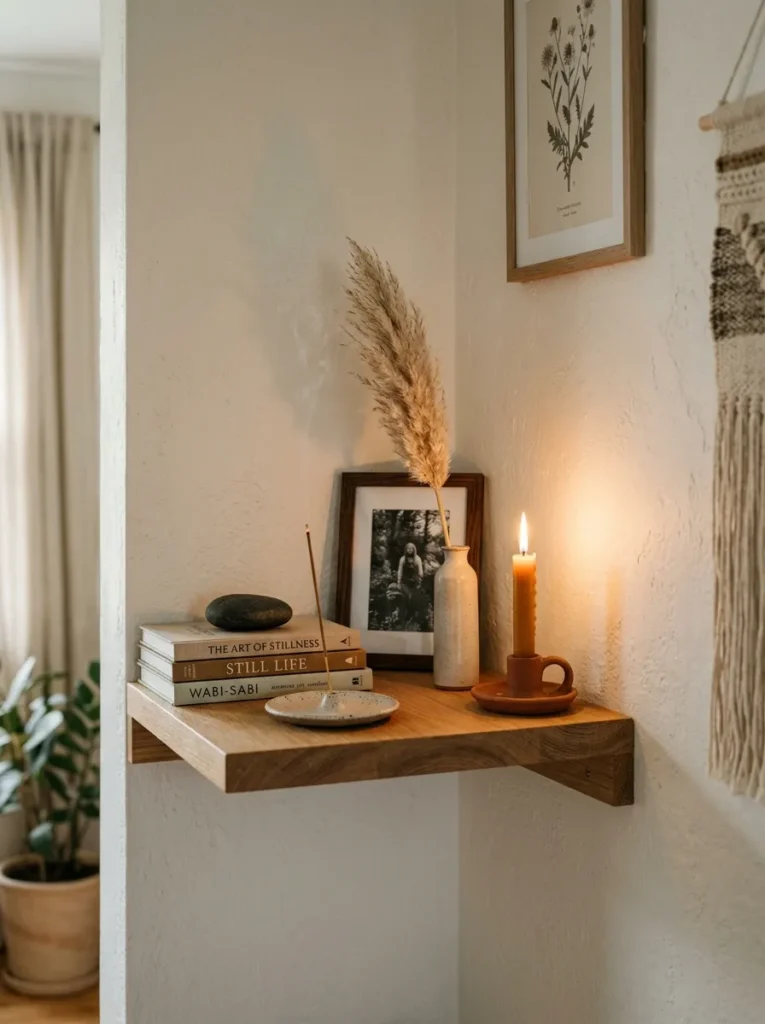
Vibe: The corner shelf display altar feels like a specific moment in time made physical — the six carefully chosen objects with generous space between them creating a composition that is simultaneously personal and beautiful, specific and universal.
Why it works: A single large corner shelf used exclusively as a composed personal altar applies the dedicated display purpose principle — the most visually powerful shelf installations are those with a single, clear purpose that the entire shelf serves. The personal altar concept (a composed arrangement of personally significant objects — photographs, natural materials, botanicals, candles, and objects of personal meaning) is the application that most clearly benefits from the corner shelf’s specific visual characteristics: the diagonal viewing axis creates a three-dimensional still-life composition in which the objects are seen from their most interesting angles, and the corner’s atmospheric enclosure (light from two wall faces, acoustic quiet from the tucked-away position) creates the contemplative quality that a personal display warrants.
The six-object formula: The composed personal altar follows the principle of the curated five-object bedside table described in the dreamy bedroom article — generous negative space between object groups, varied heights within the composition (the flat books as the base plane, the slim vase as the vertical accent, the small objects as mid-height detail), and one lighting element (the beeswax candle) that activates the composition at different times of day.
Budget: Single large corner shelf oak: $50–100. Candle, incense, botanical: $15–25. Total: $65–125.
Shop The Look
| Product |
|---|
| Large oak corner shelf 45cm single |
| Beeswax candle simple holder |
| Dried pampas stem bud vase |
| Ceramic incense holder thin |
| Small framed photograph leaning |
12. Wraparound Corner Shelf — Continuous Surface Across Both Walls
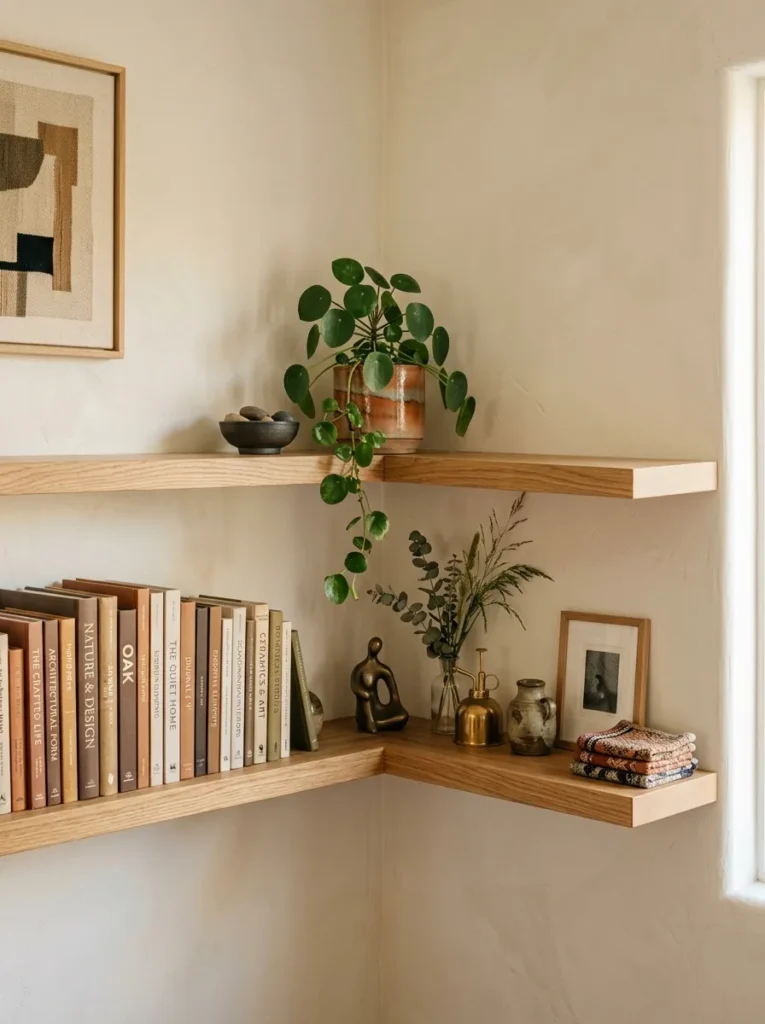
Vibe: The wraparound corner shelf feels like an architectural ledge that was planned when the room was designed — the continuous L-shaped surface reading as a permanent architectural element rather than a shelf added to a finished wall.
Why it works: A continuous L-shaped corner shelf wrapping across both wall faces applies the architectural continuity principle — a shelf that wraps continuously around a corner creates a visual reading of architectural permanence that two separate shelves on adjacent walls cannot achieve. The continuous surface (mitered at the internal corner to create a seamless join) reads as a single architectural element — a ledge or cornice at the room’s corner — rather than as two separate shelf installations that happen to be near each other. This architectural reading is amplified by the 3cm solid timber thickness (which provides the visual mass appropriate to an architectural element) and the consistent height (a single height for both arms rather than the varied heights of multiple shelves creates the even horizon line of an architectural ledge).
Mitered corner joint: The internal corner where the two shelf arms meet requires a precise 45-degree miter cut on both shelf ends, glued with wood adhesive and reinforced from below with a wooden spline or biscuit joint. A skilled timber merchant or joiner can cut the miter accurately; DIY mitering requires a compound miter saw and careful measurement.
Budget: Solid oak wraparound corner shelf (bespoke cut): $80–200. Concealed bracket set: $30–50. Total: $110–250.
Shop The Look
| Product |
|---|
| Solid oak shelf bespoke cut 3cm |
| Concealed L-bracket wraparound |
| Miter joint wood adhesive |
| Book set one arm display |
| Botanical and decorative other arm |
13. Corner Shelf as Desk or Work Surface — The Built-In Study Corner
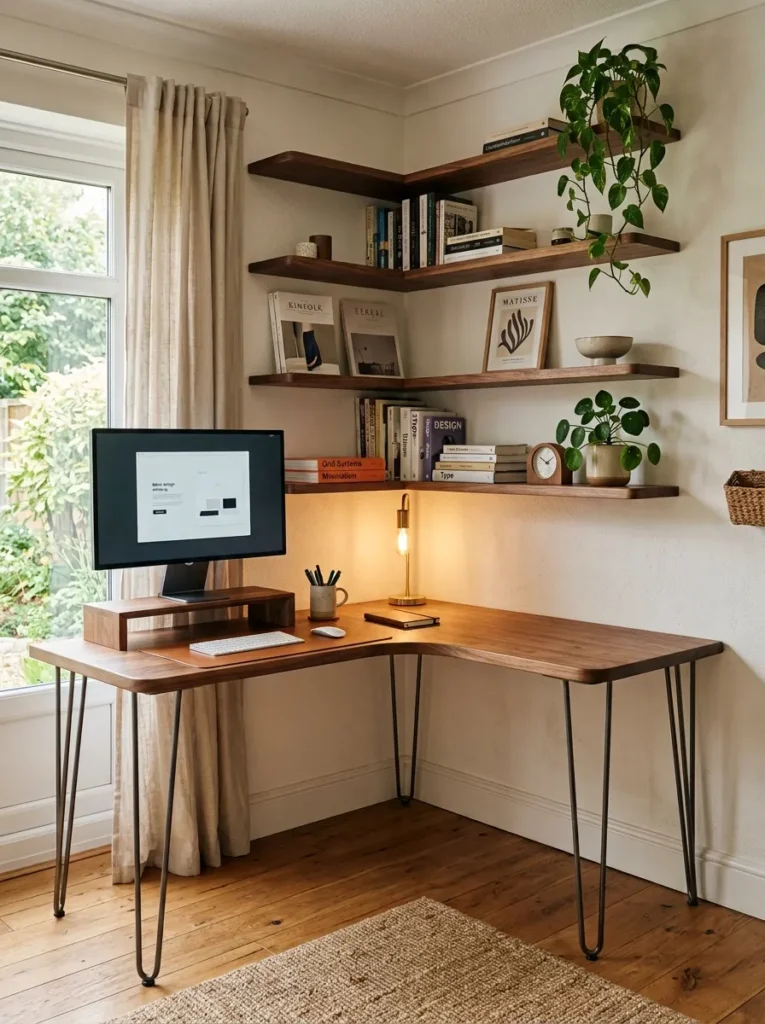
Vibe: The corner desk and shelf system feels like a complete home office that was designed for the corner rather than placed in it — the desk surface and the three shelves above sharing the same timber and the same corner geometry, creating a study zone of genuine architectural coherence.
Why it works: A corner desk surface with integrated above-desk corner shelving applies the corner workspace design principle — the corner position is specifically optimal for a home office desk because it provides the maximum desk surface area for the minimum floor footprint impact (two arms of 80cm each provide 160cm of total desk length in an L-configuration that extends away from the room’s center rather than into it) and the most acoustically and visually sheltered position in most rooms (the tucked-away corner provides the sense of focus and concentration that the room’s more exposed positions do not). The integrated shelving above the desk (in the same material and at the same depth as the desk surface) creates a complete study installation where the desk and the storage above it are part of a single designed object.
Budget: Custom corner desk (timber and legs): $150–400. Three shelves each arm: $80–150. Total: $230–550.
Shop The Look
| Product |
|---|
| Corner desk surface custom timber |
| Hairpin leg set desk support |
| Corner shelf three per arm set |
| Monitor stand desk integration |
| Plant desk display |
14. KALLAX Corner Configuration — The Modular Corner Solution
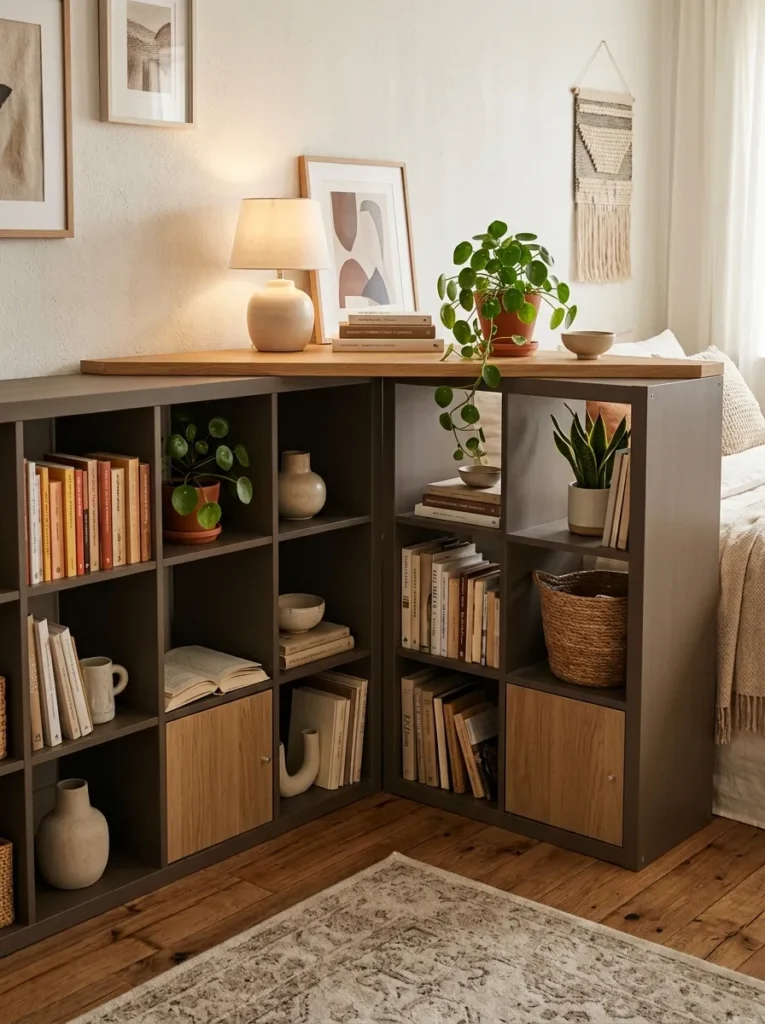
Vibe: The KALLAX corner configuration feels like the modular system finally addressed the corner geometry it always left awkward — the two L-configured units and the triangular oak connecting shelf creating a complete corner installation that reads as designed rather than arranged.
Why it works: Two KALLAX 2×4 units in an L-configuration with a custom triangular connecting shelf applies the modular system corner resolution principle — as described in the KALLAX bedroom storage articles, the KALLAX in L-configuration uses both corner walls simultaneously, providing storage capacity approximately 65% higher than a single-wall installation of comparable footprint. The specific addition in this corner shelf context is the triangular oak connecting shelf at the junction point — this single custom piece (a right-triangle timber shelf cut to fit the gap between the two unit ends at the corner) resolves the only element that the modular system cannot provide from stock components, completing the corner installation as a seamless continuous surface. The mushroom chalk paint on both units provides the design unity that makes the two-unit L-configuration read as a single designed corner installation rather than two separate KALLAX units placed near each other.
Budget: Two KALLAX 2×4 units: $160–220. Triangular oak corner shelf: $30–60. Chalk paint and inserts: $50–90. Total: $240–370.
Shop The Look
| Product |
|---|
| IKEA KALLAX 2×4 corner pair |
| Triangular oak connecting shelf |
| Deep mushroom chalk paint |
| KALLAX door insert mushroom set |
| Corner junction shelf bracket |
How to Start Your Corner Shelf Project
The single most important first move before specifying any corner shelf installation is measuring the corner precisely — both the available wall space on each wall face (from the corner point to the nearest obstruction: the window frame, the door architrave, the next piece of furniture) and the corner’s angle. Most corners in domestic construction read as 90 degrees but many are slightly off-square (87–93 degrees are common in older properties with settling walls) — a corner shelf cut for a precisely 90-degree angle will not sit flush against walls at 88 degrees. Measure the angle using a digital angle finder ($15–25 from hardware retailers) before cutting any triangular shelf and communicate the specific angle to any timber merchant or joiner cutting the shelf. A shelf that fits the actual angle of the corner sits flush against both walls and appears correctly positioned; a shelf that assumes 90 degrees when the corner is not will have visible gaps at one or both wall contacts.
The most common mistake in corner shelf specification is under-sizing the shelf depth — specifying a shelf too shallow for the corner’s geometry and the objects intended to sit on it. A triangular corner shelf needs to be at least 20cm on each wall face to provide useful storage depth for standard objects; less than 20cm creates a shelf too narrow for anything other than the smallest decorative items. For books (approximately 15cm deep), spice jars (8–10cm), plants in standard pots (12–25cm depending on pot size), and bathroom products (5–15cm), a 25–30cm wall face dimension is the most functional specification — deep enough for the intended objects while shallow enough not to project significantly into the room’s floor plan.
Three specific corner shelf improvements achievable for under $80 that immediately maximize any room’s corner potential: a single large floating triangular shelf in natural oak (approximately 35cm each wall face, concealed bracket mount) at the room’s most visible corner, positioned at 160cm height as a composed display surface ($50–80 for timber and brackets — the single addition that most immediately activates the room’s most consistently ignored space); a stacked pair of smaller triangle shelves (20cm each wall face) in painted white on one narrower corner (creating a minimal architectural element that blends into the wall while providing two composed display positions at $20–35 for MDF and paint); and one trailing plant in a terracotta pot placed on the lowest of any existing corner shelves (converting any existing corner installation from a storage system to a botanical feature at $10–20 in plant and pot cost). These three additions combined for under $80 activate three different corners simultaneously, addressing the most consistently wasted spatial zone in most domestic rooms at the lowest possible material investment.
Frequently Asked Questions About Corner Shelf Ideas
What is the strongest type of corner shelf bracket?
The structural strength of corner shelf brackets depends on three factors: the bracket material, the fixing method, and the wall structure. The strongest bracket types for corner shelves are: welded steel angle brackets (L-shaped, one arm along each wall face, the weld providing rigid connection between arms) fixed with 60mm wood screws into timber studs or 50mm masonry anchors into masonry walls. For concealed bracket systems (where the bracket is recessed into a slot in the shelf underside), the steel rod bracket (a cylindrical steel rod fixed into the wall and extending into a pre-drilled hole in the shelf) provides the cleanest appearance with excellent structural performance for shelves up to 35cm depth. The wall fixing (stud or masonry anchor) is the most critical strength variable — the same bracket fixed into a stud provides 5–10 times the load capacity of the same bracket fixed into plasterboard alone. Always fix corner shelf brackets into the structural wall elements (studs or masonry) rather than into the surface layer.
How deep should a corner shelf be for different room types?
Corner shelf depth requirements vary by room function and intended content. Bathroom corner shelves (shower and vanity products): 20–25cm each wall face, sufficient for standard product sizes (shampoo bottles 8–10cm, soap dishes 12cm, small plants 10–15cm). Kitchen corner shelves (herbs, spices, small appliances): 25–30cm each wall face, sufficient for standard kitchen items (herb pots 10–15cm, spice jars 8cm, recipe books 15cm). Bedroom and living room corner shelves (books, ceramics, plants, display): 30–40cm each wall face, sufficient for standard books (15cm), medium plants in standard pots (20–30cm), and decorative objects of varied depth. Home office corner desk: 80cm each wall face for the desk surface (ergonomic workspace width), 25–30cm for the above-desk shelves. The general rule is to specify the shelf depth at 125% of the intended deepest regular object’s depth to provide adequate working clearance.
Can corner shelves work in a very small room?
Corner shelves are specifically the most appropriate shelving type for very small rooms because they use the corner’s architectural geometry rather than the room’s flat wall surfaces, providing storage capacity without the wall-space consumption of conventional shelving. In a very small room (under 9 square metres), conventional shelving reduces the available flat wall surface area that small rooms need to preserve the sense of spatial openness; corner shelving adds storage at the room’s structural junctions without consuming any flat wall area. For very small rooms, the most effective corner shelf approach is: single floating triangle shelves (not stacked installations that create visual mass), at maximum three heights per corner (more creates visual clutter in a small room), in a material painted to match the walls (minimizing visual presence), and styled with very few objects per shelf (generous negative space is more spatially expansive than density of display).
What corner shelf material is easiest for DIY installation?
The most DIY-accessible corner shelf materials, in order of ease of installation, are: pre-made solid pine or MDF triangle shelves (available from specialist online retailers with pre-drilled bracket holes and a straight or curved front edge, typically $25–60 per shelf), which require only a drill, the correct anchors for the wall type, and the included brackets for complete installation; standard timber planks with corner miters cut by the timber merchant (the timber supplier cuts the 45-degree ends for the two wall faces and the 90-degree hypotenuse cut, the DIY maker installs the shelf on purchased corner brackets); and complete corner shelf kits (a shelf, brackets, and all fixings in a matched set, available from homeware retailers at $30–90 for small corner shelf kits). The most technically demanding DIY corner shelf option is the wraparound L-shelf with an internal mitered corner — the internal miter (a 45-degree cut at the inside corner of two joining shelf sections) requires a compound miter saw and precise measurement to produce a clean join.
How do you style a corner shelf for maximum visual impact?
The corner shelf styling approaches that consistently produce maximum visual impact follow four principles: the three-item minimum (at least three objects on any shelf creates the sense of a composed group rather than a single object adrift on a surface), the height variation principle (objects of varied heights within the shelf — one tall, one medium, one small — create visual rhythm rather than a flat line of same-height objects), the botanical anchor principle (at least one plant or dried botanical element on any shelf immediately activates the natural material warmth that non-botanical objects alone cannot achieve), and the negative space principle (leave approximately 30–40% of the shelf surface visually clear — the space between object groups is as important as the objects themselves in creating the sense of a composed rather than accumulated display). Styling a corner shelf from a diagonal viewing angle (standing at the room’s center-to-corner diagonal and looking toward the installation) reveals the three-dimensional composition that the corner’s unique geometry creates, and allows adjustment of object positions for maximum visual effect from this primary viewing angle.
Ready to Transform Your Corners?
These 14 ideas move through every dimension of corner shelf design — from the elegant simplicity of a single floating triangle shelf and the botanical lushness of a dedicated plant corner installation, through the industrial warmth of reclaimed timber on black steel brackets and the spa-quality composition of a teak bathroom corner, to the architectural completeness of a custom built-in and the compositional depth of a wraparound L-shelf, to the personal intimacy of a composed display altar and the functional intelligence of a complete corner desk-and-shelf study system. Starting with the angle measurement — the digital angle finder applied to the actual corner before any cut is made — is the beginning that ensures the first shelf fits the corner perfectly rather than revealing, at installation, the gap that an assumed 90-degree angle and an actual 87-degree corner creates. Measure the angle. Specify the depth for the intended objects. Choose the material and finish that coordinates with the room’s existing palette. And let the corner — the room’s most consistently ignored architectural opportunity — become its most interesting and most space-maximizing feature.