16 Elegant Kitchen Decor Ideas for Stylish Homes
Elegant kitchen decor refers to the design approach that prioritizes material quality, considered proportion, visual restraint, and the specific atmospheric quality of kitchens that feel genuinely warm, functional, and beautiful simultaneously — spaces where every surface, fixture, and accessory has been chosen with as much attention to its visual contribution as to its practical performance. This article gives you 16 elegant kitchen decor ideas that work across every kitchen size, every architectural style, and every budget level — from a single material upgrade that transforms a tired space to a complete design direction that makes the kitchen the most considered room in the house.
Picture a kitchen where the afternoon light catches the unlacquered brass of the tap and casts a warm reflection across the honed marble, where the linen roman blind filters the garden view into something soft and golden, where the open shelving holds a curated collection of ceramics that makes the kitchen feel like the work of someone who genuinely loves both cooking and objects, and where the whole environment produces the specific feeling of a room that has been made rather than simply furnished. That is what elegant kitchen design achieves at its best — not expense for its own sake but the evidence of considered choices made over time. Here are 16 ideas worth saving — and implementing.
Why Elegant Kitchen Decor Works So Well
Elegant kitchen decor succeeds as a design approach because the kitchen is simultaneously the home’s most functional room and its most socially significant — the space where daily domestic life is most concentrated and where the quality of surfaces, light, and material directly affects the quality of the hours spent there. A well-designed kitchen is not merely pleasant to look at but genuinely better to work in — correctly positioned lighting reduces fatigue, quality surface materials handle the demands of daily cooking without deteriorating, and considered storage systems make the workflow of meal preparation more efficient and less stressful.
The materials that define genuinely elegant kitchens are those with the specific quality of improving with use and age — unlacquered brass that develops a warm patina, honed marble that acquires a slight surface variation over years of use, aged timber that deepens in color with warmth and handling, hand-thrown ceramics whose making marks become more apparent after years of daily use. These materials share the quality of authentic aging — they are visibly honest about what they are and how they have been used, which gives a kitchen a quality of accumulated warmth that no collection of new, pristine surfaces can replicate.
The kitchen design movement has evolved significantly in the past decade away from the high-gloss, handle-free, entirely hidden-appliance aesthetic that dominated residential kitchen design through the 2000s toward a warmer, more material-rich direction that references the working kitchen traditions of European farmhouses, Parisian apartments, and English country houses — aesthetics defined by the visible presence of well-made things, the warmth of natural materials, and the specific quality of spaces designed around the pleasure of cooking rather than the concealment of its evidence.
Even the most modestly budgeted kitchen can achieve genuine elegance through a small number of high-impact decisions — replacing standard chrome hardware with unlacquered brass, adding a linen roman blind above the sink window, introducing a curated set of ceramics to open shelving, and changing the light fitting above the kitchen table. Each decision individually improves the kitchen meaningfully; implemented together they transform a standard kitchen into one that feels genuinely considered.
Style at a Glance
| Element | Trait 1 | Trait 2 |
|---|---|---|
| Philosophy | Material quality as daily experience — surfaces and fixtures that improve with use and reward close looking | Functional beauty — every design decision serving both aesthetic and practical purposes simultaneously |
| Materials | Unlacquered brass, honed marble, aged timber, hand-thrown ceramic, natural linen, zellige tile | Fluted glass, concrete, stone, woven rattan, copper, unlacquered bronze, raw oak |
| Color Palette | Warm off-white, deep navy, sage green, warm charcoal, terracotta, forest green, dusty rose |
1. Unlacquered Brass Hardware Throughout
Vibe: Warm and considered — the kitchen that looks like it has been accumulating warmth and character for years.
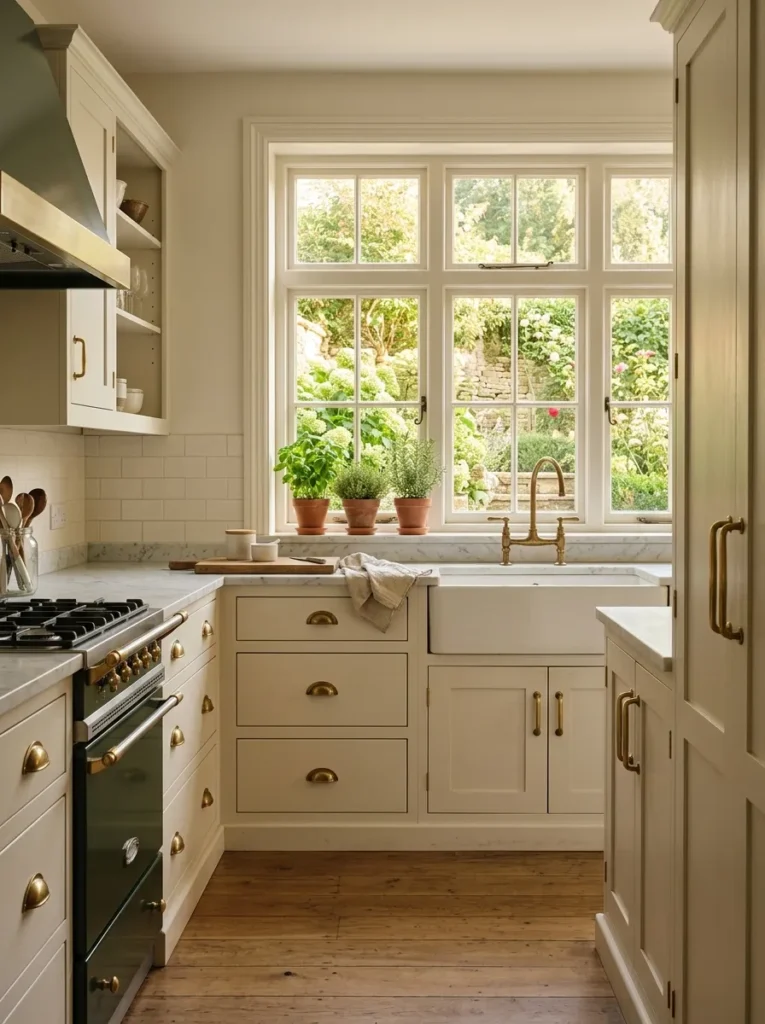
Why it works: Unlacquered brass hardware throughout a kitchen applies the material authenticity principle — lacquered brass maintains a uniform bright appearance that reads as artificial over time, while unlacquered brass develops a patina unique to the specific handling patterns, moisture contact, and environmental conditions of its particular kitchen. The cup pulls and bar handles most frequently touched develop the richest patina first while those touched less frequently remain brighter, creating a natural record of the kitchen’s daily use that is simultaneously beautiful and deeply personal. This developing quality is precisely what distinguishes unlacquered brass from every other hardware finish — chrome, brushed nickel, and lacquered brass all maintain their factory appearance indefinitely, while unlacquered brass becomes more beautiful with every passing month of use.
How to get it: Specify unlacquered brass explicitly when ordering hardware — many suppliers offer both lacquered and unlacquered versions of the same hardware, with unlacquered sometimes listed as “living finish” or “natural brass.” Do not apply any protective coating to unlacquered brass hardware after installation — patina development is the aesthetic goal and coating prevents it. Source cup pulls for shaker-style doors and bar handles for drawers from specialist hardware suppliers rather than standard home improvement retailers, who typically stock only lacquered alternatives.
Quick Win: Replacing just the kitchen tap with an unlacquered brass alternative (while leaving existing hardware in place temporarily) immediately introduces the warm brass tone that shifts the kitchen’s entire material palette — a tap is a single purchase that has an outsized visual impact because it is the most prominent metal object in the kitchen.
| Product |
|---|
| Unlacquered brass cup pull set kitchen |
| Unlacquered brass bar handle set drawers |
| Unlacquered brass kitchen mixer tap |
| Natural brass bridge tap Belfast sink |
| Brass cabinet knob set alternate hardware |
Also view: 15 Elegant Kitchen Counter Ideas That Look Expensive
2. Honed Marble Countertops and Backsplash
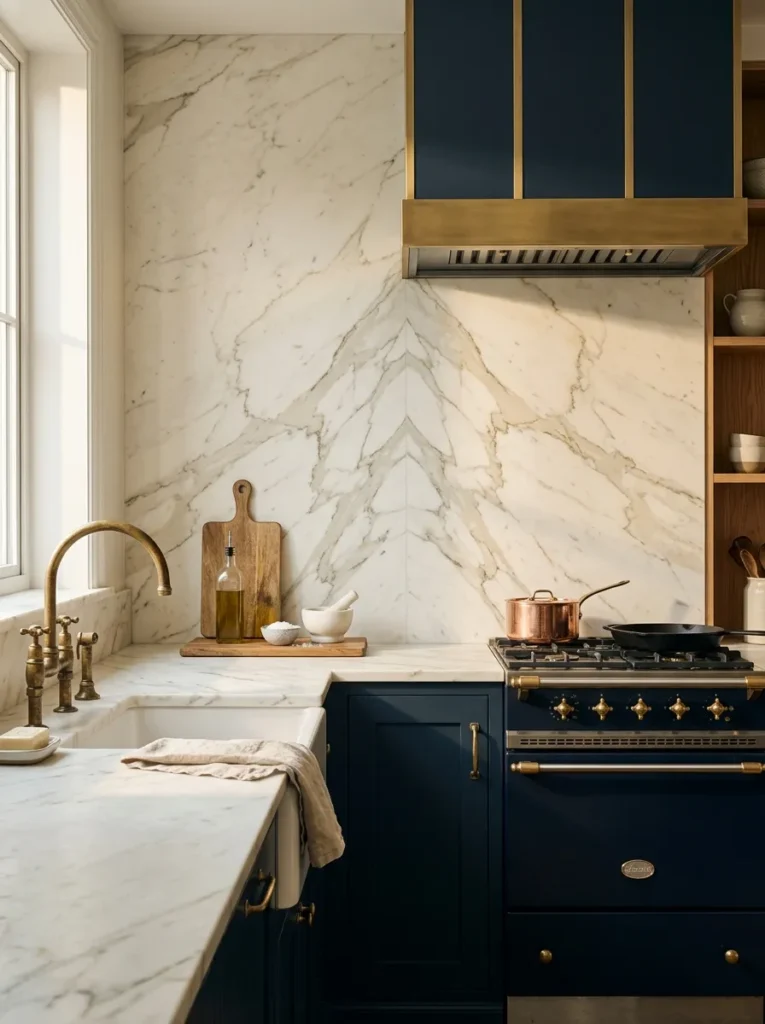
Vibe: Refined and material-rich — the kitchen surface that makes cooking feel like an act worth performing in a beautiful space.
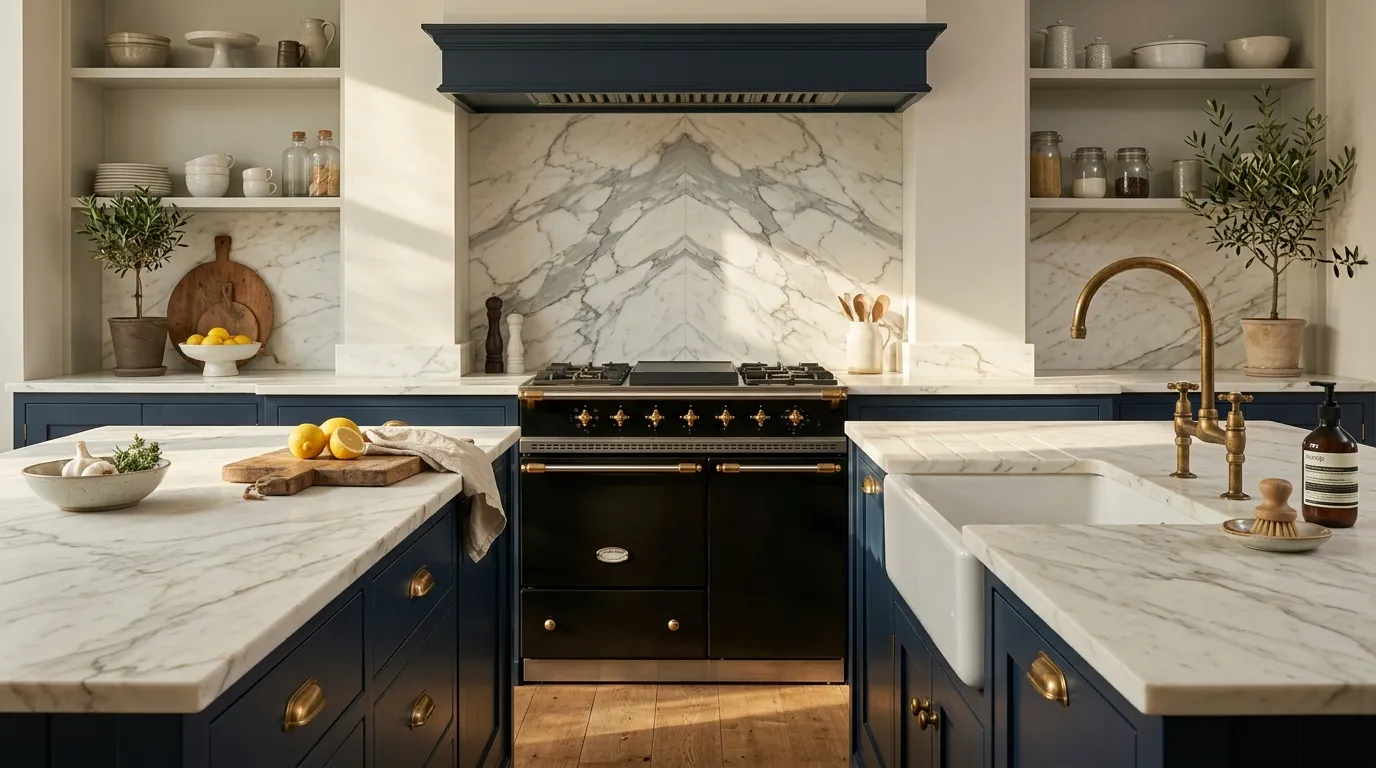
Why it works: Honed marble countertops and backsplash apply the design principle of material continuity as visual luxury — when the same stone runs from countertop through to the backsplash in a single continuous material statement (particularly when the backsplash is a book-matched slab panel where adjacent slabs are mirror images cut from the same block), the kitchen reads as having been designed around the stone rather than having stone inserted into a completed design. Honed finish specifically — matte rather than polished — provides the warm, soft light response appropriate to a kitchen context where polished marble’s high reflectivity creates visual busyness that competes with the kitchen’s other material surfaces. The honed finish also shows fewer fingerprints and water marks than polished marble in daily kitchen use.
How to get it: Source marble slabs from a stone merchant rather than buying pre-cut tiles — slabs allow the book-match selection for the backsplash panel. Specify honed finish at the stone merchant and apply a penetrating stone sealer annually in a kitchen context — unsealed honed marble absorbs oil, wine, and acidic substances and stains permanently. The book-matched backsplash panel requires the range hood to be positioned before the slab is cut so the panel dimensions are correctly sized for the range alcove.
| Product |
|---|
| Calacatta marble slab honed finish |
| Penetrating stone sealer marble |
| Book-matched marble backsplash panel |
| Marble edge profile router bit |
| Stone adhesive for backsplash panel |
Also view: 17 Elegant Living Room Paint Colors for Stylish Homes
3. Open Shelving with Curated Ceramic Display
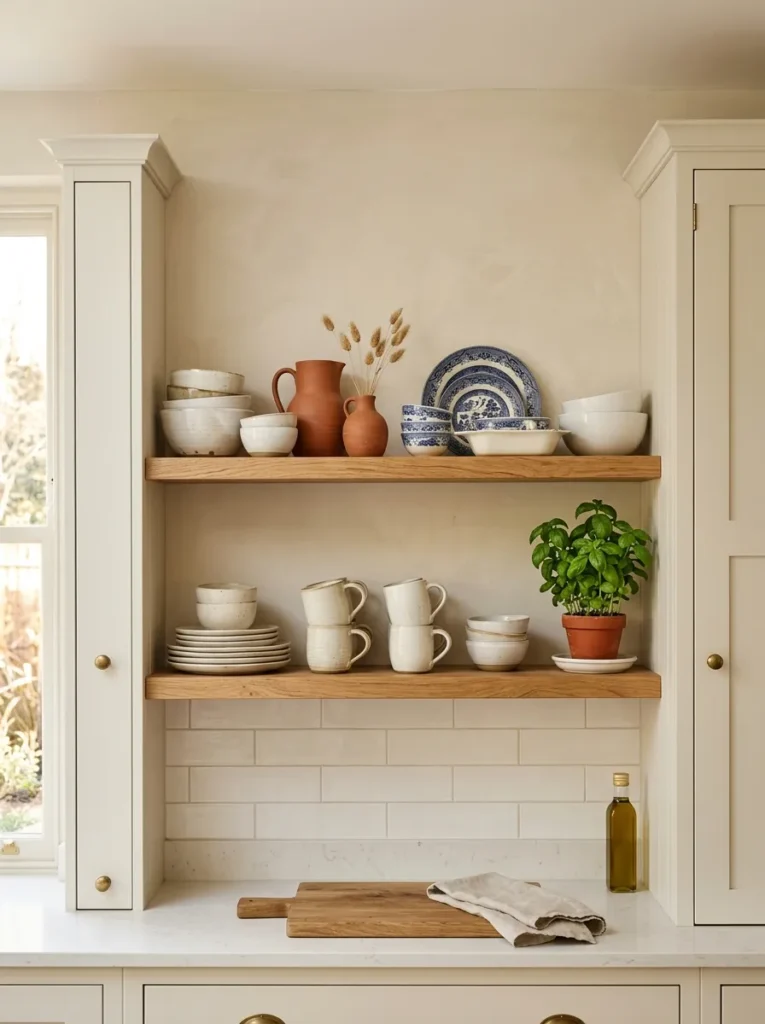
Vibe: Warm and collected — the kitchen shelves that make every daily reach for a cup feel like a considered moment.
Why it works: Open shelving with a curated ceramic display applies the design principle of functional display — objects that are both used daily and genuinely beautiful deserve to be displayed rather than concealed, and a kitchen with visible ceramic collections communicates a relationship with cooking and material that closed cabinetry conceals entirely. The specific curation principle that distinguishes elegant open shelving from cluttered open shelving is the organization of objects into tonal family groups with generous negative space between groups — cream and white ceramics together, terracotta pieces together, blue-and-white vintage pieces together — rather than random placement or strictly utilitarian arrangement by size or frequency of use.
How to get it: Mount natural oak floating shelves using heavy-duty concealed shelf brackets capable of supporting the cumulative weight of a full ceramic collection — ceramic pieces are significantly heavier than standard shelf weight calculations assume. Edit the ceramic collection ruthlessly before placing on shelves — only pieces that are both regularly used and genuinely beautiful should appear; everything else belongs in closed storage. The rule for elegant open shelf styling is a maximum of three distinct groupings per shelf with visible shelf surface between each group.
| Product |
|---|
| Natural oak floating shelf set |
| Heavy-duty concealed shelf bracket |
| Hand-thrown ceramic bowl set |
| Vintage blue-and-white serving dish |
| Small herb pot set for shelf end |
4. Zellige or Handmade Tile Backsplash
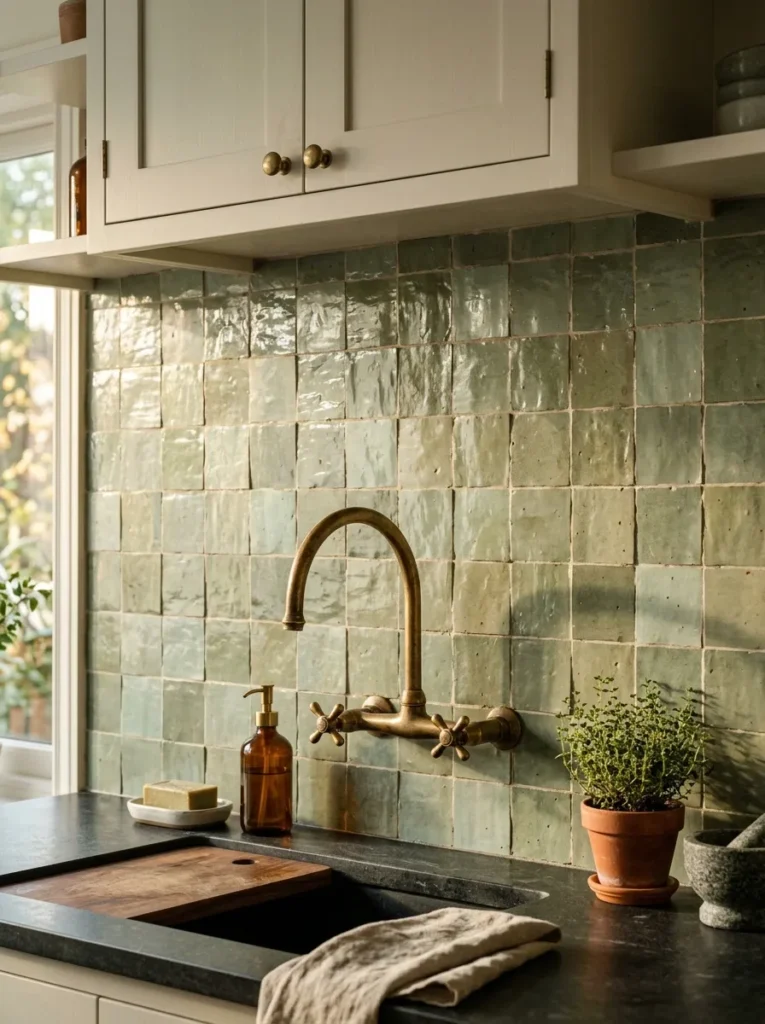
Vibe: Warm and tactile — the backsplash that makes the area behind the sink the most interesting surface in the kitchen.
Why it works: Zellige tile in a kitchen backsplash applies the principle of artisan material as primary decoration — the handmade zellige tile’s surface variation, color variation between individual tiles, and the way the glaze catches light differently at each angle create a backsplash that is more beautiful under close inspection than at distance, which is the specific quality that rewards the sustained looking a kitchen invites. The backsplash is the kitchen’s most practical location for a materially rich tile because it is a relatively small surface area (maximizing the zellige’s cost-per-square-meter impact), it is at the height where the most detail-oriented looking happens during kitchen use, and it is the surface most dramatically affected by changing light through the kitchen’s daily cycle.
How to get it: Source genuine zellige from Moroccan specialist importers or high-quality tile retailers who stock authentic handmade zellige rather than machine-made imitations — the price difference is significant but the visual difference at close range is immediate and definitive. Install with a warm gray or putty-toned unsanded grout — white grout against zellige creates too-stark contrast that diminishes the tile’s surface complexity. Specify unlacquered brass fixtures against sage green zellige — the warm metal and cool-warm ceramic pairing is the combination most consistently used and most successful in contemporary kitchen design.
| Product |
|---|
| Zellige tile sage green handmade |
| Warm gray unsanded grout for zellige |
| Zellige tile adhesive flexible |
| Unlacquered brass kitchen tap |
| Tile grout sealer for zellige joints |
5. Statement Range Hood as Architectural Feature
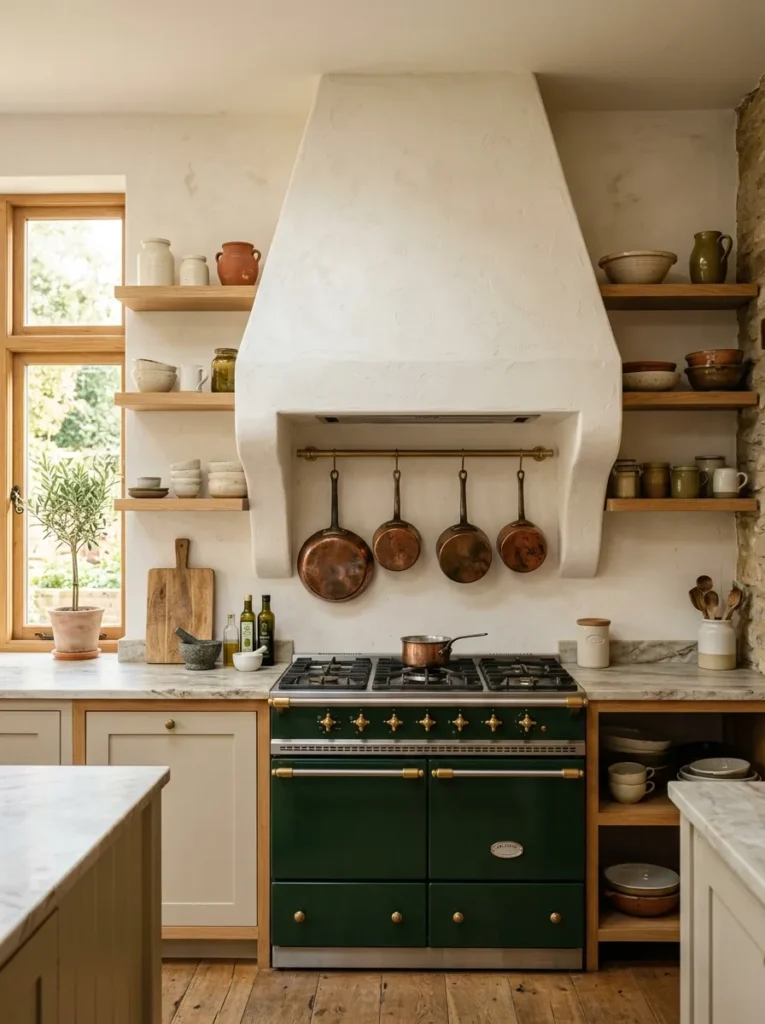
Vibe: Warm and architectural — the range hood that makes the cooking zone feel like the room’s most considered design moment.
Why it works: A statement range hood in plaster or limewash paint applies the design principle of functional element as architectural focal point — the range hood is the kitchen’s largest single surface above counter height and its visual treatment determines the character of the entire cooking zone. A custom plaster hood with Venetian plaster finish, flanked by open shelving and anchored by a range cooker below, creates a complete cooking alcove composition that references the traditional kitchen hearth — the specific spatial configuration that has defined kitchen design across centuries. The warm white plaster surface provides the visual weight and texture necessary for a focal point while the curved hood profile softens what might otherwise be an architecturally heavy element.
How to get it: Commission a custom range hood from a specialist kitchen joinery maker or plaster contractor — the hood can be constructed from a timber or MDF form (built over the standard duct) and finished in two to three coats of Venetian plaster. The plaster finish requires burnishing with a polished steel trowel while the second coat is still partially set, followed by a natural beeswax sealant. Install a brass pot rail across the hood front using wall-mounted end brackets — the pot rail adds both functional pan storage and a material accent that connects the hood to the kitchen’s brass hardware throughout.
| Product |
|---|
| Venetian plaster warm white for hood |
| Brass pot rail for hood front |
| S-hook set brass for pot hanging |
| Copper pan set for display hanging |
| Wide steel trowel for Venetian plaster |
6. Deep Color Cabinet Transformation
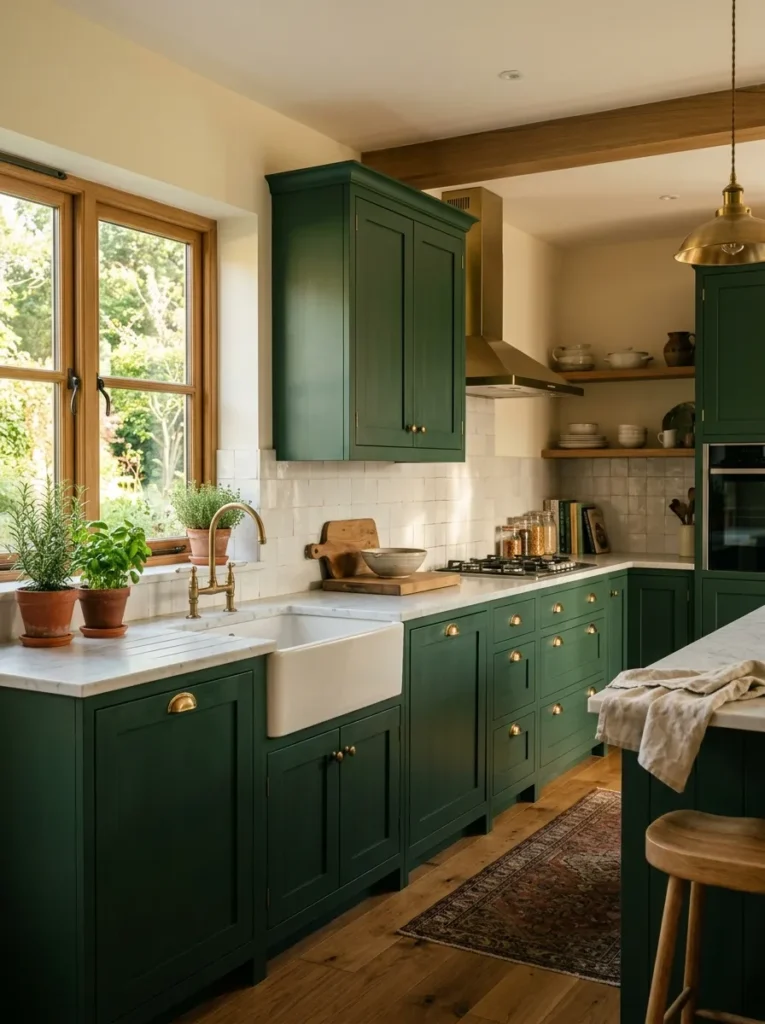
Vibe: Rich and enveloping — the kitchen color transformation that makes the room feel like it has always been this considered.
Why it works: Deep color cabinet transformation applies the chromatic commitment principle — choosing a saturated, confident color for kitchen cabinets (deep forest green, deep navy, warm charcoal, or oxblood) rather than a safe neutral produces a kitchen with a genuine design identity rather than a neutral backdrop. Deep forest green specifically creates the warmth and richness associated with traditional English country kitchens and contemporary Scandinavian domestic design simultaneously — it references botanical gardens, working libraries, and the specific quality of rooms that feel genuinely grown-in rather than recently installed. The matte chalk-finish application is critical — deep green in a gloss or semi-gloss finish reads as commercial, while the same color in matte chalk-finish reads as considered and sophisticated.
How to get it: Apply chalk-finish furniture paint specifically formulated for kitchen cabinetry — standard chalk paint requires a topcoat sealer, but specialist kitchen chalk paint brands (Annie Sloan’s Kitchen & Bathroom formulation, or Frenchic’s Alfresco range) include built-in hardeners appropriate for kitchen conditions. Apply in two to three thin coats with light sanding between coats rather than one heavy coat — thin coats build a more even color depth without brush mark accumulation. Seal with a water-based kitchen-appropriate satin varnish rather than wax for better resistance to the steam and moisture of kitchen use.
| Product |
|---|
| Deep forest green kitchen chalk paint |
| Kitchen-grade satin varnish topcoat |
| Chalk paint brush set flat |
| Fine grit sandpaper for between coats |
| Cabinet primer for adhesion base |
7. Belfast Sink with Brushed Apron Front
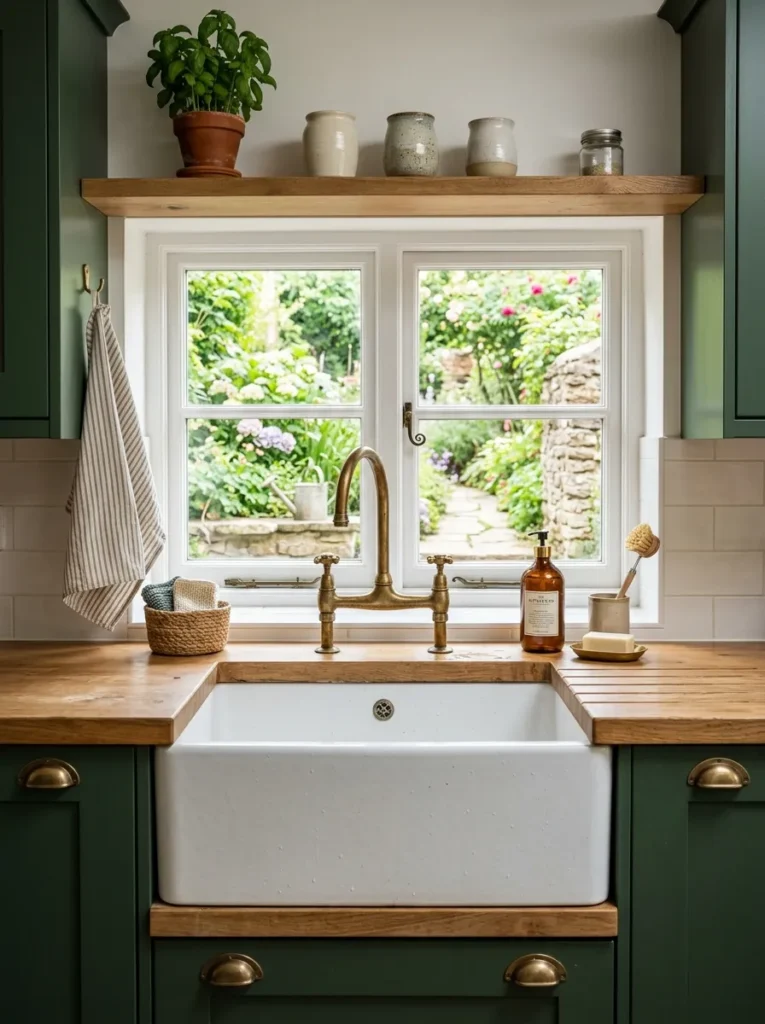
Vibe: Welcoming and classic — the sink that makes washing up feel like the most pleasant task in the day.
Why it works: A white Belfast sink with an unlacquered brass bridge tap applies the design principle of functional element as room character anchor — the sink is the kitchen workspace where the most time is spent and where the most sustained looking happens during daily use. A genuine white ceramic Belfast sink with its characteristic deep basin and apron front provides both the practical benefits (deep basin for large pots, rolled rim comfortable to lean against, durable ceramic surface) and the aesthetic quality of an object that belongs to a long tradition of quality domestic hardware rather than a contemporary product cycle. The view through the window above the sink is the specific environmental element that makes the sink position the most pleasant workspace in the kitchen — and the brass bridge tap frames this view with the warm metallic presence that makes the whole composition feel designed.
How to get it: Source a genuine vitreous china Belfast sink from a quality sanitaryware supplier — the weight and thickness of genuine ceramic is both a quality indicator and a practical advantage in kitchen use. The bridge tap should be specified in unlacquered brass with cross-head handles for the most authentic period-appropriate detail. The sink requires a slightly lower countertop installation than a standard undermount to allow the apron front to sit flush with the cabinet face — this installation detail should be specified to the kitchen fitter before cabinetry installation.
| Product |
|---|
| White ceramic Belfast sink apron front |
| Unlacquered brass bridge tap cross-head |
| Belfast sink waste and overflow brass |
| Ceramic sink grid base protector |
| Natural sponge and soap dish brass |
8. Linen Roman Blind Above Kitchen Window
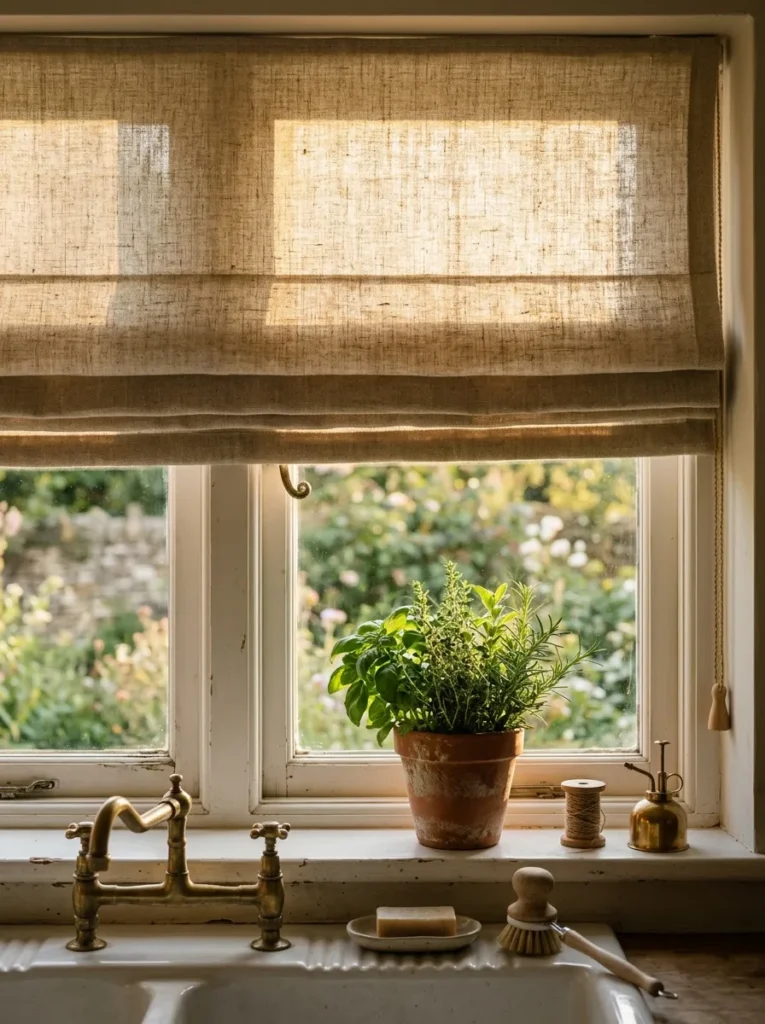
Vibe: Warm and serene — the kitchen window treatment that turns afternoon light into the room’s most beautiful feature.
Why it works: A natural linen roman blind above the kitchen sink window applies the light quality transformation principle — natural undyed linen fabric in a flat roman blind configuration converts direct afternoon sun into a warm, diffuse, golden light that flatters every surface and material in the kitchen and makes the cooking and washing up hours of late afternoon genuinely pleasant rather than glare-affected. The specific quality of light filtered through natural linen (warm in color temperature, soft in direction, visually interesting through the fabric’s weave variation visible when backlit) is categorically different from the light through a bare window or through a synthetic blind, and it is this light quality difference that most directly improves the daily experience of the kitchen at no cost beyond the blind itself.
How to get it: Source genuine natural linen (not synthetic linen-look fabric) from a fabric supplier — the warmth and weave-texture visible when backlit is a property of natural fiber that synthetic alternatives cannot replicate. Specify a flat roman blind rather than a hobbled or balloon roman style — the flat fold is the most contemporary and most elegant configuration and lies flat against the glass when raised, allowing the full window to be used when the blind is up. Have the blind made to the exact window width for maximum light control and minimum light bleed at the edges.
| Product |
|---|
| Natural undyed linen fabric blind |
| Roman blind kit flat fold |
| Blind mounting bracket set |
| Small ceramic herb pot windowsill |
| Fresh herb plant set kitchen windowsill |
9. Pendant Lighting Over Kitchen Island
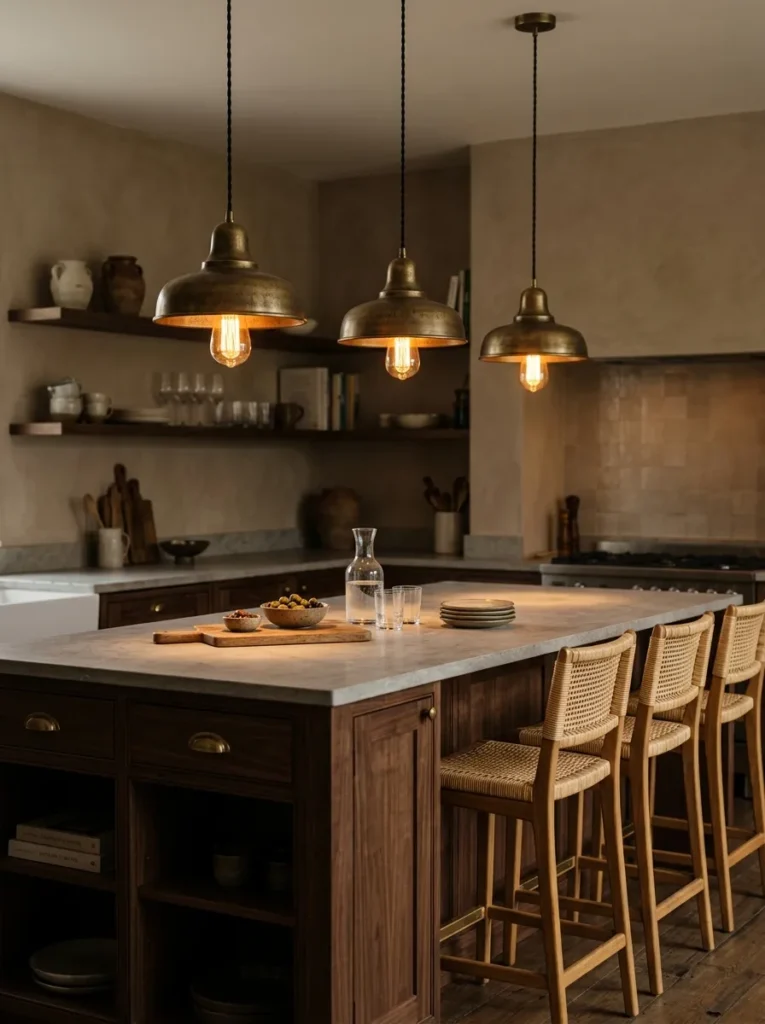
Vibe: Warm and designed — the pendant lighting that makes the kitchen island the room’s most atmospheric zone at evening.
Why it works: Three equally spaced pendant lights above a kitchen island apply the design principle of task lighting as atmosphere creation — pendant lights positioned at the correct height above a kitchen island (65–75cm above the working surface) provide adequate task illumination for food preparation while simultaneously creating a defined, warmly lit zone within the broader kitchen space that reads as the room’s primary social and work anchor. The aged brass finish and Edison bulb filament are the specific choices that produce the warm amber quality of the pendant light — at 2700K or warmer, the brass pendant light creates an evening kitchen atmosphere that standard under-cabinet LEDs cannot achieve. Three pendants are the minimum for visual completeness above a standard kitchen island — two reads as insufficient, four as excessive for most island widths.
How to get it: Space pendant lights at equal intervals across the island length — for a standard 120cm island, center pendants at 30, 60, and 90cm from the island’s left edge. Install all three on a single dimmable circuit so the pendant light level can be adjusted between full brightness for cooking preparation and low atmospheric setting for evening dining at the island. The pendants’ hanging height requires careful setting during installation — too high reduces the light quality on the surface below, too low creates glare at seated eye level.
| Product |
|---|
| Aged brass pendant light set of three |
| Edison filament bulb set 2700K |
| Dimmable pendant ceiling rose set |
| Cable canopy ceiling mount brass |
| Pendant dimmer switch compatible |
10. Vintage or Antique Finds as Kitchen Accessories

Vibe: Warm and accumulated — the kitchen that looks like it has been gathering the right things for decades.
Why it works: Vintage and antique kitchen accessories integrated with daily use apply the design principle of acquired authenticity — objects that have been used in previous kitchens by previous cooks carry a material history that new objects cannot replicate, and their presence in a contemporary kitchen creates the sense of accumulated domestic life that makes a kitchen feel genuinely inhabited rather than recently installed. The specific categories of vintage kitchen accessory that provide the highest visual return per unit of cost are: copper and brass measuring jugs and pots (their warm metallic quality relates naturally to unlacquered brass fixtures throughout), vintage ceramic storage jars and bread bins with original lettering (their aged ceramic quality is irreplicable in contemporary manufacturing), and antique kitchen scales (both visually beautiful and functionally superior to most contemporary digital alternatives for certain baking tasks).
How to get it: Source vintage kitchen accessories from antique markets, estate sales, and specialist kitchen antique dealers — the authenticity of wear and aging is the quality that cannot be replicated in reproduction pieces. Check copper and brass pieces for structural integrity (sound solder joints, no cracks) before purchasing for functional kitchen use. Display vintage accessories at counter and shelf level rather than in glass cabinets — their purpose is to be part of the kitchen’s working environment, not to be preserved from it.
| Product |
|---|
| Vintage brass kitchen scales original |
| Antique copper measuring jug collection |
| Old ceramic bread bin lettered |
| Vintage enamel colander functional |
| Antique wooden spoon collection |
11. Integrated Herb Garden on Windowsill or Shelf
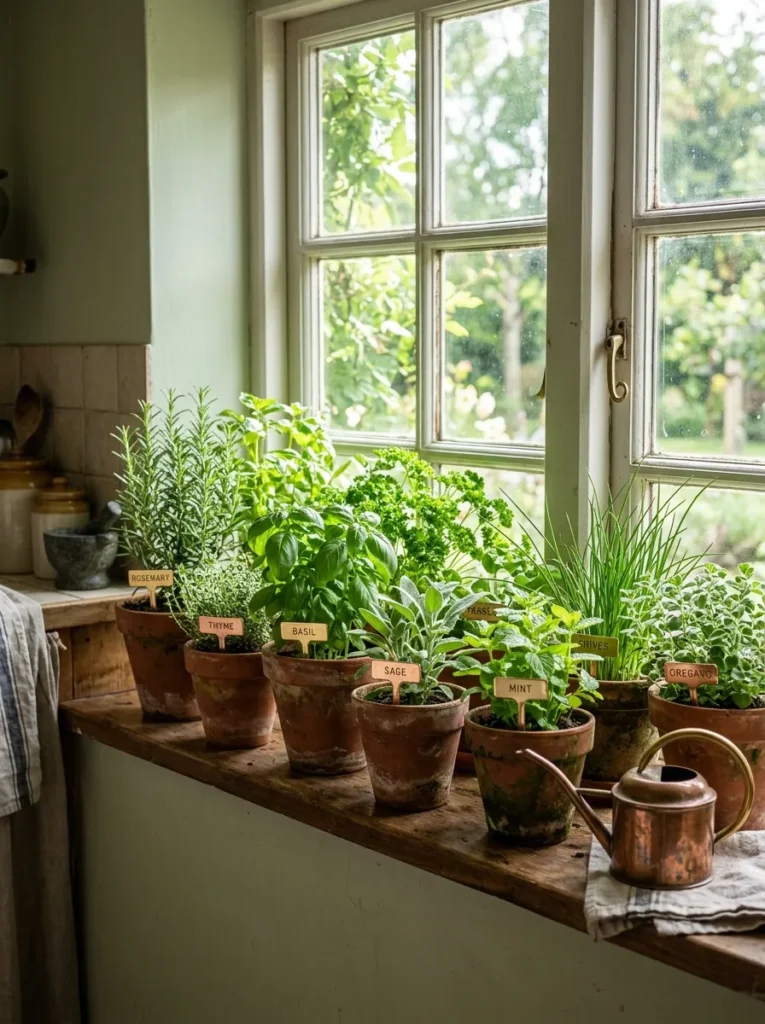
Vibe: Fresh and domestic — the herb garden that makes the kitchen smell like a kitchen should and provides the specific pleasure of cooking with things you grew.
Why it works: An integrated herb garden on the kitchen windowsill applies the design principle of living material as dynamic decoration — herbs are the only kitchen decorative element that grows, changes color with the seasons, fills the room with fragrance, and provides a daily ingredient for cooking. A row of aged terracotta pots with brass label stakes on a deep kitchen windowsill creates a domestic tableau that references both the working kitchen garden and the contemporary interest in provenance and fresh ingredient cooking, and does so with the specifically warm, organic material quality of aged clay and living plant material that no artificial decoration can replicate. The aged terracotta is the critical material choice — new bright orange terracotta reads as garden center; aged terracotta with mineral salt deposits and patchy organic marks reads as something that has been used and tended over years.
How to get it: Age new terracotta pots rapidly by soaking in water for 24 hours, applying a thin coat of plain yogurt to the exterior surface, and leaving in a shaded outdoor location for 2–3 weeks — the yogurt provides the nutrients for lichen and algae to begin colonizing the surface, replicating years of natural aging in weeks. Alternatively, source genuinely aged terracotta from garden antique dealers or reclamation yards. Plant herbs from seed or small plugs rather than large supermarket herb plants — plants grown from young plugs establish more robustly in small pots than root-bound supermarket specimens.
| Product |
|---|
| Aged terracotta pot set varied sizes |
| Herb plug plant set eight varieties |
| Brass plant label stake set |
| Copper watering can small |
| Organic herb potting compost |
12. Marble or Stone Pastry Board Display
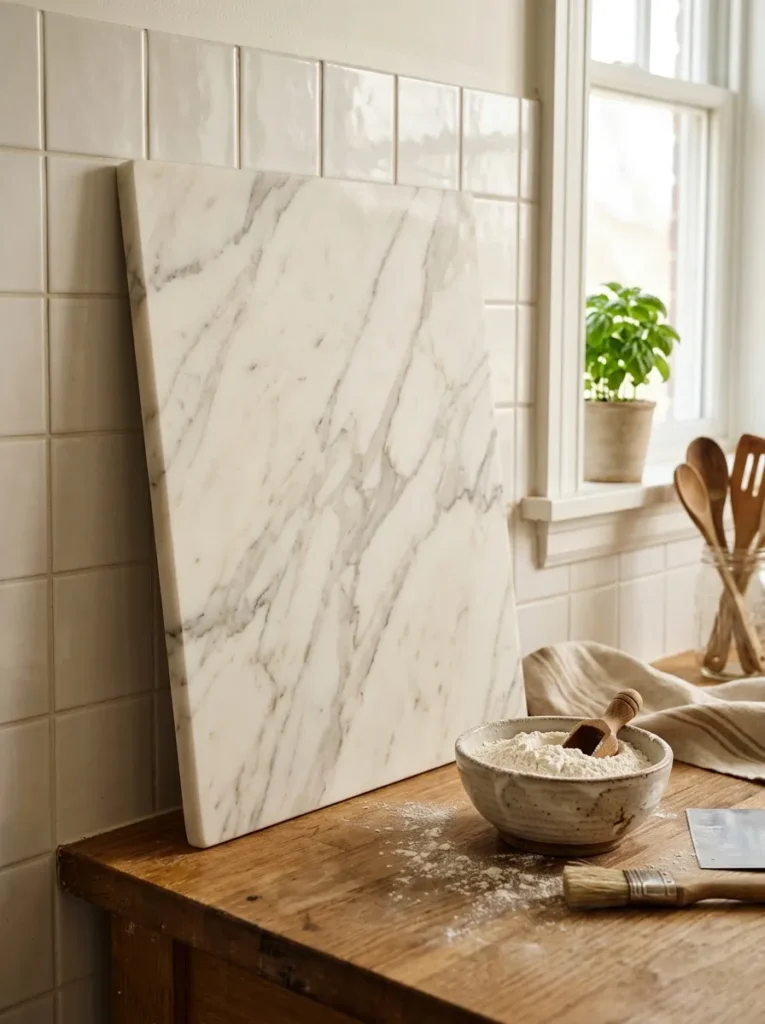
Vibe: Warm and purposeful — the kitchen object that is beautiful as decor and better than anything as a functional tool.
Why it works: A marble pastry board displayed propped against the kitchen splashback applies the design principle of functional beauty as decoration — the large marble slab is both the best possible surface for pastry work (marble’s natural coolness prevents butter from melting during pastry making) and a genuinely beautiful object that, when propped against the wall when not in active use, contributes the warm visual quality of veined stone to the kitchen’s material composition. This display approach — propping rather than storing — is the specific styling decision that makes a functional tool read as a designed kitchen object, and it references the kitchen display traditions of Parisian and Italian domestic kitchens where beautiful cooking tools are habitually displayed rather than stored.
How to get it: Source a marble pastry board from a stone merchant cut from a marble remnant — offcut pieces from worktop installations are available at very low cost from most stone suppliers and make ideal pastry board slabs at 3–4cm thickness. Specify honed rather than polished finish — the slightly porous honed surface provides better flour adhesion during pastry rolling than the slippery polished alternative. Season occasionally with a thin coat of penetrating stone sealer to maintain stain resistance without filling the pores that make the honed surface functionally superior.
| Product |
|---|
| Honed marble pastry board Calacatta |
| Marble remnant slab custom cut |
| Penetrating stone sealer for marble |
| Marble board rubber foot set |
| Ceramic flour storage crock |
13. Fluted Glass Cabinet Doors
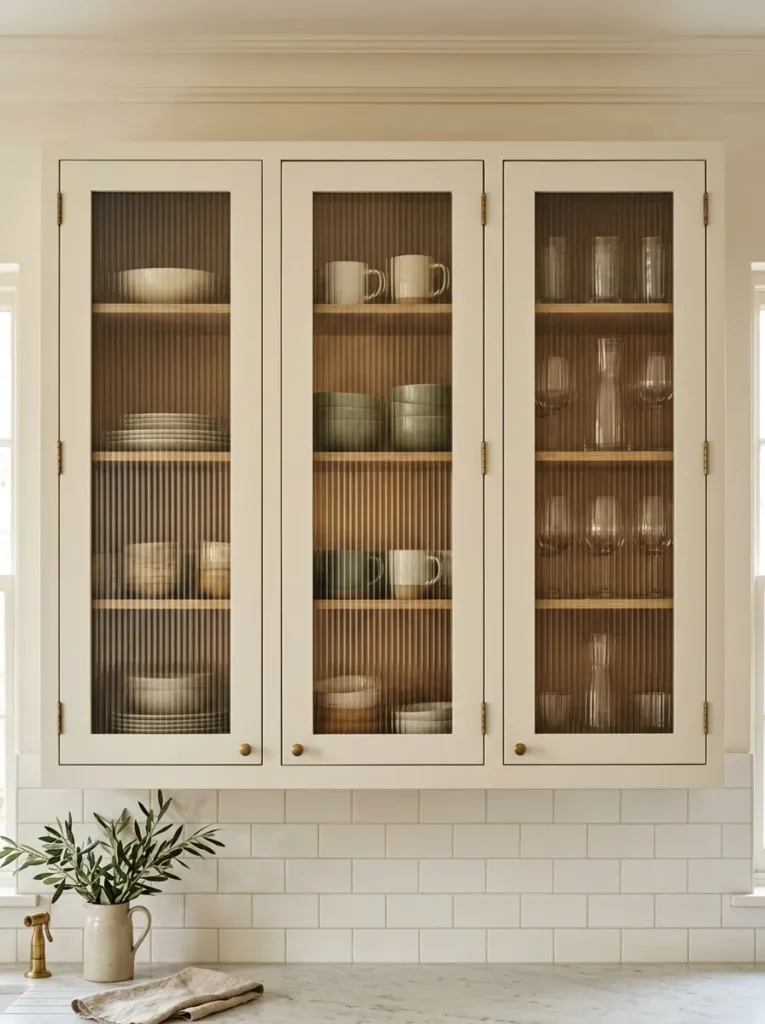
Vibe: Refined and contemporary — the cabinet detail that makes upper cabinets a feature rather than a functional background.
Why it works: Fluted glass cabinet door panels apply the material substitution principle at the cabinet level — replacing flat solid door panels with reeded or fluted glass panels transforms the upper cabinets from opaque storage containers to softly glowing display cases that reveal the warm ceramic and glass contents within without the visual clarity of clear glass. The fluted glass’s parallel vertical grooves refract light passing through them, creating a slightly blurred, warm view of the cabinet interior that is more visually interesting than the sharp clarity of plain glass and more informative than the complete concealment of solid doors. This specific diffusion quality — revealing without displaying — is the design effect that makes fluted glass the most sophisticated cabinet glazing option in contemporary kitchen design.
How to get it: Source reeded or fluted glass panels from a glass supplier and have them cut to the exact door panel dimensions — fluted glass is available in several groove width and depth variations, with narrower, shallower reeds reading as most refined. Replace existing solid door panels by removing the panel from the door frame (most shaker-style cabinet doors use a panel-and-frame construction that allows the panel to be pushed out from behind), and insert the fluted glass panel with glazing putty or silicone securing it in the frame channel.
| Product |
|---|
| Reeded fluted glass panel cut to size |
| Glass silicone sealant clear |
| Cabinet door panel router for glass |
| Brass hinge set for cabinet doors |
| Glass edge tape for panel safety |
14. Copper or Cast Iron Pan Display
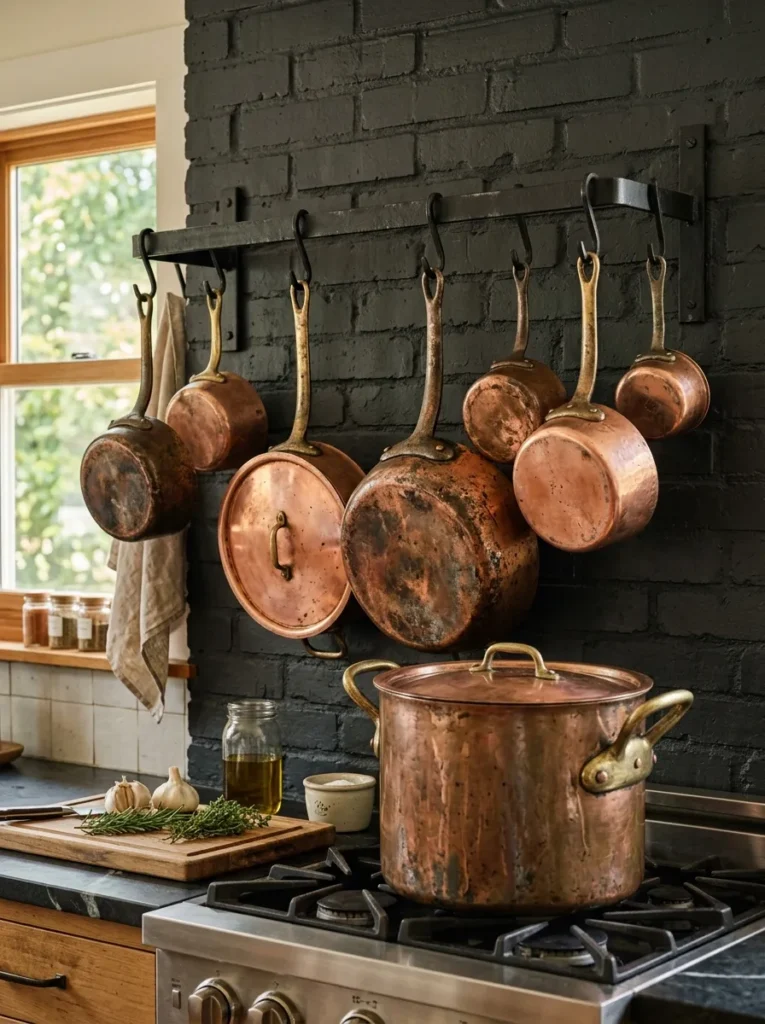
Vibe: Warm and culinary — the pan display that makes a kitchen wall into a still-life composition.
Why it works: A copper pan display on a wall-mounted iron pot rack applies the principle of functional art — genuinely high-quality copper cooking pans are both the best possible cooking vessels (copper’s thermal conductivity is significantly superior to stainless steel or cast iron for precise temperature control in sauce work) and genuinely beautiful objects whose warm, curved forms and patinated surfaces create a visual composition that no purchased decoration can replicate. The display quality is specifically produced by the collection — a single copper pan is a cooking tool; seven copper pans in varied sizes arranged by size on a black iron rack become a composition with visual rhythm, material richness, and the specific warmth of copper catching afternoon light.
How to get it: Source copper pans from specialist French kitchen suppliers (Mauviel, de Buyer) or from antique kitchen dealers where the pans have already developed the aged patina that makes old copper more beautiful than new. Mount a wall-mounted pot rack from heavy-duty iron S-hooks on a wall-mounted horizontal rail — the rail must be fixed to wall studs or masonry anchors capable of supporting the cumulative weight of a full copper pan collection. Do not polish copper pans regularly — the developing patina is the visual quality being sought, and polishing reverses it.
| Product |
|---|
| Copper pan collection Mauviel or similar |
| Black iron wall pot rack horizontal |
| Heavy S-hook set iron for pan hanging |
| Wall stud anchor set for rack mounting |
| Copper pan conditioner natural beeswax |
15. Handmade Ceramic Sink or Basin
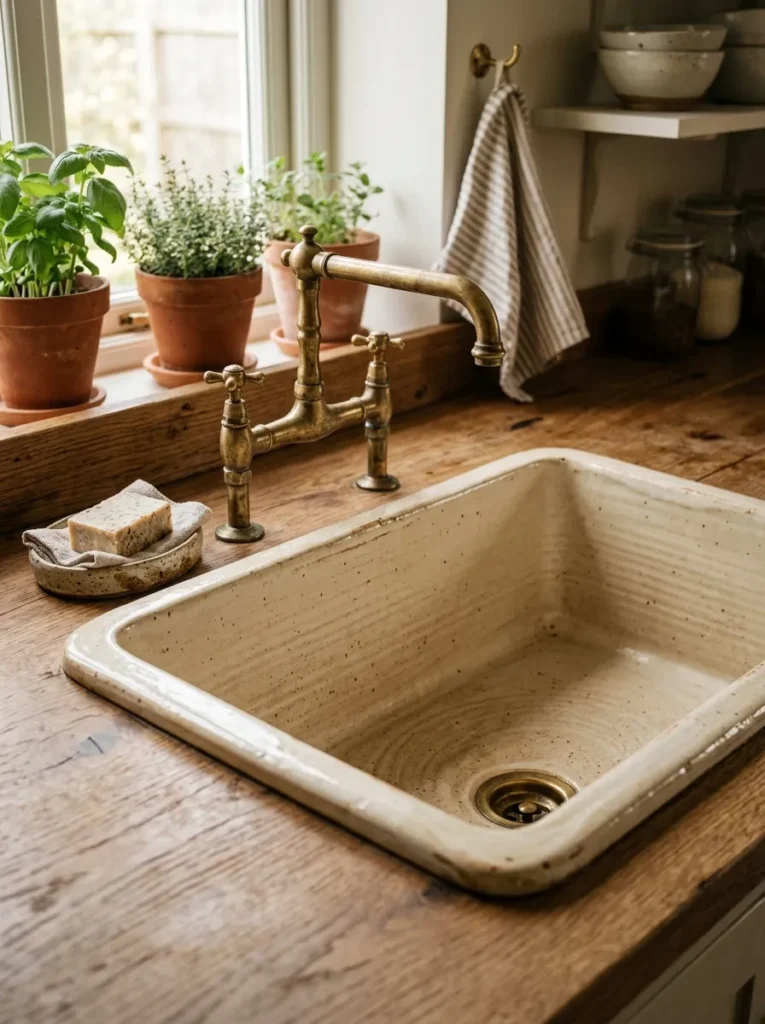
Vibe: Artisanal and warm — the kitchen sink that makes the most functional moment of the kitchen day feel like contact with something genuinely made.
Why it works: A hand-thrown ceramic kitchen sink applies the wabi-sabi principle to the kitchen’s most functional element — the slight rim irregularity, the visible throwing marks, and the warm ivory tone of hand-thrown stoneware communicate authentic making in a way that the precise uniformity of factory vitreous china cannot. In a kitchen designed around the pleasure of genuine cooking with quality materials, a hand-thrown ceramic sink is the element that most completely extends the commitment to artisan craft to every element of the kitchen’s material vocabulary. The visual impact of the hand-thrown surface is most apparent in low, raking natural light that picks up the throwing marks as subtle shadows across the sink’s interior and exterior surfaces.
How to get it: Commission a hand-thrown kitchen sink from a ceramic studio or stoneware artist — several ceramic artists produce functional kitchen sinks in stoneware clay fired to vitrification temperature for food-safe use. Specify a high-fire stoneware clay body (fired to cone 10 or above) for the density and impermeability required for a kitchen sink. The sink must be installed with a waterproof silicone seal at all countertop junctions — the slightly irregular rim of a hand-thrown piece requires more careful sealing than a factory-standard rim.
| Product |
|---|
| Hand-thrown stoneware kitchen sink |
| Clear silicone sealant for sink edge |
| Unlacquered brass sink tap |
| Handmade ceramic soap dish |
| Ceramic studio commission for custom sink |
16. Considered Kitchen Table and Chair Composition
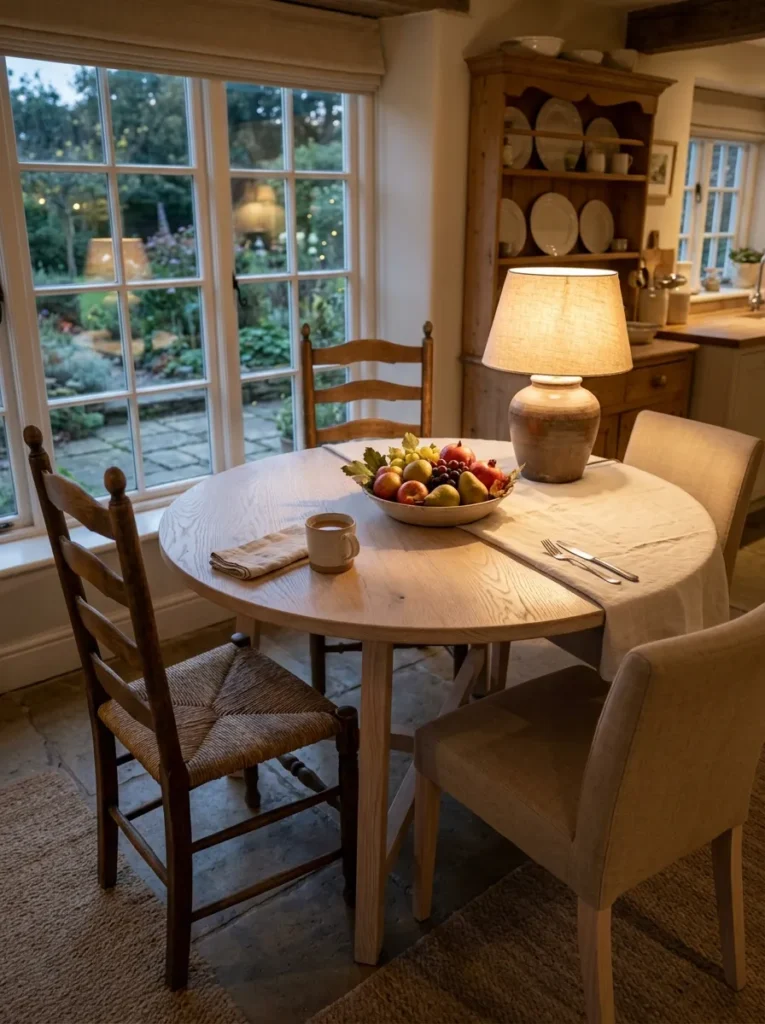
Vibe: Warm and gathered — the kitchen table that makes every meal feel worth sitting down for.
Why it works: A considered kitchen table composition with mismatched but harmonious chairs applies the collected quality principle — a perfectly matched table and chair set reads as a purchased dining suite while a round bleached oak table with thoughtfully mixed antique and contemporary chairs reads as a composition assembled over time according to personal aesthetic judgment. The round table is the shape that most naturally facilitates conversation in a domestic kitchen context — it has no head position and every seat is equally proximate to every other, creating the egalitarian social dynamic that kitchen meals at their best provide. The ceramic fruit bowl as the only permanent table decoration is the styling restraint decision that makes the table read as genuinely used rather than perpetually staged.
How to get it: Source the bleached oak table from a furniture maker or reclamation dealer — bleached oak (natural oak treated with a whitening oil wash) provides the warmth of natural timber with a lighter, more contemporary color that does not dominate the kitchen’s other material palette. Collect chairs over time from antique markets and contemporary furniture makers — the mismatched quality is most successful when chairs share either the same approximate height and scale (even if their style differs) or the same tonal palette (all warm wood tones, even if the woods differ). The ceramic table lamp is the functional addition that most completely transforms the kitchen table into an evening destination — a table with its own warm light source becomes a gathering point after the meal as well as during it.
| Product |
|---|
| Round bleached oak kitchen table |
| Antique ladder-back chair pair |
| Natural linen upholstered chair pair |
| Ceramic table lamp warm kitchen |
| Ceramic fruit bowl for centerpiece |
How to Start Your Elegant Kitchen Decor Transformation
Start with the hardware. Before repainting cabinets, replacing appliances, or considering any significant kitchen renovation, replace the existing cabinet and drawer hardware with unlacquered brass alternatives. This single modification — costing $40–$80 for a full kitchen hardware set and taking under an hour — immediately demonstrates the specific quality shift that unlacquered brass creates in a kitchen and provides the material reference point from which every subsequent decision can take its cue. The new hardware will tell you whether sage green or deep navy or off-white is the right cabinet color for your specific brass, whether open shelving or closed cabinets serves the style you are creating, and whether the kitchen’s existing surfaces need to change or simply need to relate to the new hardware. The hardware is the kitchen’s most immediately impactful single modification because it is the element touched and noticed at close range most frequently throughout the day.
The most common mistake people make when pursuing elegant kitchen decor is purchasing new appliances as the primary design investment when appliances are the element that most rarely determines a kitchen’s elegance. A kitchen with beautiful surfaces, warm lighting, quality materials, and standard appliances reads as elegantly designed. A kitchen with premium appliances, poor lighting, standard surfaces, and absent design consideration reads as well-equipped but undesigned. The design quality of a kitchen is produced by its surfaces, light, and materials — appliances are functional requirements that should be chosen for performance and positioned to minimize their visual dominance rather than treated as design statements.
Three items under $50 that make an immediate impact: A set of unlacquered brass hardware ($35–$50 for a set of eight to ten) that transforms the cabinet character before any painting or structural change; a natural linen roman blind fabric ($15–$25 per meter) that changes the light quality in the kitchen immediately; and a single hand-thrown ceramic vessel ($20–$45 from a pottery market or independent ceramic maker) placed on the open shelf or counter that introduces the handmade material quality that makes a kitchen feel genuinely considered.
Realistic expectations: A single hardware and light fitting upgrade takes one afternoon and costs $80–$200 total. A mid-level kitchen elegance transformation — new hardware, repainted cabinets, linen blind, open shelving with ceramic display, and improved pendant lighting — typically costs $400–$1,200 for materials across two to three weekends of work. A complete elegant kitchen renovation — new surfaces, zellige backsplash, Belfast sink, honed marble countertop, bespoke range hood, and quality lighting — ranges from $8,000–$40,000 depending on kitchen size and material specification. The principle that produces the highest design return at every budget level is material concentration — directing available resource toward one or two genuinely excellent material decisions (a real zellige backsplash, genuine unlacquered brass hardware, a hand-thrown ceramic sink) rather than distributing the same budget across many mediocre material upgrades.
Frequently Asked Questions About Elegant Kitchen Decor
What makes a kitchen feel elegant rather than simply well-equipped?
The defining quality of an elegant kitchen is the evidence of considered material choices made over time — surfaces that reward close looking, fixtures that develop character with use, and the specific warmth of a room where the design intention is visible in every detail from the tap handle to the shelf bracket. Elegance in a kitchen is independent of size and largely independent of cost — a small kitchen with honed marble, unlacquered brass, and natural linen reads as more elegant than a large kitchen with premium appliances, gloss surfaces, and standard chrome fittings. The specific factors most reliably associated with kitchen elegance are: warm light quality (2700K from multiple sources rather than cold overhead fluorescence), natural material surfaces (stone, timber, ceramic rather than synthetic alternatives), material authenticity (unlacquered metals that develop patina, natural stone that seals and wears), and considered restraint in accessory placement.
How do I introduce elegance into a kitchen I cannot renovate?
The modifications available to a kitchen that cannot be structurally changed are: replacing hardware (the single highest-impact low-cost modification), adding a natural linen roman blind at the window, introducing quality ceramics to any existing open shelving or countertop, improving the lighting by adding a pendant light above the dining table or kitchen island on a separate dimmable circuit, and editing the accessories on display to remove anything that does not contribute beauty or genuine daily function. These modifications collectively produce a meaningful improvement in a kitchen’s perceived elegance without any structural work — the hardware and lighting changes are particularly powerful because they affect the quality of every hour spent in the kitchen.
Is open or closed kitchen storage more elegant?
Neither format is inherently more elegant than the other — the elegance of kitchen storage depends on what is stored within it and how it is presented. Open shelving with a well-edited, curated collection of genuinely beautiful ceramics, well-organized books and objects, and generous negative space between grouped items reads as more elegant than closed cabinetry in the same kitchen. The same kitchen with open shelving holding random household accumulation reads as less elegant than closed cabinetry. The decision between open and closed storage should therefore be driven by honest assessment of the kitchen’s actual daily contents — a household whose daily ceramics are genuinely beautiful benefits from open display; one whose practical supplies are functional but not beautiful benefits from closed concealment.
What kitchen color creates the most elegant impression?
Deep, saturated colors applied to kitchen cabinetry in a matte finish consistently produce the strongest impression of elegance — deep forest green, deep navy, warm charcoal, and oxblood all create the chromatic confidence that reads as designed intention rather than neutral caution. Among these, deep forest green is the most versatile because it complements the widest range of countertop materials (marble, stone, timber, concrete), the widest range of hardware finishes (brass, bronze, matte black), and the widest range of kitchen style directions (farmhouse, contemporary, traditional, Scandi). Warm off-white and aged plaster tones are the elegant alternatives for kitchens where a deeper color feels unsuitable — these warm neutrals are categorically different from standard builder’s white and provide the specific warmth that relates naturally to natural material surfaces.
How important is kitchen lighting to its elegance?
Kitchen lighting is the most impactful single environmental factor in a kitchen’s perceived elegance — more impactful than its surfaces, its cabinetry color, or its hardware. A kitchen with beautiful surfaces under cold, flat fluorescent light reads as clinical and undesirable. The same kitchen under warm 2700K pendant lighting with a dimmable circuit reads as warm, welcoming, and genuinely elegant. The specific lighting configuration that most reliably produces an elegant kitchen atmosphere is: warm pendant lights above the island or dining table on a dimmable circuit (for atmosphere), warm under-cabinet LED at 2700K for task lighting (for function), and the elimination of cool-white ceiling fluorescents in favor of warm-toned recessed downlights where overhead ambient light is needed. The investment in correct kitchen lighting — new pendant fixtures, new downlight bulbs, dimmer switch installation — returns more elegance per pound spent than any equivalent material or finish investment.
Ready to Create Your Dream Elegant Kitchen?
These 16 ideas cover the complete range of what elegant kitchen decor can achieve — from the immediate warmth of unlacquered brass hardware and the light-transforming quality of a natural linen blind, to the architectural presence of a plaster range hood and the artisan quality of a hand-thrown ceramic sink. Every elegant kitchen transformation begins with the smallest possible commitment to material quality — replacing one tap, introducing one quality ceramic to an existing shelf, adding one pendant light above the table — and builds from that first considered choice outward with the same principle of material authenticity applied consistently to every subsequent decision. Right now, look at the hardware on your kitchen cabinets and ask honestly whether it is contributing to or detracting from the kitchen’s quality — if it is detracting, that is where you begin, and everything else follows from the warmth and character that the right hardware introduces into the room’s material vocabulary. Save the ideas that match your kitchen’s architecture, your cooking life, and the daily experience you want your kitchen to provide — and begin from that first hardware replacement.