15 DIY Fabric Crafts for Every Home
DIY fabric crafts for every home use textile materials — cotton, linen, velvet, wool, canvas, denim, felt, and natural fiber blends — along with the full range of making techniques available to the domestic crafter (hand sewing, machine sewing, no-sew bonding, surface embroidery, printing, dyeing, and weaving) to create functional and decorative objects that serve the home’s specific aesthetic and practical needs while expressing the maker’s individual skill, material sensibility, and creative intention. This article gives you exactly 15 ideas spanning every room of the home, every skill level from absolute beginner to confident intermediate, and every purpose from purely functional to purely decorative, so every maker finds a project that is achievable, rewarding, and genuinely worth making.
DIY fabric crafts done well are not merely homemade versions of purchasable products — they are specifically superior to their purchased equivalents in three ways that the handmade always exceeds the manufactured: they are made in the specific materials, dimensions, and colors that the specific home requires rather than in the averaged specifications of mass production; they carry the specific quality of having been made by the person who uses them, which creates an ongoing relationship between maker and object that no purchased equivalent provides; and they develop the maker’s skill and material knowledge in a way that compounds with each project, making each subsequent fabric craft both more pleasurable to make and more beautiful as a result. Here are 15 ideas worth making.
Why DIY Fabric Crafts Work for Every Home
The material case for fabric as a domestic craft medium rests on its specific combination of accessibility, versatility, and sensory contribution that no other craft material provides simultaneously. Fabric is available at every price point and in every material quality from inexpensive cotton poplin to genuine hand-woven linen — the same technique (a simple running stitch, a turned hem, a gathered ruffle) produces entirely different results at different material qualities, meaning that the investment in making time produces returns at whatever material budget the maker specifies. Fabric is forgiving in ways that hard materials (wood, ceramic, metal) are not — mistakes can be unpicked, re-sewn, and revised without structural damage; dimensions can be adjusted during making rather than requiring new materials; and the completed object can be washed, ironed, and restored to its original quality after use.
Domestically, fabric crafts produce the highest sensory contribution per making investment of any craft category. A handmade linen cushion cover, a hand-embroidered tea towel, a hand-dyed curtain panel, or a hand-sewn table runner each contributes simultaneously to the room’s visual quality (color, texture, pattern), its tactile quality (the specific feel of the material against hands, against skin, against furniture surfaces), and its acoustic quality (soft textiles absorb sound reflections, making rooms feel warmer and more intimate). This multi-sensory contribution makes fabric crafts among the highest-return domestic investments available per making hour.
Style at a Glance
| Element | Craft Core | Home Design Edge |
|---|---|---|
| Philosophy | Make what the home needs in the material it deserves | Every fabric craft should improve with washing and use |
| Materials | Natural fiber preferred — linen, cotton, wool, canvas | Warm neutrals, botanical tones, earth palette |
| Skill Range | No-sew iron-on (beginner) to gathered curtain (intermediate) |
15 DIY Fabric Crafts for Every Home
1. Linen Cushion Cover — The Foundational Fabric Project
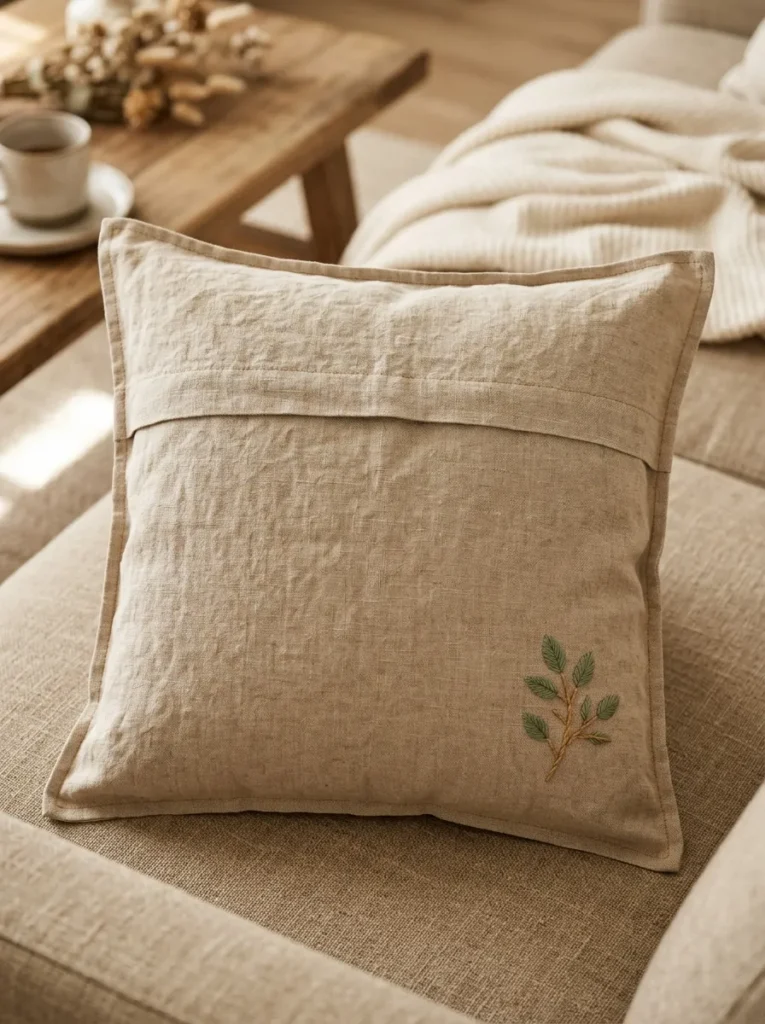
Vibe: The handmade linen cushion cover feels like the most direct possible expression of “I made this for this specific cushion in this specific room” — the warm oat linen, the small botanical embroidery, and the envelope closure creating a cushion cover that is both better-made and more personal than any shop-purchased equivalent.
Why it works: A linen cushion cover with an envelope back and a small embroidered detail applies the foundational fabric project principle — the linen cushion cover is the ideal starting project for a new fabric crafter because it introduces the three most fundamental sewing skills in their simplest application: cutting fabric to size (one measurement, two rectangles for the front and two rectangles for the envelope back), sewing straight seams (three sides sewn, one side with the overlapping envelope panels), and pressing and finishing (ironing the seams open, turning the cover right side out). The small botanical embroidery is an optional addition that introduces basic embroidery stitch knowledge (stem stitch for lines, satin stitch for filled areas) without requiring the commitment of a full embroidery project.
Envelope back construction: Cut two back panels, each the full width of the cushion and approximately 70% of the cushion’s height (35cm for a 50cm cushion). Hem one long edge on each back panel. Place both back panels on the front panel (right sides together) with the hemmed edges overlapping at the center — the overlap of approximately 15–20cm creates the pocket closure that holds the cushion insert. Sew around all four edges and turn right side out through the back opening.
Budget: 0.6m washed linen fabric: $8–20 depending on quality. Thread and embroidery thread: $3–6. Total: $11–26 per cushion cover.
Making time: 45–90 minutes for a beginner; 20–30 minutes for an experienced maker.
Quick Win: A no-sew version of the cushion cover uses iron-on hem tape along the three sewn seams instead of machine stitching — achievable in 20 minutes without a sewing machine and with the same clean result for the first season of use.
Shop The Look
| Product |
|---|
| Washed linen fabric oat color |
| Sage green embroidery thread |
| Embroidery needle set fabric |
| Cushion inner 50×50cm |
| Envelope back template |
Also view: 14 Corner Shelf Ideas That Maximize Space
2. Hand-Dyed Tea Towels — Natural Color on Natural Fiber
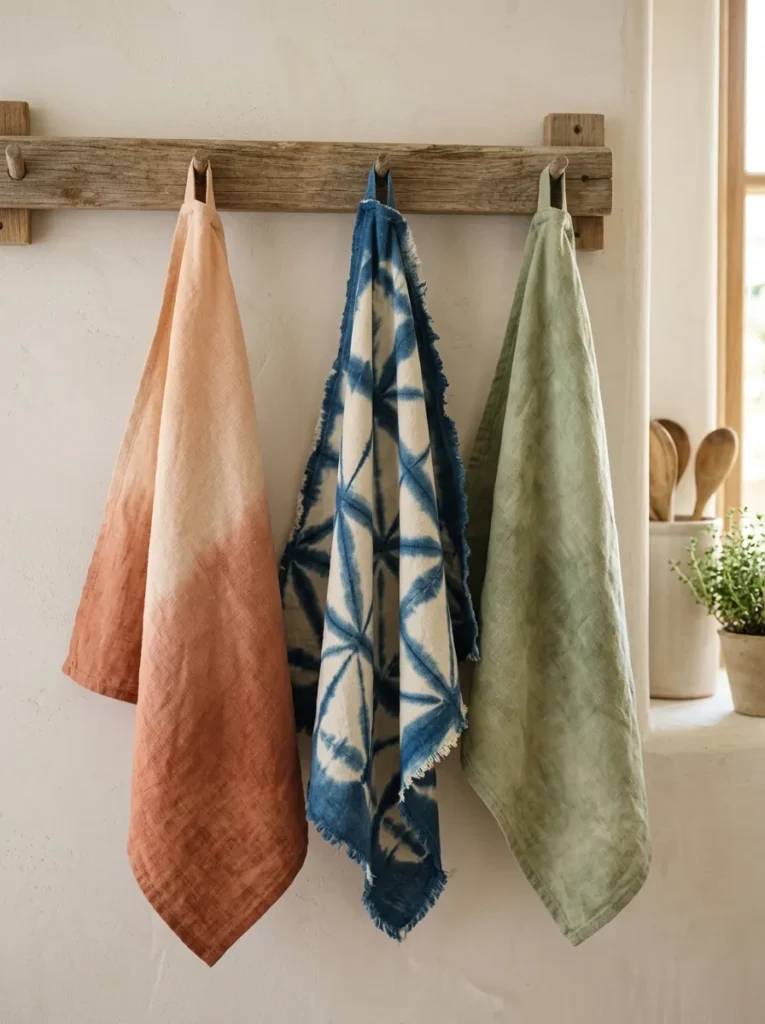
Vibe: The hand-dyed tea towels feel like the kitchen’s most beautiful functional objects — the specific warmth and variation of hand-applied color creating textile objects whose particular loveliness comes directly from the imperfection of the making process.
Why it works: Hand-dyeing plain cotton or linen tea towels applies the natural color variation principle — commercially produced tea towels are dyed with uniform industrial color that covers the fabric’s surface completely and identically; hand-dyed fabric develops the specific color variation of a dye applied by human hands in water (the ombre gradient, the shibori’s resist pattern, the botanical dye’s specific variation from point to point in the fabric) that reads as genuinely warm and handmade. The three different dyeing techniques (ombre dip-dye, shibori fold, botanical color) in a coordinated earth palette create a tea towel set that functions together as a composed kitchen textile installation.
Natural dye materials: Botanical dyes (from plants and food) are the most accessible and most genuinely natural dyeing medium for home use. Onion skins (yellow-orange), avocado pits and skins (dusty rose-blush), black beans (blue-gray), and turmeric (golden yellow) are all available from the kitchen and produce reliable colors on pre-mordanted cotton and linen. Pre-mordanting (treating the fabric with a mordant — typically alum — before dyeing) is required for most natural dyes to bond permanently with plant fiber.
Budget: Three plain linen or cotton tea towels: $12–25. Natural fiber-reactive dye or natural dye materials: $8–15. Mordant (alum): $5–8. Total: $25–48 for the complete set.
Making time: 2–4 hours including dye preparation and fabric treatment.
Shop The Look
| Product |
|---|
| Plain linen tea towel set three |
| Fiber-reactive dye earth tones |
| Natural dye alum mordant |
| Shibori elastic band fold set |
| Dye fixative natural fiber |
3. Macramé Plant Hanger — Knotted Natural Fiber
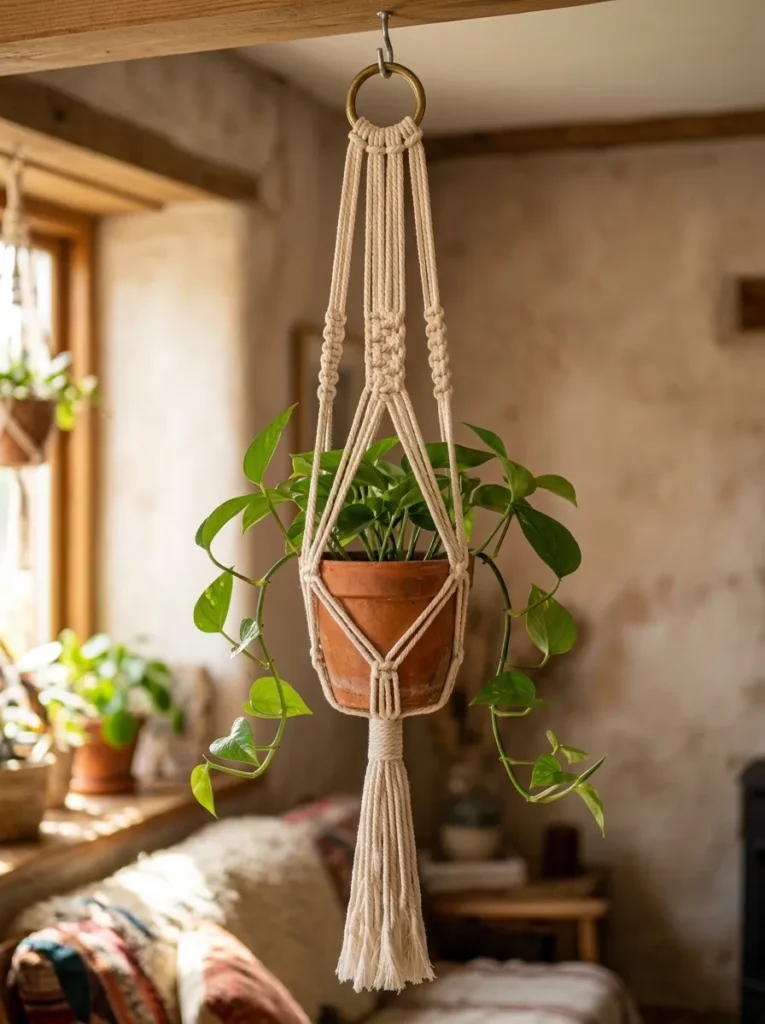
Vibe: The macramé plant hanger feels like a piece of fiber sculpture that was also designed to hold a plant — the knotted cotton creating a three-dimensional textile form whose structure is simultaneously the decoration and the function.
Why it works: A macramé plant hanger in natural undyed cotton cord applies the functional fiber sculpture principle — macramé (the practice of creating decorative textile structures through systematic knotting rather than weaving or sewing) produces objects whose structural beauty (the pattern of the knots, the rhythm of the repeated sequence, the three-dimensional form of the hanging cradle) is the same quality as their functional beauty (the cord structure is both the decorative element and the structural support for the plant). Natural undyed cotton cord is specifically the most appropriate material for a contemporary macramé plant hanger because it coordinates with any interior palette without imposing a color (the warm natural cream of undyed cotton reads as neutral against any background) and because it develops a natural patina through use (the handling of the cord during knotting and the slight aging in the air creates the specific warm quality of genuinely used natural fiber).
Basic knot vocabulary: The macramé plant hanger requires two knots only — the lark’s head knot (for attaching cord to the ring at the top) and the square knot (the primary knot of all basic macramé, worked by alternating left and right half-hitches around two central cord pairs). Both can be learned from a five-minute video tutorial and practiced on a test section of cord before beginning the full hanger.
Budget: 5mm natural cotton macramé cord 50m: $8–15. Brass ring: $2–4. Total: $10–19 per hanger.
Making time: 2–4 hours for a beginner; 1–2 hours for an experienced macramé maker.
Shop The Look
| Product |
|---|
| 5mm natural cotton macramé cord |
| Small brass ring 25mm |
| Ceiling hook plant hanger |
| Terracotta pot small trailing |
| Pothos or succulent plant |
4. Fabric-Covered Storage Baskets — Textile Over Structure
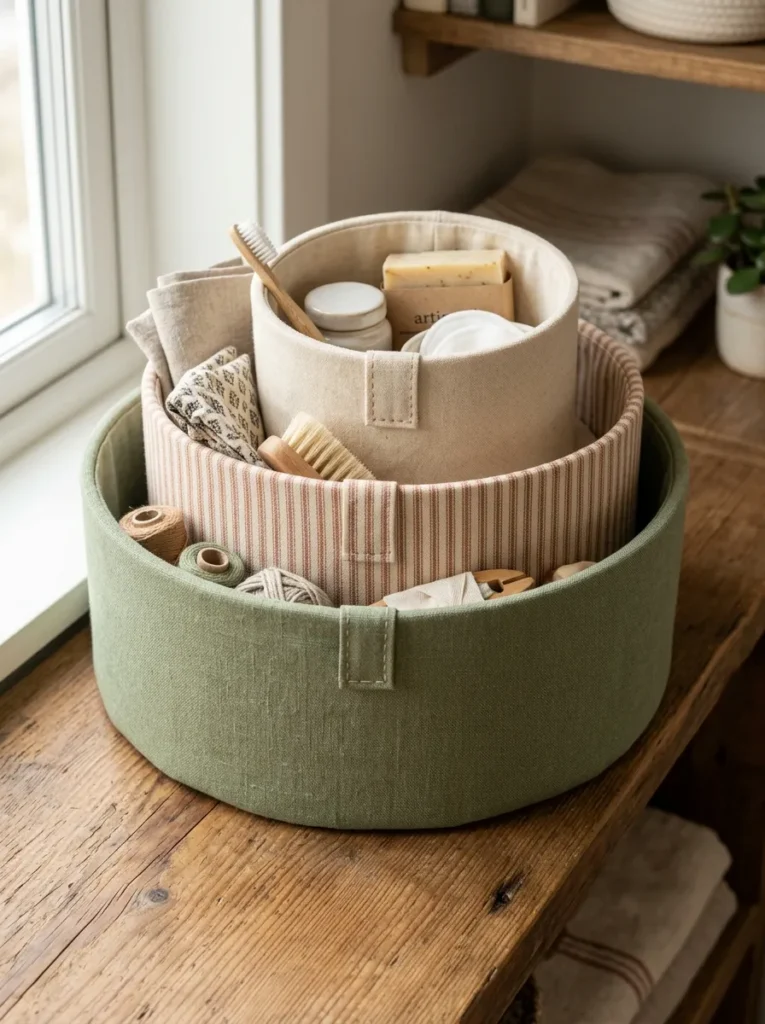
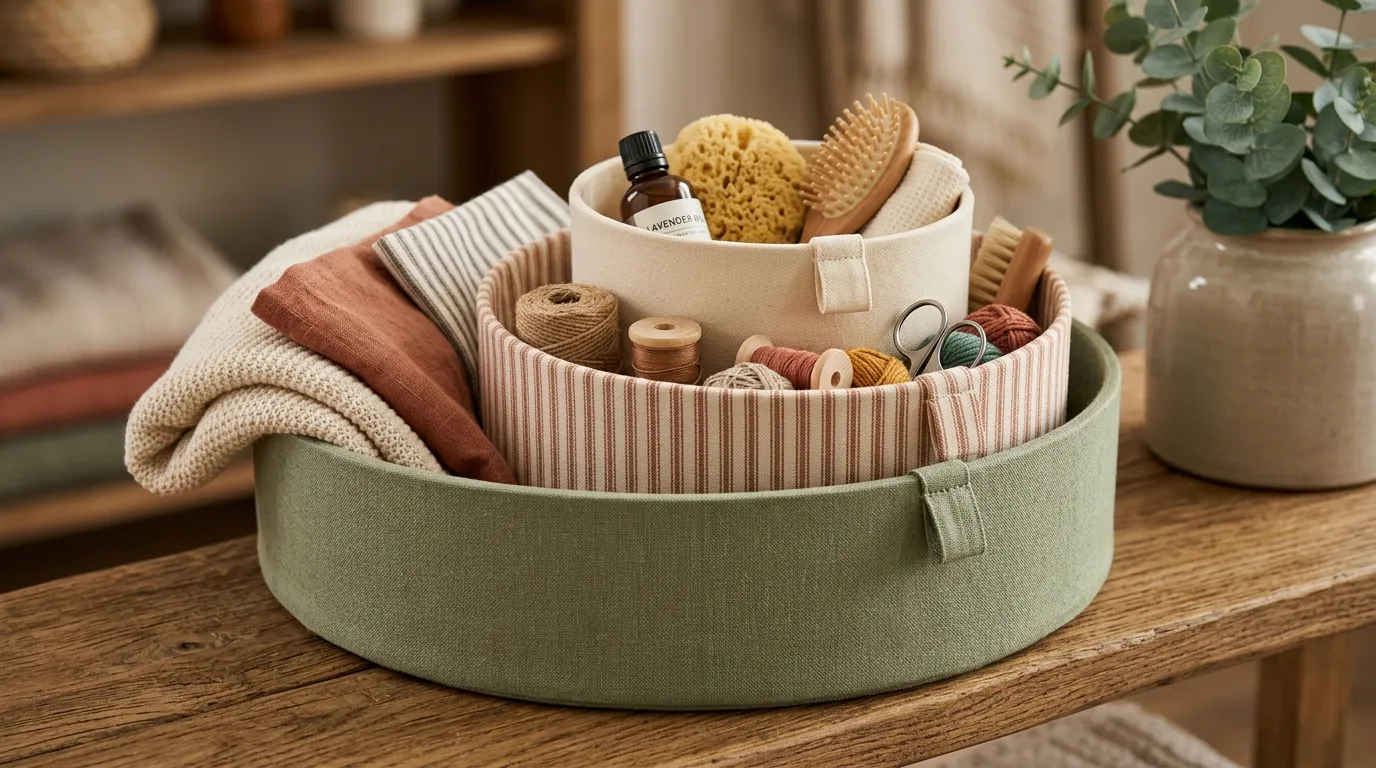
Vibe: The fabric-covered baskets feel like storage that decided to be beautiful as well as functional — the coordinating fabric palette across three sizes creating a storage set whose visual warmth transforms any shelf from organized to designed.
Why it works: Fabric-covered storage baskets using coordinated fabrics in a harmonious palette applies the material transformation principle — a plain cardboard or wire storage basket (available from homeware retailers at $3–8) is a functional but visually undistinguished object; the same basket covered in quality natural fabric is a designed object of genuine warmth and character that contributes to the shelf’s visual palette rather than merely occupying space on it. The three-basket set in a coordinated palette (one patterned, one solid accent, one neutral) follows the textile styling principle of variety within cohesion — the three fabrics are clearly related by palette (sage, terracotta, cream) while being distinct by pattern and texture.
Fabric application technique: Cut the fabric to fit the basket’s exterior (measuring the basket’s circumference and height for a side panel, and the basket’s base diameter for a base circle). Apply the fabric using a strong fabric glue (not PVA — use a flexible fabric adhesive) to the basket exterior, smoothing the fabric flat as you work around the circumference. Fold the top edge of the fabric over the basket rim to the interior and glue inside. For a cleaner finish, line the basket interior with a second piece of coordinating fabric glued flat to the interior walls.
Budget: Three baskets: $10–25. Fabric (0.5m of each): $12–30. Fabric adhesive: $5–8. Total: $27–63 for the complete set.
Making time: 45–90 minutes per basket.
Shop The Look
| Product |
|---|
| Round storage basket set three |
| Warm sage linen fabric |
| Terracotta cream stripe cotton |
| Fabric adhesive flexible |
| Warm cream cotton solid |
5. No-Sew Curtain Panel — Simple Fold and Press
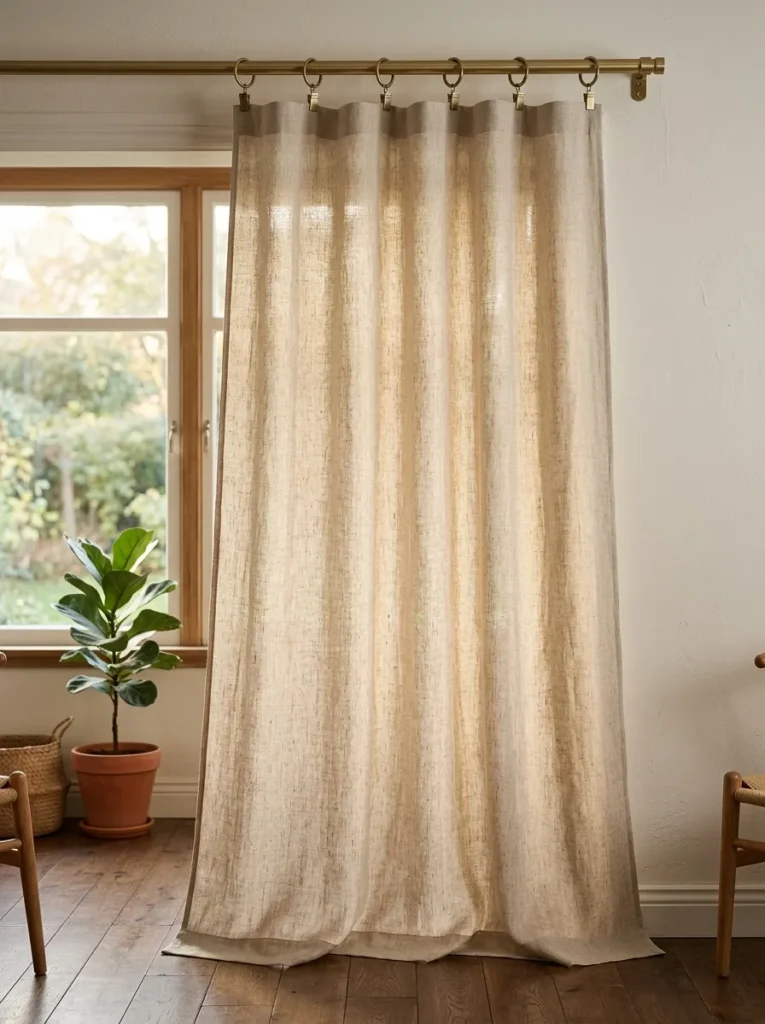
Vibe: The no-sew linen curtain panel feels like a curtain that was made from the best possible fabric without a single stitch — the natural linen’s warm diffusion of morning light creating the most beautiful window effect available regardless of the panel’s no-sew construction.
Why it works: A no-sew linen curtain panel using iron-on hem tape and clip rings applies the zero-sewing maximum-impact principle — the most visually significant improvement available for a bedroom or living room window is the replacement of short, thin curtain panels with floor-to-ceiling natural linen panels hung from ceiling-height rods extended beyond the window frame (as established in the dreamy bedroom article). This improvement does not require any sewing: clip rings (which grip the fabric’s top raw or folded edge without a sewn header) eliminate the need for curtain heading tape and the sewing machine work that pleat headers require; iron-on hem tape provides a clean bottom hem in two minutes with an iron rather than 30 minutes at a sewing machine. The only skill required is measuring, cutting, and pressing.
Fabric specification: Use a natural linen or cotton-linen blend at approximately 150–180cm wide per panel for a single window — this provides the 1.5–2× fullness ratio that makes hung curtains drape with their characteristic soft folds. A very inexpensive fabric at this width will produce a better result than an expensive fabric at 90cm width if the width constraint prevents adequate fullness.
Budget: Natural linen fabric (1.5m per panel): $15–40. Brass clip rings (10 per panel): $8–15. Iron-on hem tape: $4–8. Total: $27–63 per panel.
Making time: 30–45 minutes per panel including measuring, cutting, hemming, and hanging.
Shop The Look
| Product |
|---|
| Natural linen fabric panel width |
| Brass curtain clip ring set ten |
| Brass curtain rod ceiling height |
| Iron-on hem tape no-sew |
| Curtain rod ceiling bracket pair |
6. Embroidered Hoop Art — Simple Stitches, Lasting Beauty
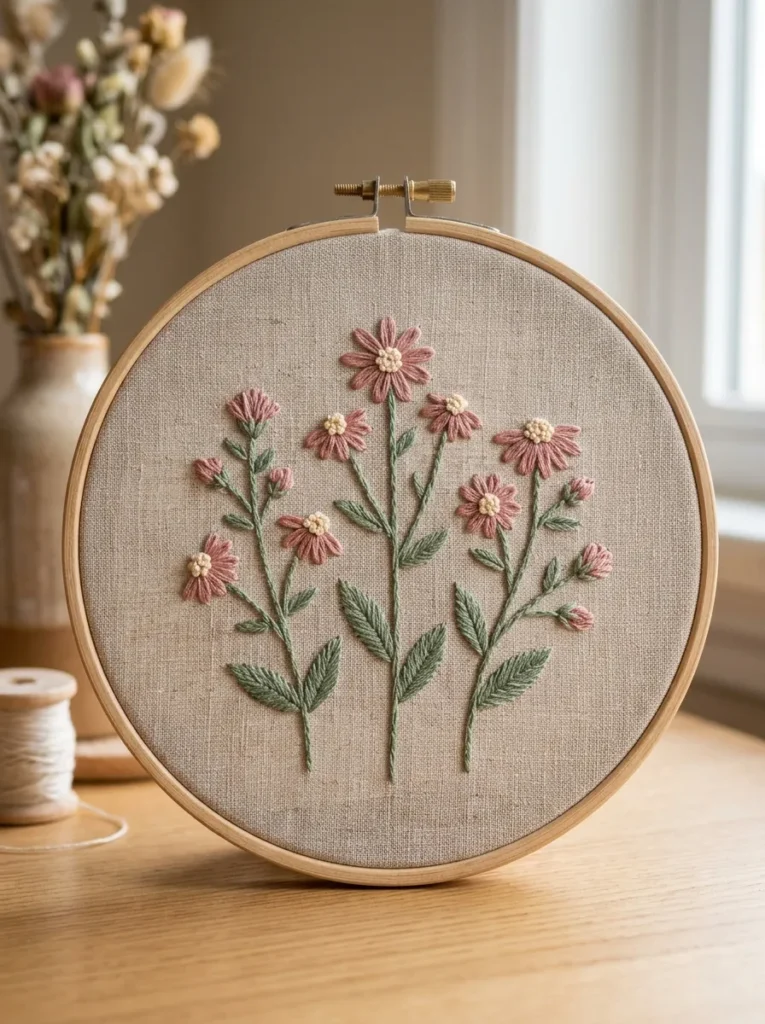
Vibe: The embroidery hoop art feels like a botanical illustration that was made rather than printed — the hand-worked stitches creating a surface of genuine textile richness that no print or reproduction can replicate.
Why it works: A simple botanical embroidery hoop in a limited three-color palette applies the focused palette embroidery principle — embroidery is the fabric craft most prone to the beginner’s mistake of using too many colors (each color requires a separate needle threaded with the appropriate thread, and too many colors creates visual busyness rather than visual beauty). A three-color palette (sage green for botanical structure, dusty rose for the primary decorative element, warm cream for accent detail) produces the specific restrained warmth of a genuine botanical illustration — visually complex through the variety of stitches used, visually unified through the limited color system.
Stitch vocabulary for botanical embroidery: The three-stitch beginner vocabulary (stem stitch for lines and stems — a simple spiral stitch following a drawn line; lazy daisy stitch for petals — a single loop tacked at its tip; French knot for centers and dots — thread wrapped around the needle and pulled through the fabric) is sufficient to complete a complete botanical composition from stems through petals to center detail. All three stitches are teachable from a five-minute video tutorial.
Budget: 20cm wooden embroidery hoop: $3–8. Linen fabric (20×20cm piece): $2–5. Embroidery thread set: $5–12. Total: $10–25 per hoop artwork.
Making time: 3–8 hours depending on the design’s complexity and the maker’s embroidery experience.
Shop The Look
| Product |
|---|
| Natural wood embroidery hoop 20cm |
| Natural linen fabric embroidery |
| Sage green embroidery thread |
| Dusty rose embroidery thread |
| Embroidery needle set sizes |
7. Linen Table Runner — The Seasonal Table Textile
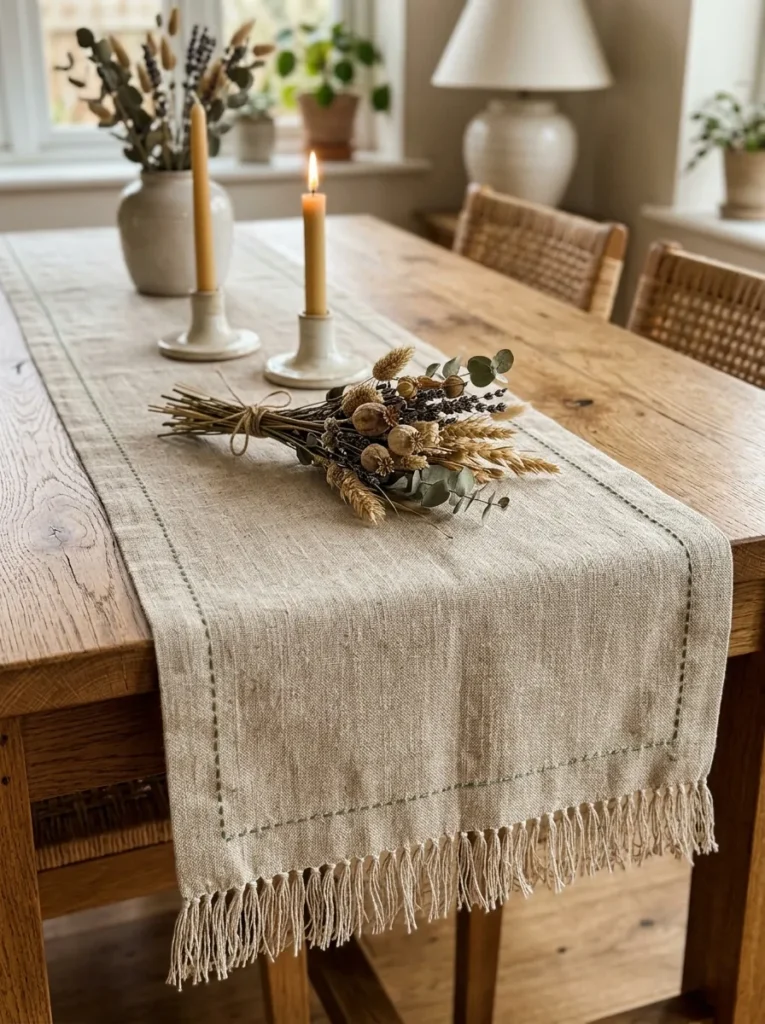
Vibe: The handmade linen table runner feels like a dining table given a piece of genuinely good textile craft to sit on — the warm natural linen, the hand-stitched border, and the hand-pulled fringe creating a table runner of simple beauty that improves with each wash.
Why it works: A linen table runner with a hand-stitched running stitch border and hand-pulled fringe applies the simple craft maximum beauty principle — the table runner is one of the domestic textile objects where the simplest making technique (a running stitch border, a pulled-thread fringe) produces the most beautiful result because the linen fabric’s own qualities (warmth of color, texture of weave, the specific way it drapes over the table edge) do most of the aesthetic work. The hand-stitched border adds the specific quality of hand embroidery — the slight variation in stitch length and spacing that reads as genuinely made rather than manufactured — and the hand-pulled fringe uses the linen’s own woven structure to create the most natural of all fringe types.
Fringe construction: Identify the warp threads (the threads running the runner’s length) and the weft threads (the threads running the runner’s width — these will be pulled out to create the fringe). Using a sharp needle, gently pull out individual weft threads from each short end of the runner, working from the cut edge inward toward the intended fringe depth (3cm). The remaining warp threads create the fringe. Work slowly and consistently — pulling too many threads at once risks pulling threads from the runner’s body rather than the fringe zone.
Budget: Natural linen fabric 0.5m: $8–15. Sage green embroidery thread: $2–4. Total: $10–19 per runner.
Making time: 2–3 hours including fringe pulling and border stitching.
Shop The Look
| Product |
|---|
| Natural linen fabric wide weave |
| Sage green embroidery thread fringe |
| Embroidery needle running stitch |
| Dried botanical table centerpiece |
| Simple ceramic candlestick pair |
8. Patchwork Throw — Fabric Scrap Warmth
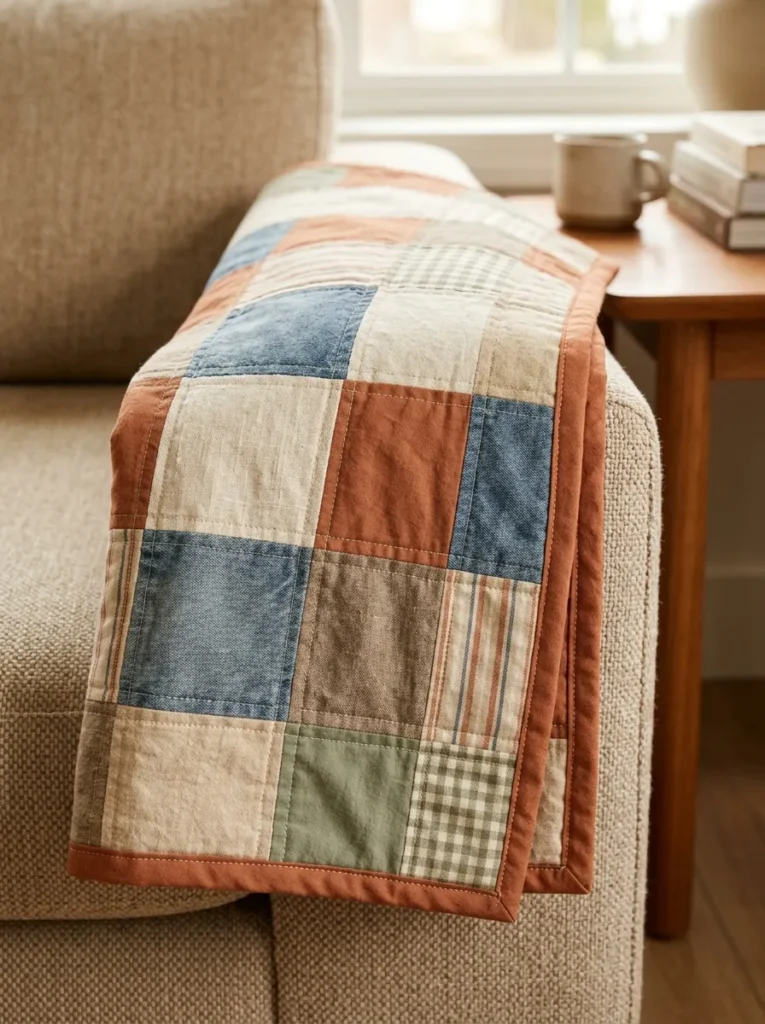
Vibe: The patchwork throw feels like the fabric memories of a household gathered into a single warm object — each square from a different source material creating a throw whose warmth is the accumulated warmth of many textiles made into one.
Why it works: A patchwork throw in a coordinated earth palette from varied fabric sources applies the material collection narrative principle — patchwork is the fabric craft that most directly expresses the collector’s and the preserver’s instinct: taking small pieces of fabric (from old clothing, from fabric remnants, from market finds) and composing them into a single coherent textile object that is more than the sum of its parts. The discipline of the coordinated palette (all fabrics chosen from the same earth-tone family — warm cream, faded denim, terracotta, sage, mushroom) creates the visual coherence that allows the varied fabric sources to read as a composed whole rather than as a random collection.
The simplest construction approach: For a beginner patchwork maker, the most straightforward approach is a simple grid of same-size squares (20×20cm finished, meaning 21×21cm cut size with 0.5cm seam allowance on each edge). Lay all squares out on a flat surface in the desired arrangement before sewing — this pre-arrangement step (spending 15–20 minutes moving squares around until the color distribution reads as balanced) is the most important single step in producing a beautiful patchwork.
Budget: Fabric squares from scraps: zero to $20 depending on source. Muslin backing: $5–10. Binding fabric: $3–8. Total: $8–38 for the complete throw.
Making time: 8–15 hours for a 30-square throw — a multi-session project.
Shop The Look
| Product |
|---|
| Fabric scrap bundle earth tones |
| Cream muslin backing fabric |
| Terracotta cotton binding strip |
| Patchwork ruler square cutter |
| Rotary cutter self-healing mat |
9. Drawstring Bag — The Most Useful Small Project
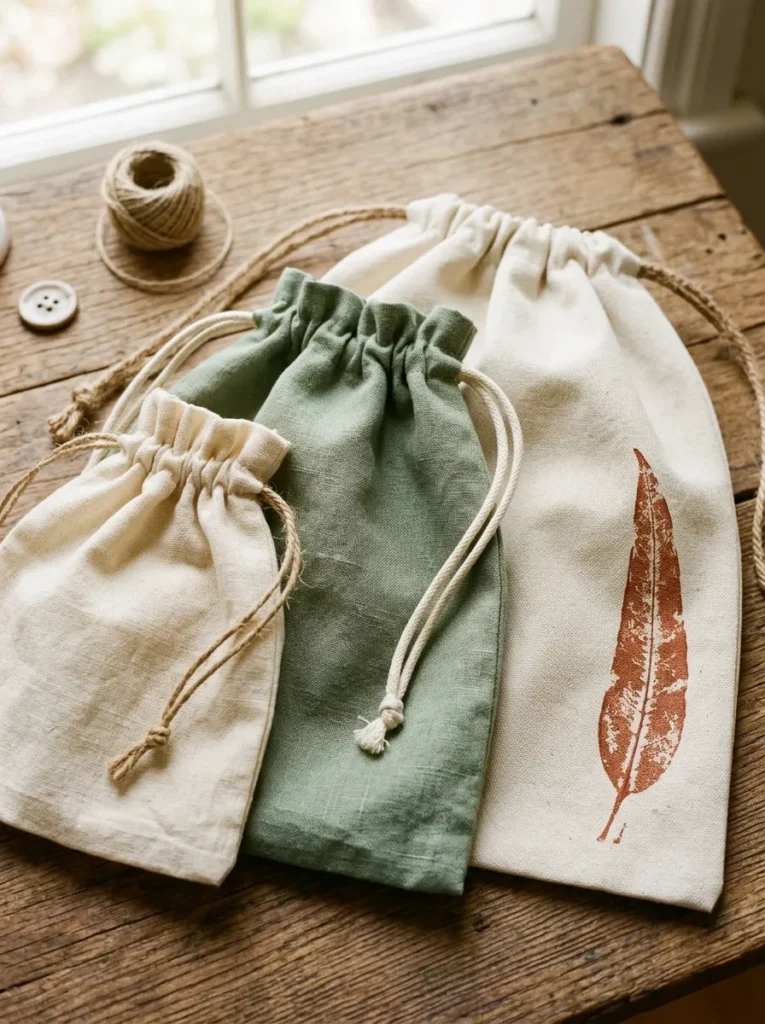
Vibe: The drawstring bag set feels like the most useful household object that takes 30 minutes to make and lasts for years — the three coordinated bags serving every small storage need in the home from dried herbs to bread to laundry to gifts.
Why it works: A set of drawstring bags in graduated sizes applies the graded functional set principle — a single drawstring bag is useful; a set of three graduated sizes (small, medium, large) in coordinating fabrics covers every conceivable drawstring bag function in the domestic space: the small for jewelry storage and travel accessories, the medium for bread keeping and produce storage, the large for laundry sorting and bulk storage. Making a set rather than a single bag in one session is more efficient (the cutting and setup time is amortized across three bags rather than repeated) and more useful (the varied sizes mean the right bag is always available).
The simplest drawstring construction: Cut two rectangles of the same size. Sew together on three sides (two long sides and one short side) with a 1cm seam allowance. Fold the top edge over twice (to create a 2cm channel for the drawstring). Sew along the bottom edge of this folded channel, leaving the two ends of the channel open. Thread the drawstring cord through the channel using a safety pin. Knot both ends of the cord to prevent it pulling through the channel.
Budget: Natural cotton muslin 0.5m: $3–8. Sage linen 0.5m: $5–12. Natural canvas 0.5m: $4–9. Total: $12–29 for the complete set.
Making time: 20–30 minutes per bag; 90 minutes for the complete set.
Shop The Look
| Product |
|---|
| Natural muslin cotton fabric |
| Warm sage linen fabric |
| Natural canvas fabric |
| Jute drawstring cord 3mm |
| Botanical fabric stamp leaf |
10. Fabric Wall Hanging — The Woven or Printed Art Panel
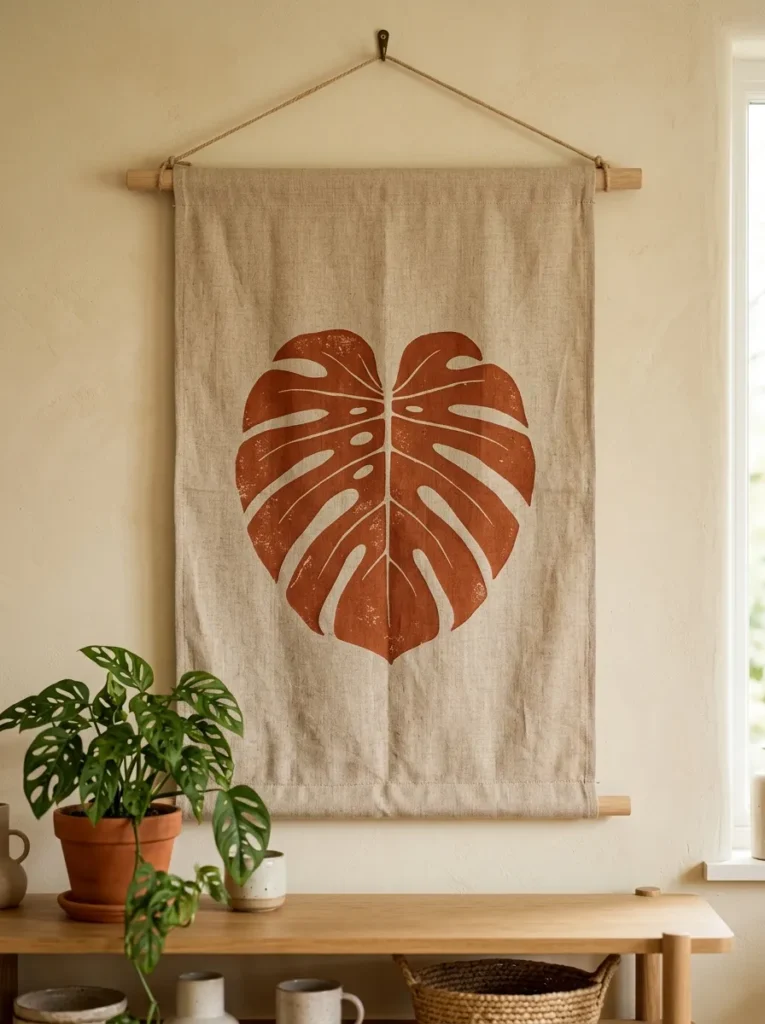
Vibe: The fabric wall hanging feels like an art print that decided to be a textile instead — the large-scale monstera block print on warm linen creating a wall artwork of genuine botanical character from a technique achievable in an afternoon.
Why it works: A large fabric wall hanging with a block-printed botanical motif applies the textural art form principle — a fabric wall hanging’s specific contribution to a room’s art collection is its textural quality: unlike a framed print or a canvas painting (which present a flat surface to the viewer), a fabric hanging presents a surface with genuine material depth (the linen weave, the slightly textured print surface, the way the fabric drapes from the dowel and moves slightly in air currents). This three-dimensional quality and gentle movement creates the specific animate quality of textile art that flat art works cannot provide. The block-printed botanical motif (a monstera leaf cut in relief from a rubber block and stamped in fabric ink) provides the large-scale graphic impact of a statement artwork from a handmade process that any maker can achieve.
Block printing technique: Carve the monstera leaf form in relief on a rubber block (or a high-density foam block) using a lino-cutting tool. Apply textile ink to the raised surface of the block using a foam roller (apply the ink to the roller first, then roll it onto the block). Press the inked block firmly and evenly onto the fabric and lift cleanly to reveal the print. Repeat on a test fabric before printing the final hanging. Heat-set the ink by pressing with an iron (protected by a cloth) for 30 seconds once the ink is completely dry.
Budget: Linen fabric 0.6m: $8–20. Timber dowels: $5–10. Rubber block and lino tools: $10–20. Textile ink: $5–12. Total: $28–62 per hanging.
Making time: 2–4 hours including design, carving, printing, and assembly.
Shop The Look
| Product |
|---|
| Oat linen fabric ground |
| Timber dowel 3cm two lengths |
| Rubber block lino tool carving |
| Terracotta textile ink |
| Natural cord hanging loop |
11. Quilted Placemat Set — The Table-Top Textile
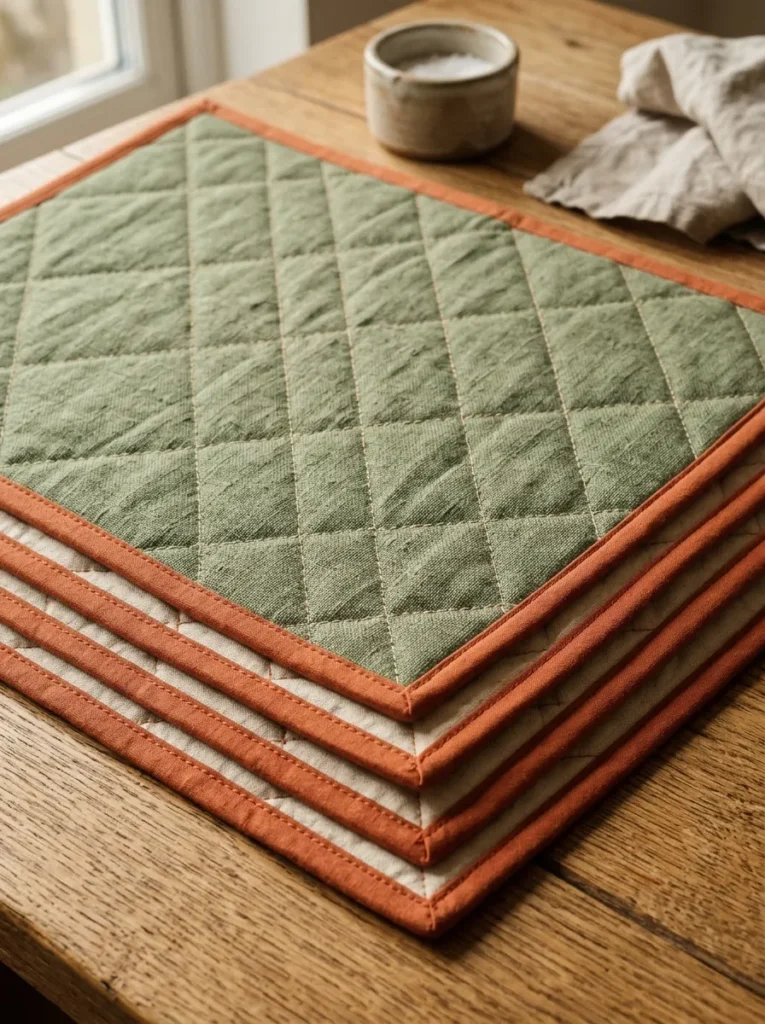
Vibe: The quilted placemat set feels like table textiles made with the genuine intention of lasting for years and improving with each wash — the linen, the wadding, and the quilted structure creating a placemat with real material substance.
Why it works: A set of four quilted placemats with a simple diagonal grid quilting pattern applies the tactile function enhancement principle — a placemat’s primary function is surface protection and placement definition, but a quilted placemat’s secondary functions (the slight cushioning of the wadding, the texture of the quilted surface under the plate, the warmth of the layered textile) create a table experience of genuine sensory quality that a single-layer fabric or commercial plastic placemat cannot provide. The diagonal grid quilting (the simplest quilting pattern — straight lines at 45 degrees, sewn with a walking foot and a quilting guide) provides the structural integrity that prevents the three fabric layers from shifting during use and washing.
The walking foot requirement: Quilting through three layers of fabric (front, wadding, back) requires a walking foot (also called an even-feed foot) rather than a standard presser foot — the walking foot feeds all three layers evenly through the machine simultaneously, preventing the lower layers from bunching or slipping. Walking feet are available for most sewing machine brands at $10–20.
Budget: Sage linen (0.5m): $6–15. Cream cotton (0.5m): $3–8. Thin wadding (0.5m): $4–8. Terracotta binding: $2–4. Total: $15–35 for the complete set.
Making time: 4–6 hours for a set of four.
Shop The Look
| Product |
|---|
| Warm sage linen front fabric |
| Cream cotton backing fabric |
| Thin quilting wadding 100g |
| Terracotta binding cotton strip |
| Walking foot sewing machine |
12. Fabric Gift Wrapping Squares — Furoshiki Inspired
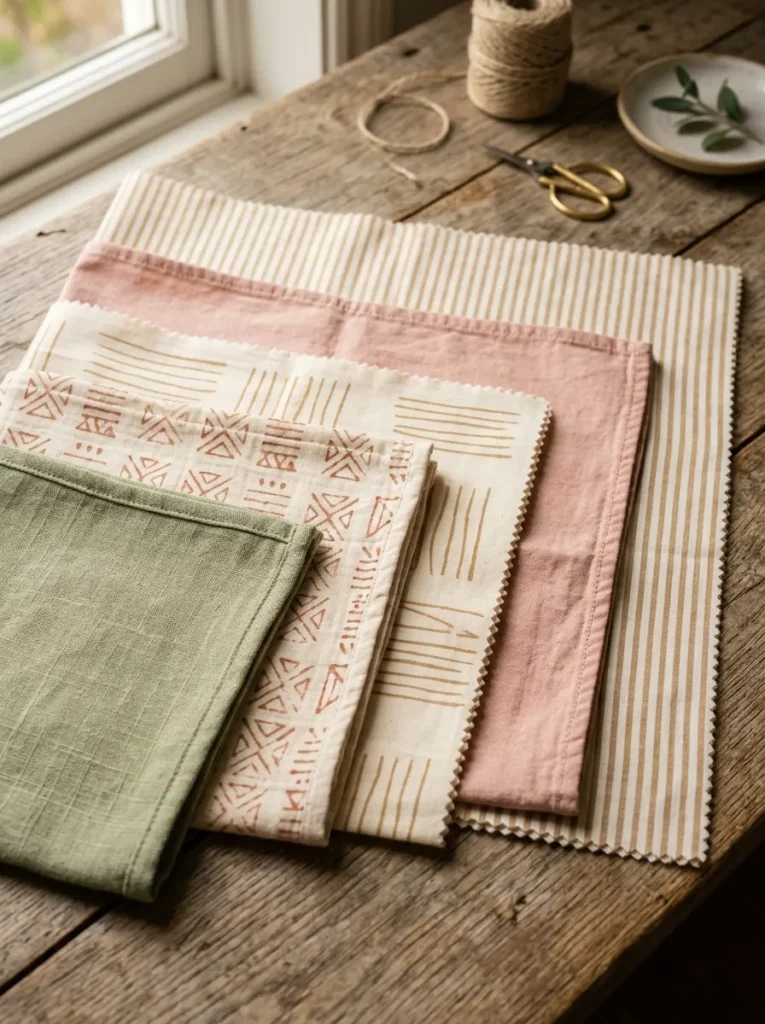
Vibe: The furoshiki fabric wrapping squares feel like a gift that begins before the gift inside it — the beautiful fabric squares creating a wrapping that the recipient keeps and uses, making the wrapping itself a gift of lasting value.
Why it works: A set of fabric gift wrapping squares in varied sizes applies the zero-waste gifting principle — fabric gift wrapping (inspired by the Japanese furoshiki tradition of wrapping objects in cloth using knot techniques) replaces disposable paper wrapping with a reusable fabric square that the recipient retains and uses after the gift is opened. Each fabric square is the simplest possible fabric project — a square of fabric with finished edges — but its impact as a gift wrapping medium extends far beyond its making simplicity: the varied fabric patterns and sizes create a gifting aesthetic of genuine natural beauty, and the fabric wrapping’s reusability means it contributes positively to the recipient’s household rather than to their bin.
Edge finishing options: The simplest edge finish for fabric wrapping squares is pinking shears (scissors with a zigzag blade that prevent fraying on woven fabrics) — no sewing required. A more permanent finish uses a narrow rolled hem (the fabric edge folded twice and sewn close to the fold on all four sides) which prevents any fraying permanently and creates a refined finished edge.
Budget: Five varied fabric squares from fabric remnants: $10–25. Thread: $2–3. Total: $12–28 for the complete set.
Making time: 10–20 minutes per square (rolled hem version).
Shop The Look
| Product |
|---|
| Sage linen fabric wrapping |
| Natural muslin block print |
| Dusty pink cotton square |
| Pinking shears edge finish |
| Warm stripe cotton square |
13. Pet Bed Cushion Cover — Practical and Personal
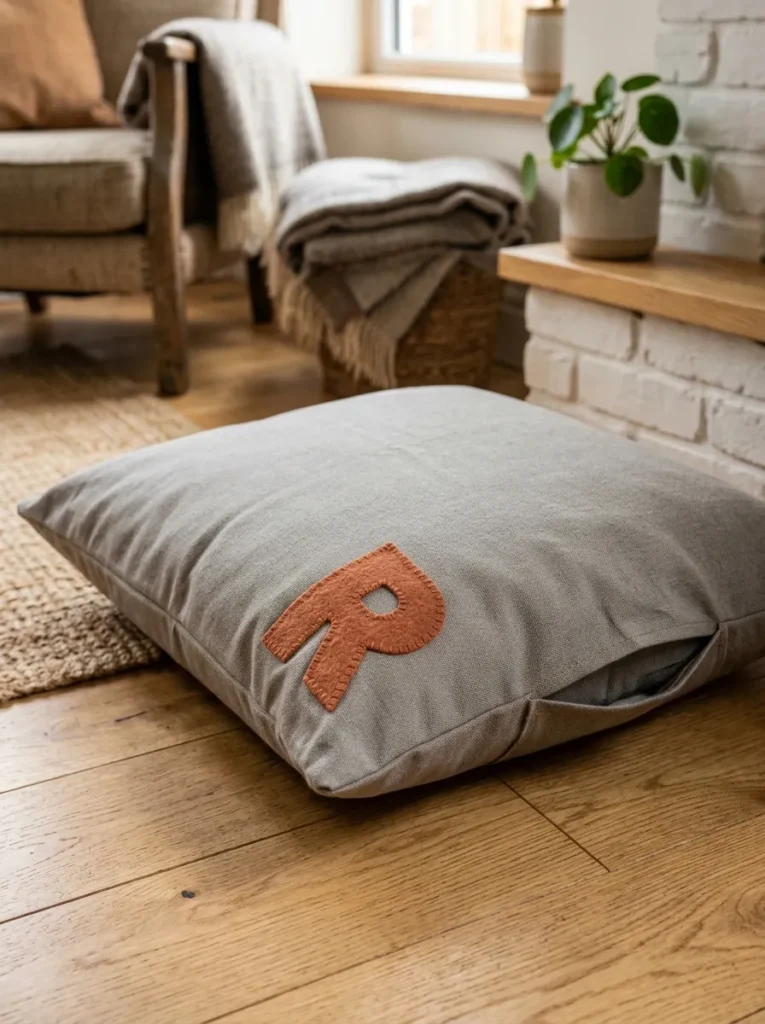
Vibe: The handmade pet bed cover feels like the animal’s specific belonging within the household has been formally acknowledged — the pet’s initial in appliqué on a quality canvas cover creating a pet bed of genuine personal warmth.
Why it works: A hardwearing canvas pet cushion cover with a felt appliqué initial applies the functional personalization principle — a pet bed cover has the most demanding performance requirements of any domestic textile: it must withstand frequent washing (ideally weekly at 60°C for hygiene), the mechanical stress of the animal’s entry and exit movements, and the accumulated wear of constant occupancy. Canvas (the most hardwearing of all plain-woven natural fabrics) meets all three requirements; the envelope back allows complete cushion removal for washing without zips that can catch on pet fur or fail under frequent use. The appliqué initial (felt cut to the letter form and blanket-stitched to the canvas front) personalizes the cover with the minimum additional construction effort.
Budget: Natural canvas 1m: $8–18. Terracotta felt (small piece): $2–4. Cushion insert: $15–25. Total: $25–47 per pet bed.
Making time: 1.5–2.5 hours.
Shop The Look
| Product |
|---|
| Natural canvas fabric hardwearing |
| Terracotta felt appliqué piece |
| Embroidery thread blanket stitch |
| Large rectangular cushion insert |
| Pet initial letter template |
14. Fabric Advent Calendar — The Seasonal Reusable
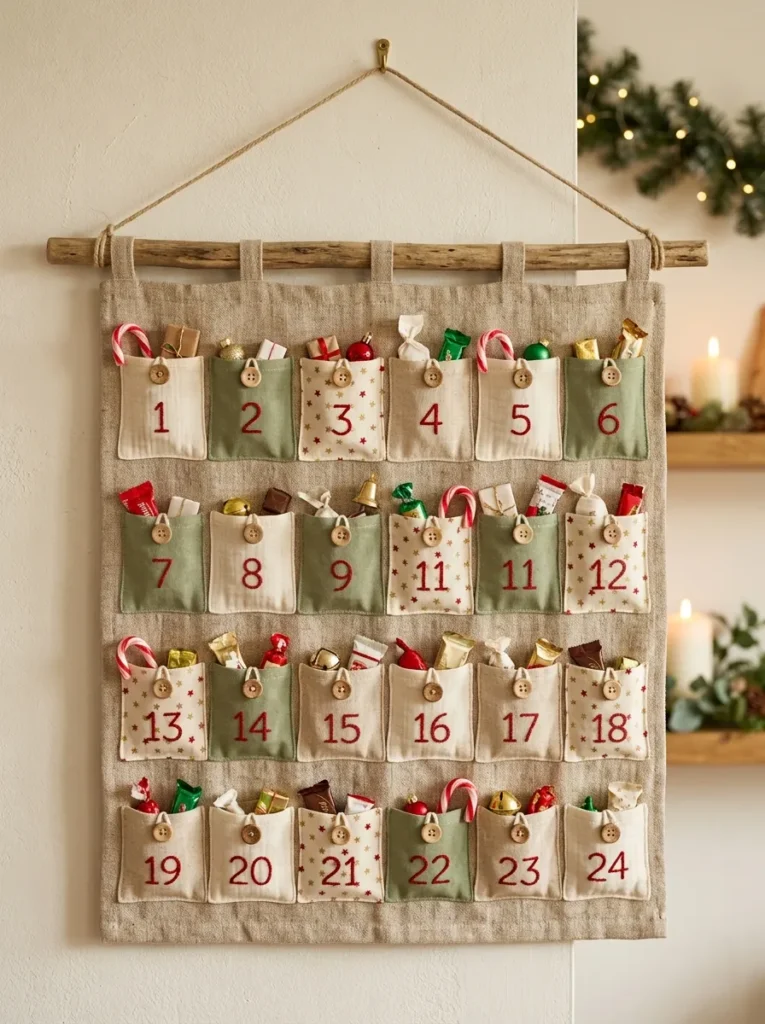
Vibe: The fabric Advent calendar feels like the most heirloom-quality version of a Christmas countdown — the natural linen background and the varied fabric pockets creating a seasonal object that will be used for decades rather than discarded after one December.
Why it works: A fabric Advent calendar with hand-embroidered numerals applies the reusable heirloom seasonal object principle — a commercial paper Advent calendar is a single-use object discarded on Christmas Day; a handmade fabric Advent calendar is refillable every year, improvable (the pockets can be restuffed with different treats each December), and genuinely more beautiful after a decade of use (the linen background developing the warm patina of a frequently handled and laundered textile). The construction is straightforward: the main linen panel with a sewn dowel sleeve at the top, and 24 individual small fabric pockets constructed separately (each pocket a simple three-sided rectangle, the top edge turned and the pocket sewn to the linen background through the pocket’s bottom and side edges).
Budget: Linen background fabric (0.7m): $10–25. Varied pocket fabrics (small remnants): $5–15. Timber dowel: $3–5. Thread: $3–5. Total: $21–50 for the complete calendar.
Making time: 6–10 hours — a committed project best spread over several sessions.
Shop The Look
| Product |
|---|
| Natural linen background fabric |
| Assorted small pocket fabrics |
| Warm red embroidery thread numerals |
| Timber dowel calendar hang |
| Small button set pocket closure |
15. No-Sew Felt Wall Letters — Children’s Room Personalization
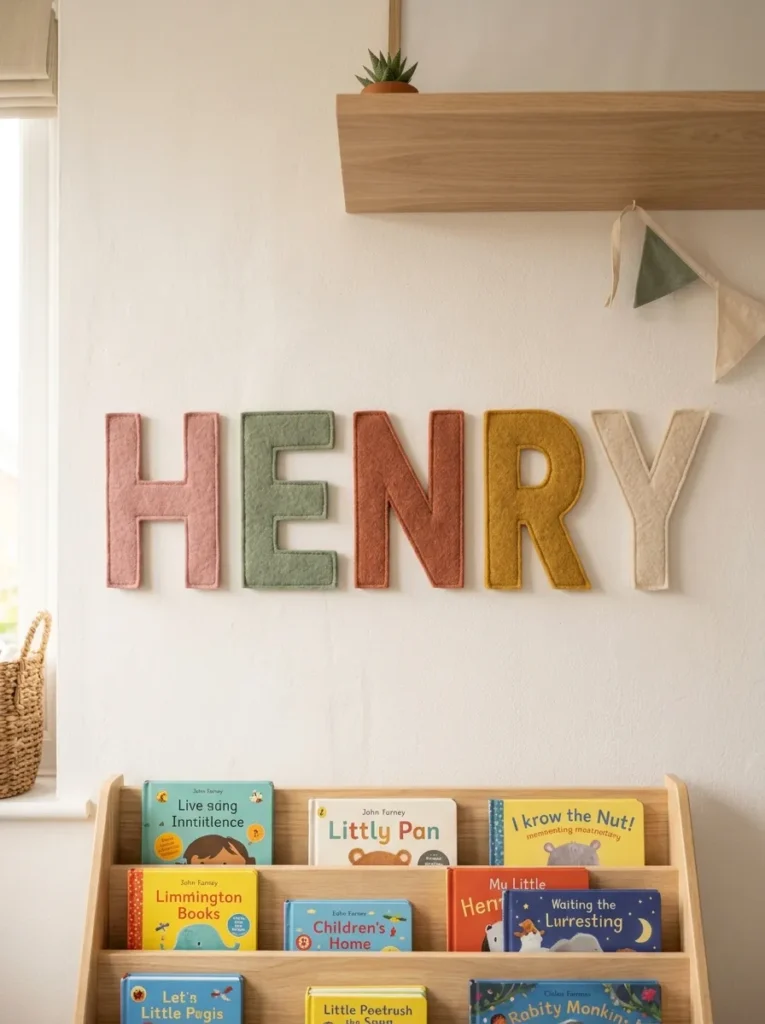
Vibe: The felt wall letters feel like the most personal possible wall decoration in a child’s room — the warm felt colors, the dimensional thickness, and the child’s own name on the wall creating a display of genuine personal warmth.
Why it works: No-sew wool-blend felt wall letters in coordinated earth tones applies the children’s room personalization principle — a child’s name displayed on their bedroom wall is the most personally significant possible room decoration, and felt is the material that most effectively renders letter forms for wall display: it has sufficient thickness (3mm) to read as dimensional from across the room, sufficient weight to lie flat on the wall without curling or sagging, and sufficient surface texture to catch light in a way that printed alternatives do not. The no-sew technique (letters cut from felt sheet with sharp scissors, backed with adhesive mounting squares for wall application) makes this the most accessible personalized room decoration available — no sewing machine, no template cutting machine, and no special tools required beyond good fabric scissors and a printed letter template.
Template approach: Print the chosen letters at 20cm height on standard printer paper, cut out the paper templates, pin to the felt sheet, and cut around the template shape. The self-adhesive mounting squares (removable adhesive appropriate for painted walls) allow the letters to be repositioned if the spacing needs adjustment after initial placement.
Budget: Wool-blend felt sheet set five colors: $10–20. Mounting squares: $4–8. Total: $14–28 for the complete name display.
Making time: 20–40 minutes total including template printing, cutting, and mounting.
Shop The Look
| Product |
|---|
| Wool-blend felt sheet earth tones |
| Letter template 20cm printable |
| Sharp fabric scissors |
| Self-adhesive mounting squares |
| Felt coordinating color set |
How to Start Your DIY Fabric Craft Practice
The single most important first move before beginning any fabric craft project is handling the fabric before committing to a project — visiting a fabric shop (rather than ordering online without samples) and feeling the linen’s texture, the canvas’s weight, the felt’s surface between the fingers, the cotton’s softness against the face. This physical material assessment reveals the quality variables that photography and written descriptions cannot communicate: a linen that reads as warm and natural in a shop photograph may feel scratchy and stiff in the hand; a canvas described as hardwearing may be too stiff for the drape a cushion cover requires; a felt described as wool-blend may be 80% acrylic with only a surface resemblance to genuine wool. The specific sensory qualities of fabric — weight, hand (the feel of the fabric against the skin), drape, surface texture — determine the finished object’s quality more directly than any construction technique, and these qualities cannot be assessed from photographs or descriptions alone.
The most common mistake for new fabric crafters is beginning with too ambitious a project — the full patchwork quilt, the lined Roman blind, the structured bag with interfacing and hardware — before the foundational skills (straight seam sewing, accurate cutting, pressing seams) are developed to the point where they are reliable rather than effortful. Every fabric craft project in this list is achievable at the stated skill level, but the most satisfying learning path runs from the simplest (the drawstring bag, the no-sew curtain, the felt letters) through the foundational (the linen cushion cover, the embroidery hoop, the table runner) to the more technically demanding (the quilted placemat, the patchwork throw, the fabric wall hanging). This progression ensures that each project builds on the skills developed in the previous one rather than requiring skill leaps that produce frustration rather than confidence.
Three specific fabric craft investments under $50 that enable the widest range of projects from this list: a basic sewing kit (sharp fabric scissors, hand sewing needles, a tape measure, seam ripper, and a selection of thread in warm neutrals — $15–25 for a complete beginner kit, enabling all hand-sewn and no-sew projects in this list); a set of five stranded embroidery floss in the warm earth palette (sage green, dusty rose, warm terracotta, warm cream, and warm tan — $5–10 for five skeins, enabling the embroidery hoop, the table runner border, the linen cushion detail, and the Advent calendar numerals); and one metre of washed natural linen in warm oat ($10–20 from a quality fabric retailer — the foundation fabric for the cushion cover, the table runner, the wall hanging, and the wrapping squares, providing material for multiple projects from one fabric purchase). These three investments combined for under $50 provide the core tools and the primary material for eleven of the fifteen projects in this list.
Frequently Asked Questions About DIY Fabric Crafts
What is the best fabric for beginner sewing projects?
The most appropriate fabrics for beginner sewing projects share three properties: they are woven (not knit), they are medium-weight (not very light or very heavy), and they are natural fiber or natural-fiber blends. Woven fabrics (linen, cotton poplin, canvas, denim, chambray) maintain their shape during cutting and sewing, have predictable grain lines that respond to pressing, and produce clean straight seams when sewn on a machine. Knit fabrics (jersey, fleece, stretch velvet) require different seam techniques (zigzag or overlock stitches rather than straight stitch) and different cutting approaches (they stretch during cutting and sewing if not handled carefully) that make them less appropriate for beginners. Within the woven category, medium-weight fabrics (standard cotton poplin, standard linen at 150g/m², light canvas) are most forgiving: light fabrics fray easily and are difficult to keep straight during cutting; heavy fabrics (upholstery canvas, thick denim) require significant sewing machine pressure and can strain beginner machines.
Do you need a sewing machine to make fabric crafts?
No — seven of the fifteen projects in this list require no sewing machine: the no-sew curtain panel (iron-on hem tape and clip rings), the felt wall letters (cut and mount, no stitching), the fabric gift wrapping squares (pinking shears edge finish), the macramé plant hanger (knotting, no sewing), the fabric-covered storage baskets (fabric adhesive), the hand-dyed tea towels (dyeing, no construction required), and the drawstring bag (achievable by hand sewing in 30 minutes rather than 20 minutes at a machine). The projects that most benefit from a sewing machine are those with long straight seams requiring consistent tension (the patchwork throw, the quilted placemat set, the Advent calendar) — for these, a basic entry-level machine ($60–120) provides adequate performance for all beginner and intermediate projects in this list.
How do you choose the right thread color for a fabric project?
Thread color matching for construction seams (seams that join two pieces of fabric) should closely match the darker of the two fabrics being sewn — slightly too dark is less visible than slightly too light in a finished seam. For topstitching (visible stitching on a garment or object’s exterior surface), exact matching or deliberate contrast are both appropriate: exact matching creates a refined, professional appearance; deliberate contrast (a sage green topstitch on natural linen) creates a designed, handmade quality. For embroidery thread, choose colors that harmonize rather than match exactly with the background fabric — the slight tonal variation between an embroidery thread and its background fabric creates the depth of a genuine botanical illustration, while exact matching makes the embroidery disappear. The general rule for embroidery is to select thread colors two to three tones darker than they appear on the skein — embroidery thread worked on fabric appears slightly lighter than the skein because the stitch density dilutes the thread’s color intensity.
How do you care for handmade fabric crafts?
Natural fiber handmade fabric crafts (linen, cotton, canvas, wool) generally improve with washing — linen specifically softens, relaxes, and develops warmth through each wash and dry cycle, meaning that a linen cushion cover, table runner, or curtain panel is more beautiful in its second year of use than in its first. Care recommendations for natural fiber fabric crafts: machine wash at 30–40°C on a gentle cycle (avoid 60°C or above for all natural fibers except cotton, which tolerates higher temperatures), use a mild or natural fiber-appropriate detergent (avoid fabric softener, which coats natural fibers and reduces their natural texture), and press with a hot iron while slightly damp for linen and cotton (pressing linen while damp is specifically the treatment that restores its crispness after washing). Embroidered elements should be pressed from the back with a towel beneath the embroidery (pressing from the front crushes the stitch texture).
What is the most sustainable approach to fabric crafting?
The most sustainable fabric crafting approach prioritizes: using natural fibers over synthetic (natural fibers biodegrade; synthetic microfibers from polyester and acrylic shed into waterways during washing and accumulate in marine ecosystems), using second-hand or remnant fabrics over new yardage (charity shops, fabric remnant sales, old clothing, and bed linen provide high-quality natural fabric at lower cost and zero additional resource use), choosing projects that use the full fabric piece with minimal waste (quilts, patchwork, and drawstring bags are specifically designed to use fabric remnants productively), and making functional objects that replace disposable or single-use equivalents (fabric gift wrapping replacing paper, reusable tea towels replacing paper towels, fabric advent calendars replacing paper ones). The most sustainable fabric crafter makes fewer, better objects from better materials rather than many objects from cheap synthetic materials.
Ready to Make Your First Fabric Craft?
These 15 ideas move through every dimension of what DIY fabric crafting can contribute to a home — from the foundational warmth of a washed linen cushion cover and the natural color of hand-dyed tea towels, through the functional beauty of a drawstring bag set and a quilted placemat set, to the artistic contribution of an embroidery hoop and a fabric wall hanging, to the seasonal joy of a reusable Advent calendar and the personal warmth of a child’s name in felt on a bedroom wall. Starting with the material experience — visiting a fabric shop and handling the linen, feeling the canvas, testing the felt’s surface before committing to any project — is the beginning that ensures every subsequent making decision is grounded in genuine material knowledge rather than in the approximations of online shopping. Handle the materials first. Choose the project that the specific material invites. Make the simplest version first, building the skill that makes the next version more beautiful. And let the specific pleasure of making — the rhythm of the stitch, the warmth of the fabric in the hands, the satisfaction of the finished object in the room — be the reason that the fabric craft practice continues beyond the first project and becomes one of the home’s most genuinely rewarding ongoing pleasures.